
Discover Varaždin County
Accommodation in Varaždin County
Varaždin County brings together historic sites and regional culture with thermal history, cycling opportunities and natural attractions.
Quick facts about a holiday in Varaždin County
Notable cultural themes include Lepoglava lace, the history of the city of Varaždin and the Roman site of Aquae Iasae. For outdoor activities, there are four road cycling routes and one additional cycling route that partly runs off paved roads. In the county, 15 food and drink establishments carry the “Okusi varaždinskog kraja” standard for local dishes, drinks and traditional homemade products. These different highlights can help you plan your trip and look for a hotel or other accommodation.
What culture and history can you discover?
Lepoglava is one of Croatia’s three main lace-making centres and is associated with bobbin lace. International Lace Festivals have been held there continuously since 1997. Another way to explore regional culture is through the mountaineering museum: it was founded to promote mountaineering as a way of life, centred on Mount Ivančica as a link between people and nature.
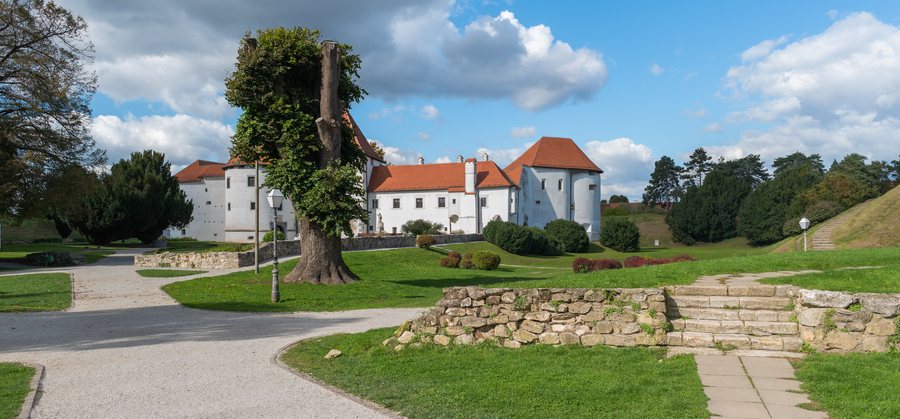
In Ivanec, Stari grad is considered one of the county’s most valuable historical and archaeological sites; it is also significant to Ivanec’s historical development. In the city of Varaždin, Stari grad is the most important historic building. Across around 40 museum rooms, visitors can see collections of guild objects, furniture, historical portraits, weapons, paintings, clocks, porcelain and glass, as well as other everyday items from the lives of Varaždin’s nobility and wealthy citizens.
Dvor Trakošćan offers another historical highlight. The protected complex includes the castle, associated buildings, a landscaped park and woodland with a lake. Its permanent exhibition presents the way of life of the Croatian nobility and the history of the Drašković family through objects dating from the 15th to the 19th century.
Where do thermal history and pilgrimage meet?
From the 1st to the 4th century, Aquae Iasae was an important Roman settlement beside a thermal spring in the area of today’s Varaždinske Toplice. The site is considered one of Croatia’s best-preserved Roman archaeological sites. Its public architecture included bath buildings with pools and a basilica, a forum with colonnades around the main thermal spring, and a Capitolium with temples to Jupiter, Juno and Minerva. The Toplička Route leads to Varaždinske Toplice, Croatia’s oldest thermal spa, and to the archaeological excavations of a Roman bath. Varaždinske Toplice has a thermal spring and is considered a modern thermal spa.
In Ludbreg, the focus is on pilgrimage traditions: the pilgrimage site of the Precious Blood is unique in Croatia and is one of the few in the world to have been recognised by a papal bull. Ludbreška Sveta nedjelja is one of Croatia’s oldest pilgrimage traditions. The pilgrimage complex also includes a permanent outdoor exhibition of Murano glass mosaics along the Stations of the Cross.
Which nature and leisure activities suit your interests?
Trakošćan Park Forest includes the landscaped grounds around the castle and the surrounding woodland by Lake Trakošćan. The artificial lake covers about 23 hectares. Near Lepoglava lies Gaveznica–Kameni vrh, a fossil volcano formed about 22 million years ago; Gaveznica is also known as the first discovered agate deposit in Croatia. Opeka Arboretum is considered a protected natural rarity and a horticultural monument. In Varaždin, the cemetery is also an example of park architecture and a natural monument.
Around Novi Marof, well-maintained walking, hiking and cycling trails lead to viewpoints, healing water springs, striking rocks and excursion destinations. The Topličica excursion area near Novi Marof has two large pools with slides, a children’s amusement park and tennis courts. Aquacity, three kilometres from the centre of Varaždin and also known as “Varaždinsko more”, offers opportunities for walking, swimming and relaxation.
How can you plan for cycling and regional cuisine?
The “Od dvorca do dvorca” route connects Stari grad in Varaždin with Trakošćan Castle. Together with the Toplička Route, it shows that the cycling opportunities cover different themes: castles on one route, thermal history and Roman archaeology on the other. The county has also introduced the “Cyclist Welcome Quality” standard for providers of cycling tourism services. When looking for a hotel, it may therefore help to decide first which of these interests matter to your trip, rather than assuming a particular location for your accommodation.
For regional dishes, drinks and traditional homemade products, you can look to the 15 food and drink establishments that carry the “Okusi varaždinskog kraja” standard. This is a practical starting point for anyone who wants to include local cuisine in their trip alongside cultural or natural attractions.
Which subregions would you like to explore further?
For further orientation, explore the subregions Visoko Municipality, Beretinec Municipality, Varaždinske Toplice Municipality, Ludbreg Municipality, Novi Marof Municipality, Varaždinske Toplice, Petrijanec, Gornji Kneginec, Jalžabet Municipality, Ivanec Municipality, Bednja Municipality, Lepoglava Municipality, Maruševec Municipality, Donja Voća Municipality and Varaždin.
FAQ
What cycling opportunities are there in Varaždin County?
There are four road cycling routes and one cycling route that partly runs off paved roads. “Od dvorca do dvorca” connects Stari grad in Varaždin with Trakošćan Castle.
What makes Aquae Iasae special?
From the 1st to the 4th century, Aquae Iasae was an important Roman settlement beside a thermal spring. The facilities described included bath buildings, a forum and a Capitolium with temples to Jupiter, Juno and Minerva.
What facilities are available at Topličica?
The excursion area near Novi Marof has two large pools with slides, a children’s amusement park and tennis courts.
For the broader travel overview: Croatia.

.jpg)