
Discover Egerág: Stations of the Cross, Church Art and Farmers’ Market
Accommodation in Egerág
Church art, Stations of the Cross and a farmers’ market give Egerág a range of local points of interest. To put your stay in context, it is also worth looking at the broader travel destination of Baranya, which offers everything from early Christian history and exhibitions to nature trails and wine tasting.
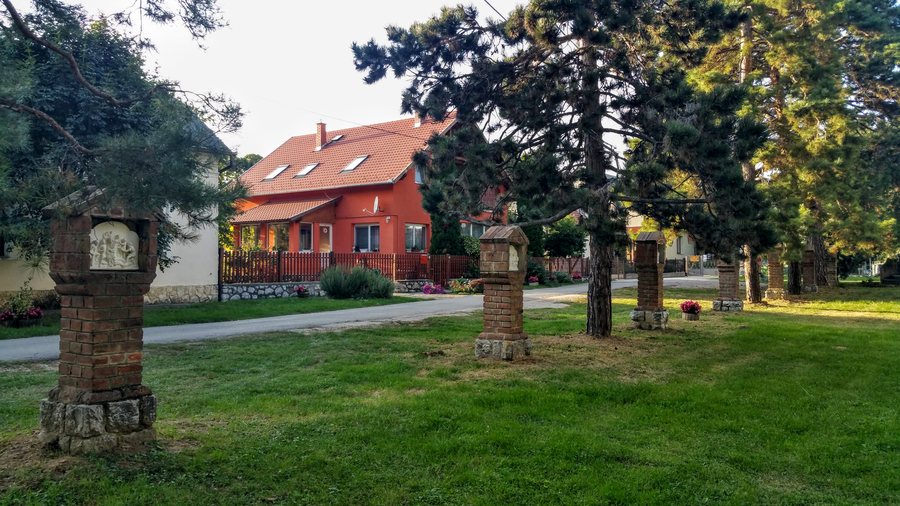
Egerág at a glance
- Fourteen Stations of the Cross stand in front of the Roman Catholic church; they were erected in 1946.
- The complex includes a Calvary cross and a Holy Sepulchre, which also serves as an outdoor altar.
- The paintings on the two altars are by Endre Graits (1854–1909), a painter from Pécs.
- Local producers from the surrounding area sell their goods at the farmers’ market.
What makes the church in Egerág distinctive?
The fourteen Stations of the Cross stand in front of the Roman Catholic church in Egerág and were erected in 1946. A Calvary cross and a Holy Sepulchre complete the complex; the sepulchre also serves as an outdoor altar. The Stations of the Cross and their associated features are thus grouped in one specific location, while the altar paintings offer a separate way to explore the church’s art.
The painting on the late Baroque high altar and the painting on the Neoclassical-style side altar, which depicts the death of Saint Joseph, are by Endre Graits (1854–1909), a painter from Pécs. The different stylistic descriptions of the altars and the religious subject of the side-altarpiece offer several points of interest for visitors interested in art and cultural history. If you would like to see the altar paintings in particular, check in advance whether the church is open to visitors.
What cultural attractions does the broader travel destination of Baranya offer?
Within the broader travel destination of Baranya, the Early Christian Necropolis of Sopianae in Pécs offers a different historical perspective. It comprises decorated tombs dating from the 4th century. The tombs were built as underground burial chambers with above-ground memorial chapels and decorated with richly detailed Christian wall paintings.
The Zsolnay Cultural Quarter is also in Pécs. Its exhibitions include “Golden Age of Zsolnay,” “Pink Exhibition” and an exhibition on the history of the family and factory. For children, there are outdoor playgrounds, an interactive lab, a planetarium, the Bóbita Puppet Theatre, a ceramics painting workshop and classes at the Hercules Workshop. The freely accessible outdoor area is free to enter and use during opening hours; check the current opening hours when planning your visit.
Siklós Castle and the Nagyharsány Sculpture Park are also among the cultural attractions in the broader travel destination of Baranya. The castle is one of Hungary’s best-preserved military complexes and one of its most significant Renaissance buildings. Modernisation of the museum wing made the Gothic area, which had previously been inaccessible to visitors, accessible. At Nagyharsány Sculpture Park, the “Art in Nature” programme includes a guided tour.
What nature and landscape experiences are available in Baranya?
Within the broader travel destination of Baranya, the Ős-Dráva Visitor Centre near Szaporca combines an interactive exhibition with a demonstration farm where practical farming takes place, as well as three themed nature trails. They provide information about traditional agriculture, the Ős-Dráva Programme and the wildlife along the Drava. Native Hungarian domestic animals are displayed in the farming area, including Hungarian Grey cattle, Mangalica pigs, Hucul horses and heritage breeds of sheep and poultry.
The Wilderness Nature Trail along the Old Drava has a birdwatching and bird-ringing station, a lookout point, a photography hide, a covered activity area and several rest areas. Another landscape attraction is the Kikerics Panorama Trail: it allows visitors to walk safely along the cliff edge while protecting the park’s plant life from trampling. Baranya thus brings together nature interpretation, wildlife watching and a trail designed to protect the landscape.
How do the market and food-and-drink options differ?
At Egerág’s farmers’ market, local producers from the surrounding area sell their goods. In the broader travel destination of Baranya, Villány’s row of wine cellars offers a specifically wine- and food-focused option: all year round, you can go from cellar to cellar and sample wines and tasty dishes. The options have different focuses. Before planning a visit to the farmers’ market, check whether it is taking place and when.
What does this selection mean for your hotel search?
FAQ
What is located in front of the church in Egerág?
Fourteen Stations of the Cross stand in front of the Roman Catholic church, along with a Calvary cross and a Holy Sepulchre. The Holy Sepulchre also serves as an outdoor altar.
When were the Stations of the Cross erected, and who created the altar paintings?
The Stations of the Cross were erected in 1946. The paintings on the late Baroque high altar and the Neoclassical-style side altar, which depicts the death of Saint Joseph, are by Endre Graits (1854–1909) from Pécs.
What does the farmers’ market in Egerág offer?
Local producers from the surrounding area sell their goods there. Before making a specific visit, check whether the market is taking place and when.
To the broader travel overview: Pécsi.

