
Discover Mátészalka
Accommodation in Mátészalka
Mátészalka brings together places of remembrance, public art, and a festival programme. Those planning a cultural trip will find a range of topics here: the history of the Jewish community, the story of early electrification, and events for which a specific programme was planned in 2026.
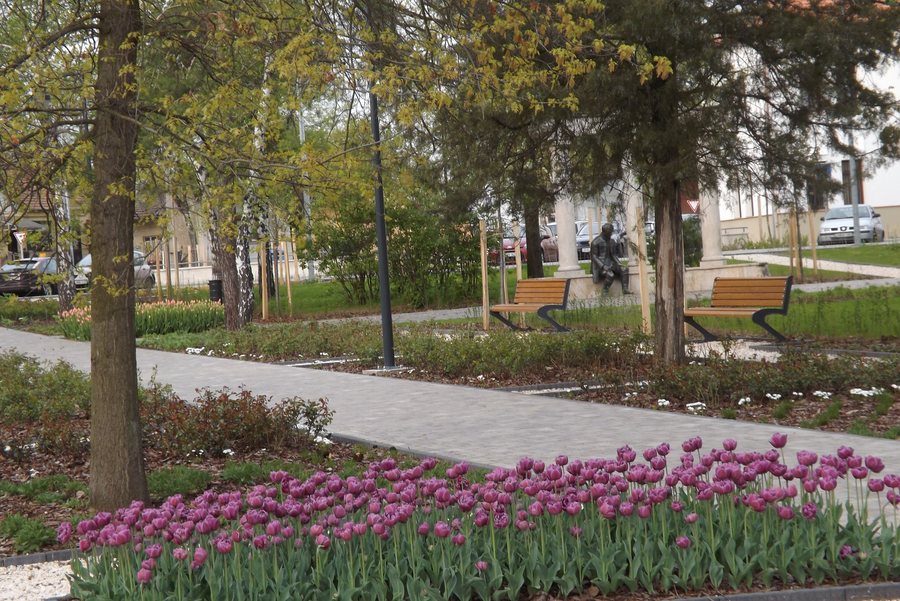 Kölcsey Ferenc monument and park detail, Mátészalka
Photo: Kossuthzsuzsa at Hungarian Wikipedia via Source, CC BY-SA 3.0
Kölcsey Ferenc monument and park detail, Mátészalka
Photo: Kossuthzsuzsa at Hungarian Wikipedia via Source, CC BY-SA 3.0
Mátészalka facts at a glance
The Mátészalka Synagogue was built in 1857 as a symbol of the strengthening of the Jewish community and today serves as a cultural space where the past and contemporary art meet. The renovated house at Kossuth utca 16 contains an exhibition on the history of electrification; the house preserves the memory of Hungary’s first electrified home. The municipality names the Hét Vezér díszkút and the Szent István-Lovasszobor as major tourist attractions. Concerts and other events were planned for Fényes Napok 2026 on 28 and 29 August.
What cultural history can you discover in Mátészalka?
The synagogue brings together two different aspects of the city’s history. Its construction in 1857 represented the strengthening of the Jewish community. Today, it is a cultural space where the past and contemporary art meet. This connects the site both with its historical significance and with its present-day cultural use, without conflating the two.
The exhibition in the renovated house at Kossuth utca 16 explores another topic: the history of electrification. The building also preserves the memory of Hungary’s first electrified home. Here, the broader development of electrification and the house’s particular historical significance stand side by side. Those interested in the history of technology will find a different way to explore the city here than at the synagogue.
Which works of art does the municipality name as attractions?
The Hét Vezér díszkút and the Szent István-Lovasszobor are two major tourist attractions named by the municipality of Mátészalka. Both works are by the sculptor Bíró Lajos, who lives there. The year 2000 is also recorded for the Szent István-Lovasszobor: it was unveiled then. When comparing the two works of art, you can note their different forms—a decorative fountain and an equestrian statue—while also bearing in mind their shared artistic authorship.
What was planned for Fényes Napok 2026?
Concerts, children’s programmes, a market, an amusement park, a festival parade, and food demonstrations were planned for Fényes Napok 2026 in Mátészalka on 28 and 29 August. The programme therefore included stage performances, activities for children, a market, food, and a parade. The dates and events listed refer to the 2026 edition; they do not describe a future event calendar.
These topics have different focal points: the synagogue and the electrification exhibition lead to history and culture, the two works of art to sculpture in the cityscape, and the festival to an event programme scheduled for specific dates. Which aspect of Mátészalka you would like to explore further therefore depends on whether you are more interested in historical sites, art, or events.
If you would like to compare other destinations, you can also find Nyírmeggyes, Papos, Nyírcsaholy and Géberjén.
FAQ
When was the Mátészalka Synagogue built?
It was built in 1857 as a symbol of the strengthening of the Jewish community.
What is the exhibition at Kossuth utca 16 about?
The exhibition covers the history of electrification. The renovated house preserves the memory of Hungary’s first electrified home.
What events were planned for Fényes Napok 2026?
Concerts, children’s programmes, a market, an amusement park, a festival parade, and food demonstrations were planned for 28 and 29 August.
For the main travel overview: Mátészalkai.

,_M%C3%A1t%C3%A9szalka_2014_%C3%A1prilis_159.jpg)