
Hotels in Valkas Municipality – Nature and Cultural Heritage
Accommodation in Valkas Municipality
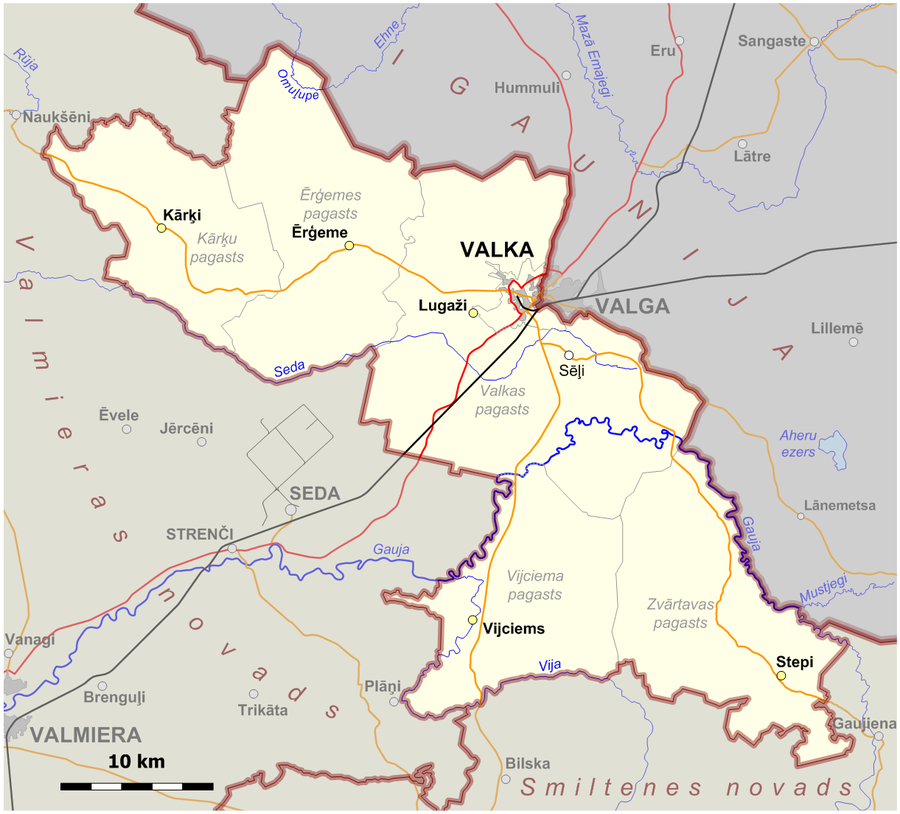
Valkas Municipality combines a distinctive natural environment with well-preserved cultural heritage. Along the Gauja River are floodplains, forests, and protected habitats; museums, castle ruins, historic estates, and industrial monuments likewise bring different eras to life. This range is complemented by a short nature trail and the long-distance Mežtaka hiking route, which can be walked in both directions.
Nature
Ziemeļgauja is a unique area along the natural, unregulated Gauja River, with a system of oxbow lakes, botanically valuable meadows, and old mixed and broadleaf forests. Oak, elm, and ash forests grow in the Zemā sala floodplains; oxbow lakes of the Gauja are also found there. The Taurīšu ezers protected area was established to protect the rare moss species Lapzemes āķīte and spīdīgā āķīte.
Several notable elevations and historic landscape features lie in the vicinity of Valkas Municipality. Celīškalns Hill is located near Valkas Municipality. Cālīši is a ruin in the wider regional vicinity of Valkas Municipality. The hills of Ruķu Kalns, Torņakalns, and Kalnaegļu Pilskalns are also located around Valkas Municipality.
Trails
The Lustiņdruvas Nature Trail is 1.3 km long and features a forest fitness area and an obstacle course. The Mežtaka long-distance hiking route is divided into 102 sections. It can be started at any physically accessible location and walked in both directions; the trail markings also run in both directions.
Culture
The Valkas Local History Museum is located in the building where the Vidzeme Seminary for Parish School Teachers operated from 1853 to 1890. Its permanent exhibitions cover the Vidzeme Seminary for Parish School Teachers and the cultural and educational work of its students from the 19th century to the beginning of the 20th century, as well as Valka as the cradle of Latvian independence. At the museum, visitors can learn about the cultural heritage left by Jānis Cimze and his students and follow historical developments in Valkas Municipality.
In Ērģeme, the ruins of a Livonian Order castle built in the 14th to 16th centuries survive, including a round, four-storey corner tower. The castle ruins are a state monument of historical and archaeological significance. A constructed wooden footbridge leads from the castle ruins to the ruins of Ērģeme Church.
The Vijciema čiekurkalte cone-drying facility is protected as a state industrial monument of national significance. It operated continuously from 1895 until the 1970s, resumed operations in 1992, and continues to use original equipment more than 100 years old to obtain seeds for new forests.
The ethnographic “Ielīcas” farmstead in Vijciema Parish is a state cultural monument dating from the 18th and 19th centuries. It preserves a complete complex of traditional buildings typical of the region, including a dwelling house, bathhouse, three granaries, a stable, a barn, a carriage house, and a cellar.
The Jānis Lūsēns Music House Ozolu skola displays a collection of musical instruments belonging to composer Jānis Lūsēns in a large, acoustically designed hall housed in a historic building.
On 16 August 2026, the ethnographic “Ielīcas” farmstead is scheduled to reopen to everyone as part of the “ĢIMEŅU SPĒKS IELĪCĀS” event, continuing an annual tradition. During the three-day “Satiec savu meistaru” event in Valkas Municipality, those interested were able to meet craftspeople in eight workshops at five venues.
Other parts of Valkas Municipality include Zaķi, Omuļi, and Turna.
To the higher-level travel overview: Latvia.
More destinations
More places within the same destination:

