
Antatilčiai: Memorials and Two Castle Mounds
Accommodation in Antatilčiai
In Antatilčiai, memorials in the village center stand alongside two castle mounds with different names, terrain features, and dates. The information about their access routes also offers practical guidance for planning your visit.
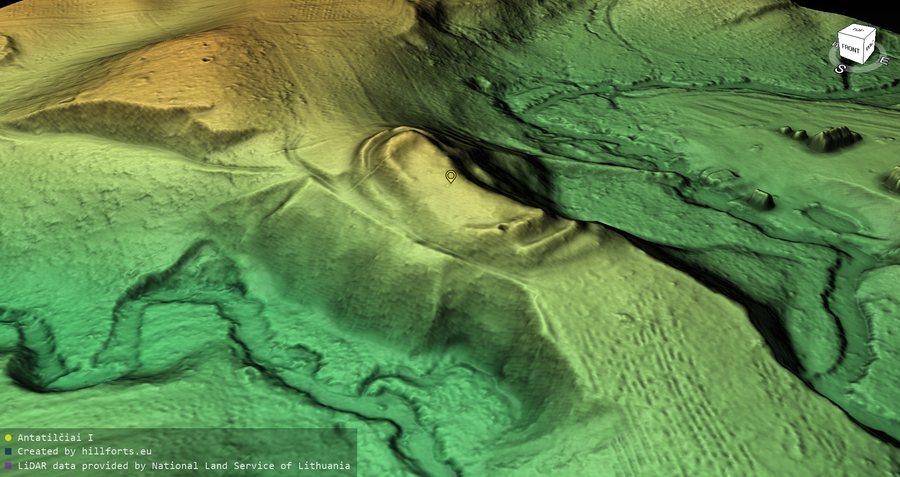
Antatilčiai at a glance
- In the village center, there is a wooden cross and a separate koplytstulpis dedicated to the printer Juozas Kapočius.
- Antatilčių I is also called Pilalė and is dated to the beginning of the second millennium.
- Antatilčių II, also known as Papilėda, lies at the confluence of the Siesartis and Žydaupis rivers.
- Access routes to the two castle mounds are described from different starting points: about 650 m from the center and about 300 m from a homestead.
How do the two castle mounds differ?
Their names help distinguish the two sites: Antatilčių I is also known as Pilalė, and Antatilčių II as Papilėda. Pilalė is dated to the beginning of the second millennium. Papilėda is dated to the period from the end of the first millennium to the beginning of the second. Both dates therefore reach into the beginning of the second millennium; they do not establish a simple chronological ranking.
Papilėda is also distinguished by its terrain. The castle mound lies at the confluence of the Siesartis and Žydaupis rivers. Its slopes are steep and 12 m high; the platform is triangular and elongated in a west-east direction. It measures 30 × 15 m. The height refers to the slopes, while the measurements refer to the platform—two different features that together give a concrete picture of this castle mound.
What memorials are in the village center?
A wooden cross in the center is intended to protect the village and bears a wooden rūpintojėlis figure. Its inscription reads “Čia išėjusiems atminti. 2000 m.”; in English: “In memory of those who have passed away. 2000”. Both its protective purpose and its commemorative dedication are part of the cross’s description.
Nearby stands a separate koplytstulpis dedicated to the printer Juozas Kapočius. It is a distinct memorial, not part of the cross. When viewing the memorials in the village center, this distinction helps you identify each dedication correctly: the cross commemorates the deceased and bears the figure described above; the koplytstulpis is dedicated to Juozas Kapočius.
How do the described access routes differ?
A field track about 650 m long leads to the Antatilčių I (Pilalė) castle mound from the village center. For Antatilčių II (Papilėda), a footpath about 300 m long is described from a homestead. It runs through the forest along the left bank of the Siesartis to the castle mound. The access routes therefore differ in both their starting points and the type of path described.
The two distances cannot therefore be compared as if they were two equivalent routes: one starts in the village center, the other at a homestead. The description of the forest and the left riverbank applies to the route to Papilėda, not to the field track to Pilalė. If you plan to visit both castle mounds, consider their access routes separately. Since current trail conditions are not known, check that each route is passable before setting out.
Discover more destinations: Eišiškės, Švenčionys, Bezdonys, Kaniūkai, Žydkaimis, Trakai, Strėva, Juodšiliai.
FAQ
How do the dates of the castle mounds differ?
Pilalė is dated to the beginning of the second millennium. Papilėda is dated to the period from the end of the first millennium to the beginning of the second.
What route lengths are described?
A field track about 650 m long leads to Castle Mound I from the village center. To Castle Mound II, a footpath about 300 m long runs from a homestead through the forest along the left bank of the Siesartis.
What does the cross in the village center say?
The inscription reads “Čia išėjusiems atminti. 2000 m.” and means “In memory of those who have passed away. 2000”.
For the broader travel overview: Vilnius District.

