
Mrowino: History and Travel Planning
Accommodation in Mrowino
Mrowino reveals itself through its history: its story includes a manor house with a historic estate complex, the school, and two distinct mill histories. The local history stretches from the former noble estate, documented since 1404, to buildings from the 19th and early 20th centuries. For planning your trip, this offers a concrete point of reference if you are interested in local history and historic buildings.
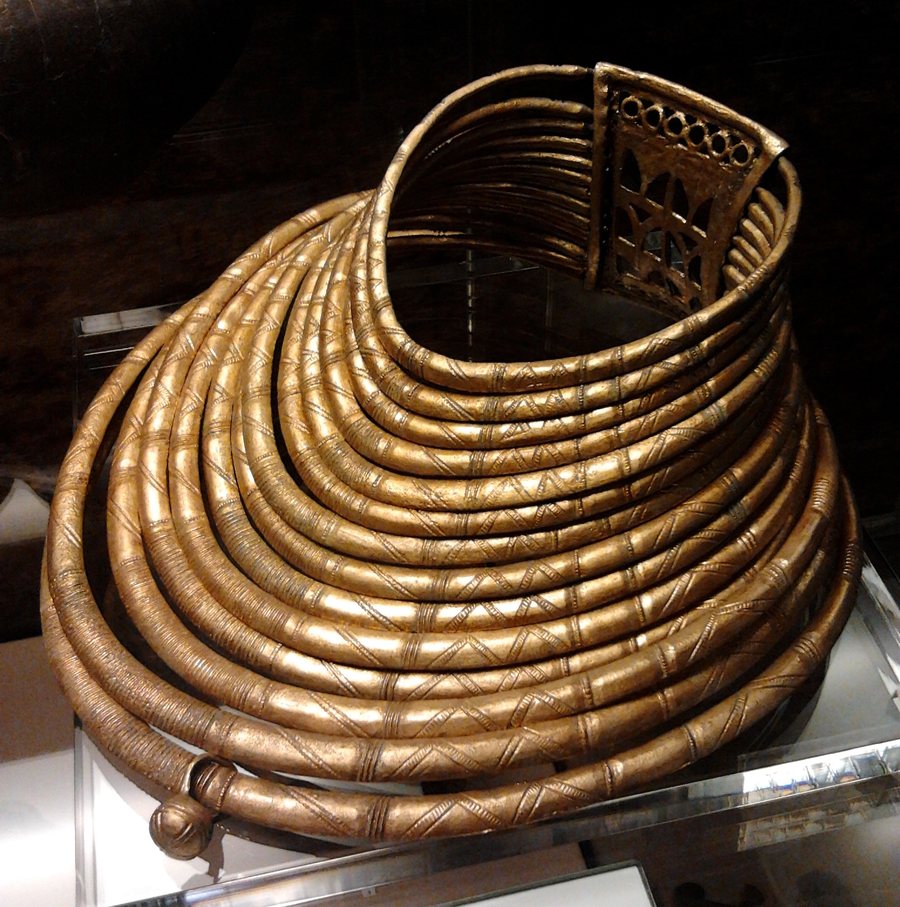 File:Bronze pectoral from Mrowino.jpg
Photo: Anonymous ( Greater Poland ) Unknown author via Wikimedia Commons, CC0
Key facts about Mrowino
- The brick manor house was built at the turn of the 18th and 19th centuries and remodeled in 1905.
- The historic estate complex includes a landscape park dating from the early 20th century.
- The brick school at Szkolna 2 dates from 1905.
- The estates of Zmysłowo, Kokoszczyn, and Przybroda were established within Mrowino’s territory.
- A post mill on Zbożowa Street was built in 1850 and dismantled on February 5, 2021.
What local history lies behind the estate?
Mrowino was a former noble estate belonging to the Mrowiński family, documented since 1404, as well as a royal estate. The estates of Zmysłowo, Kokoszczyn, and Przybroda are also part of the history of its territory. These three names broaden the picture of Mrowino beyond the manor house alone.
The brick manor house was built at the turn of the 18th and 19th centuries. The year 1905 refers to its remodeling, not its original construction. This distinguishes two separate building phases rather than tying the building to just one date.
How do the manor house, park, and school fit together chronologically?
The landscape park is part of the historic estate complex and dates from the early 20th century. The manor house, by contrast, is noted as having been remodeled in 1905. These details refer to different parts of the complex and help place its construction history in context.
The brick school at Szkolna 2 also dates from 1905. The old school in Mrowino bears a commemorative plaque marking its 100th anniversary. The manor house and the school thus share a date, but are different buildings with distinct historical contexts.
Which mill histories can be distinguished?
Two different windmills are documented in Mrowino. The post mill on Zbożowa Street was built in 1850 and dismantled on February 5, 2021. The year it was built therefore refers to a former structure, not one that still exists today.
The Mrowiński windmill has a different history: it was moved from Buk to Mrowino in 1910, with miller Wiktor Nowak involved in the move. A post mill is a type of windmill in which the mill body is mounted on a post so that it can be turned to face the wind. The location on Zbożowa Street and the move from Buk are therefore two different details that should not be confused.
What other cultural landmarks are there?
A statue of the Immaculate Virgin Mary stands on Szkolna Street. A statue of Saint Florian is located at the fire station building. The two religious depictions are thus associated with different locations and figures.
If you are exploring Mrowino’s historical attractions as part of your trip, you can distinguish between the history of the estate, the school building, the mill heritage, and these individual cultural landmarks. Taken together, the facts tell the story of both former property ownership and the buildings and statues in the village.
Discover more destinations: Wojnowko, Komorniki, Zakrzewo, Boduszewo, Szczytniki, Chomęcice, Suchy Las, Kórnik.
FAQ
When was the manor house built?
At the turn of the 18th and 19th centuries; it was remodeled in 1905.
What is the difference between the two mill histories?
The post mill on Zbożowa Street was built in 1850 and dismantled in 2021. The Mrowiński windmill was brought to Mrowino from Buk in 1910.
Where are the statues located?
The statue of the Immaculate Virgin Mary stands on Szkolna Street; the statue of Saint Florian is at the fire station building.
For the main travel overview: Poznań.

