
Sadki: Church, Remembrance and Culture
Accommodation in Sadki
Sadki offers several concrete starting points for planning a cultural history trip: a Baroque parish church with a Renaissance tombstone, and an obelisk commemorating the victims of the Pomeranian Crime. The church’s construction history and the location of the memorial each give these topics their own temporal and local context.
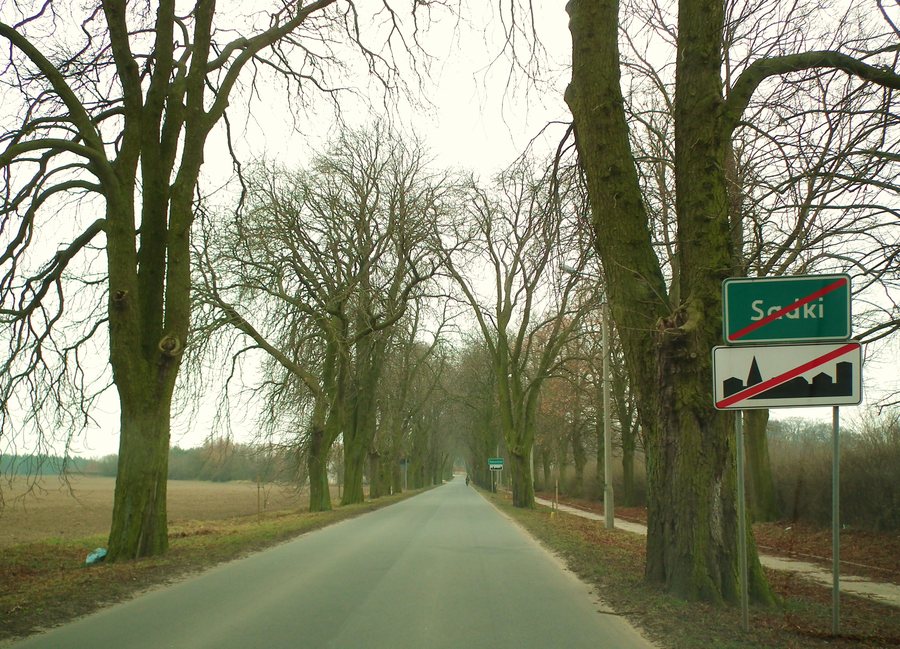 File:MOs810, WG 2015 54 Okonecczyzna (Aleja Sadki Sampstrzel).JPG
Photo: MOs810 via Wikimedia Commons, CC BY-SA 4.0
File:MOs810, WG 2015 54 Okonecczyzna (Aleja Sadki Sampstrzel).JPG
Photo: MOs810 via Wikimedia Commons, CC BY-SA 4.0
Sadki at a glance
The brick parish church of St. Adalbert was built between 1748 and 1767. It is considered an example of Baroque ecclesiastical architecture; its interior is designed in the Rococo-Baroque style. The church contains a Renaissance tombstone for Paweł Samostrzelski from the second half of the 16th century. The obelisk at the entrance to the village from the direction of Nakło nad Notecią commemorates people murdered by the German occupying forces in autumn 1939. A municipal report describes the obelisk’s renovation in 2024.
What does the parish church reveal about Sadki’s cultural history?
The parish church of St. Adalbert brings together different historical periods in its furnishings. The brick church building dates from the second half of the 18th century: its construction period, from 1748 to 1767, helps place it in context. Its Baroque architecture and the Rococo-Baroque style of the interior offer a specific focus for anyone interested in ecclesiastical architecture.
The tombstone for Paweł Samostrzelski adds an earlier historical note. It dates from the second half of the 16th century and is located in the parish church. This means that evidence from different periods can be found side by side in one building: the church itself was built later than the date of the tombstone.
Where is the obelisk, and what does it commemorate?
The obelisk stands on National Road 10 at the entrance to Sadki from the direction of Nakło nad Notecią. It commemorates the victims of the Pomeranian Crime: people murdered by the German occupying forces in autumn 1939. The memorial site anchors this remembrance at a precisely identified point at the village entrance.
Both the reason for the memorial and the date are important to understanding it. The monument does not commemorate historical events in general, but the victims named above and their murder in autumn 1939. A municipal report describes its renovation in 2024; the act of remembrance itself is enduring. Thus, the history being commemorated and the obelisk’s subsequent upkeep are two distinct aspects.
What cultural perspective does the municipality of Sadki offer?
Beyond the individual buildings in the village, the municipality of Sadki also has a strong cultural continuity. This is based on a preserved medieval settlement layout and shaped by historic buildings and ensembles from different periods.
The topics can therefore be considered according to your interests: the church offers information about architecture and construction dates, the tombstone points to an earlier period, and the obelisk commemorates the events of 1939. The wider perspective of the municipality complements these individual points of reference with cultural continuity across different periods.
Discover more destinations: Rajgród, Szubin, Wiele, Minikowo, Ślesin, Nakło Nad Notecią and Kowalewo.
FAQ
When was the parish church of St. Adalbert built?
The present-day brick church was built between 1748 and 1767.
What notable feature is inside the parish church?
It contains a Renaissance tombstone for Paweł Samostrzelski from the second half of the 16th century.
What does the obelisk at the village entrance commemorate?
It commemorates the victims of the Pomeranian Crime, who were murdered by the German occupying forces in autumn 1939.
To the wider travel overview: Nakielski.

.JPG)