
Korzkiew
Accommodation in Korzkiew
Korzkiew brings together a historic castle complex and a fortified church, along with a landscape park and a trail towards Ojców. This gives you several concrete points of interest to consider when choosing a destination for culture and scenery.
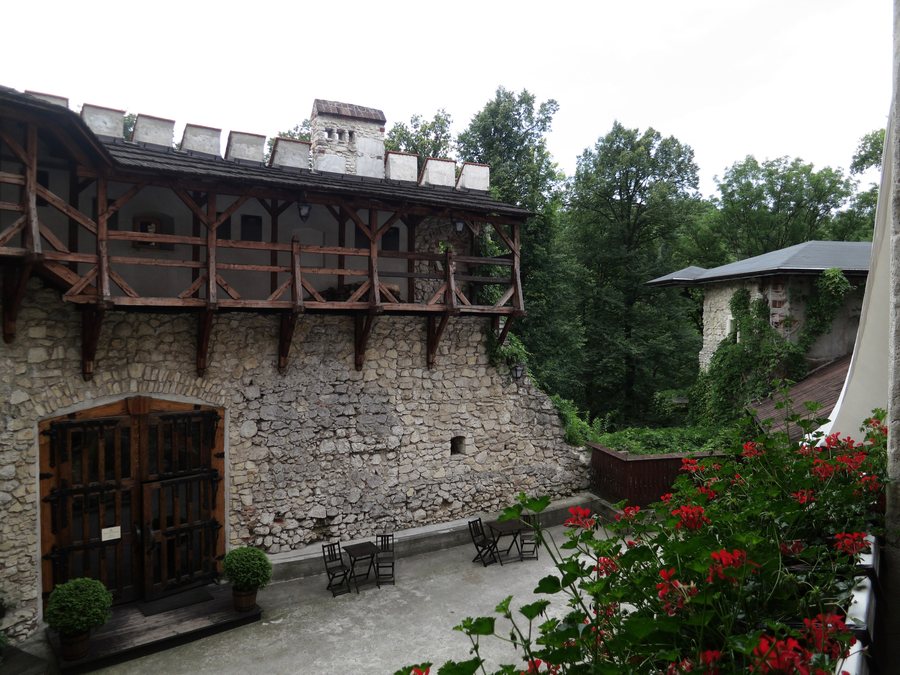
Korzkiew at a glance
Korzkiew lies in the valley of the Korzkiewka, a left-bank tributary of the Prądnik. The restored castle ruins stand on a prominent rocky spur, encircled by a bend in the Korzkiewka. At the foot of the castle hill is a landscape park covering about 6 ha, established in 1820. A blue trail leads from Korzkiew into the Prądnik Valley at Prądnik Korzkiewski and onward to Ojców (6 km).
Which historic sites define Korzkiew?
The Church of the Nativity of St John the Baptist was completed in 1630. Its character is shaped by its hilltop location, compact form and massive reinforced walls. Many of its loopholes are now bricked up. The church’s fortified character is evident in specific features of its design, not merely in its name.
The objects kept in the church also point to different periods. It houses a Gothic reliquary from the 14th century. The high altar also holds two reliquaries from the 17th century: made of wood, polychrome-painted and gilded, they take the form of a female and a male head. Those interested in sacred art and historic furnishings will therefore find two clearly distinct examples here. The church’s completion in 1630 should not be confused with the age of the individual works of art.
The castle adds its own history to this cultural focus. Its oldest structure dates from the second half of the 14th century. In the time of Casimir the Great, the castle formed part of a border defence system. Today, the restored ruins crown the rocky spur above the Korzkiewka. The church and castle thus represent different aspects of the area’s history: the church through its surviving features and furnishings, and the castle through its historic role in the defence system.
What characterises the landscape around Korzkiew?
Korzkiew’s varied terrain was shaped by erosion and karst processes. The castle hill, the rocky spur encircled by the Korzkiewka and the stream valley are specific features of this landscape. At the foot of the hill, the landscape park of about 6 ha complements the historic complex with a designed green space. It was established in 1820. Its location by the castle hill sets it apart from the wider landscape, whose relief was shaped by natural processes.
For planning your trip, this provides a straightforward guide: you can explore Korzkiew based on your interest in architectural history, sacred furnishings or the landscape. The blue trail also offers a route towards the Prądnik Valley and Ojców.
Where does the blue trail lead?
The blue trail leads from Korzkiew into the Prądnik Valley at Prądnik Korzkiewski and continues to Ojców; the stated distance to Ojców is 6 km. The route offers a specific point of reference for travellers who want to look beyond Korzkiew’s castle, church and park. The information given does not specify walking time or trail conditions, so you should not assume a particular duration when planning your route.
FAQ
When was the church in Korzkiew completed?
The Church of the Nativity of St John the Baptist was completed in 1630.
Which historic objects are kept in the church?
It houses a Gothic reliquary from the 14th century. The high altar holds two wooden, polychrome-painted and gilded reliquaries from the 17th century, shaped as a female and a male head.
How large is the landscape park?
The landscape park at the foot of the castle hill, established in 1820, covers about 6 ha.
Where does the blue trail lead?
It leads from Korzkiew into the Prądnik Valley at Prądnik Korzkiewski and continues to Ojców (6 km).
Back to the main travel overview: Dziekanowice.

