
Paszkówka: Palace, Palace Park and Church Art
Accommodation in Paszkówka
Paszkówka brings together historic architecture, a geometrically designed palace park and religious art. The main question is whether you are more interested in the history of the park, a church’s interior furnishings, or a route on foot or by bike.
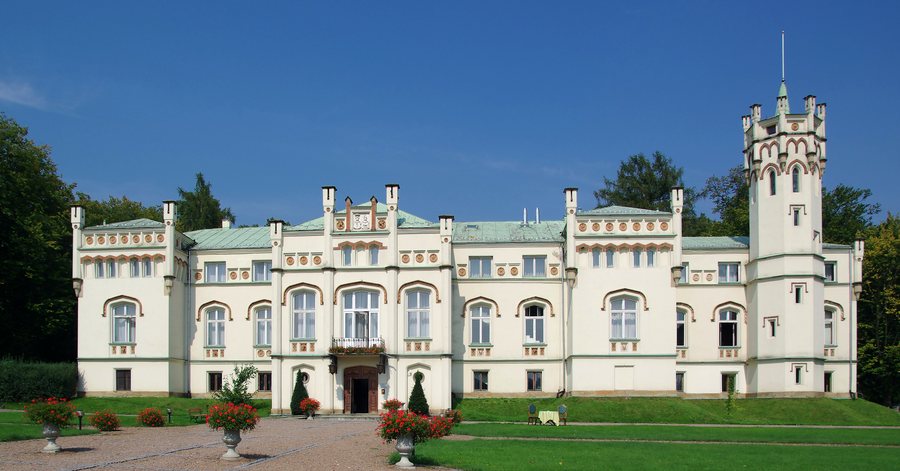
Paszkówka at a glance
- The neo-Gothic palace was built by Leonard and Ludwika Wężyk between 1865 and 1870.
- The palace park dates from the second half of the 18th century and has a Baroque geometric design.
- The Church of the Transfiguration of the Lord contains artworks and furnishings from several centuries.
- A cycling loop of around 7 km starts at the Pod Dębem fishing pond and leads to the wooden church in Sosnowice.
What do the palace and palace park tell us about the area?
The palace and park represent different periods of design in Paszkówka. The palace was built between 1865 and 1870 by Leonard and Ludwika Wężyk, and is neo-Gothic in style. The palace park dates back to the second half of the 18th century and follows a Baroque geometric layout. The palace’s architecture and the formal garden design can therefore be understood as two distinct aspects of the area’s historic character.
The trees also shape the park. It is home to monumental trees estimated to be 200 to 300 years old, including lime trees, oaks, maples and ash trees. A surviving hornbeam avenue adds to the collection. The park can thus be viewed from two perspectives: its geometric design and its old trees and avenue.
What art defines the Church of the Transfiguration of the Lord?
The church brings together furnishings from different centuries. These include a 14th-century figure of an apostle and a 16th-century image of Mary with the infant Jesus. Baroque sculptures depict Saint Anne and Saint Joachim. The stone baptismal font dates from the second half of the 17th century. The artworks and baptismal font therefore point to different periods.
Another feature is the Secessionist polychrome decoration on the interior walls and vaults. Polychromy refers to a multicoloured decorative scheme. In the church in Paszkówka, the design is based on Jan Matejko’s work; it was executed by his student Antoni Gramatyka. Alongside individual historic objects, the walls and vaults form a unified decorative scheme. Visitors interested in church art can distinguish between these two aspects: the individual furnishings and the room’s colour scheme.
How do the routes differ?
The cycling loop, around 7 km long, starts at the Pod Dębem fishing pond in Paszkówka and leads to the historic wooden church in Sosnowice. If you are planning the ride, check the route and local conditions in advance.
A Stations of the Cross route leads from the church in Sosnowice to the parish church in Paszkówka; its individual stations are marked with birch crosses. The two descriptions focus on different things: for the cycling loop, the length, starting point and destination are given; for the Stations of the Cross route, the connection between the churches and the way the stations are marked. This lets you understand the routes according to their described itineraries without treating their characteristics as interchangeable.
FAQ
When do the palace and palace park date from?
The palace park dates from the second half of the 18th century. The neo-Gothic palace was built between 1865 and 1870.
Who designed the church’s polychrome decoration?
The design for the Secessionist polychrome decoration is by Jan Matejko. It was executed by his student Antoni Gramatyka.
Where does the cycling loop start?
The cycling loop, around 7 km long, starts at the Pod Dębem fishing pond in Paszkówka and leads to the historic wooden church in Sosnowice.
For the broader travel overview: Bęczyn.

