
Discover Kłopotnica
Accommodation in Kłopotnica
Kłopotnica offers a clear focus for planning your trip: historic architecture. Around 20 historic houses, several distinctive portals, a brick-built chapel, and a stone outbuilding invite you to compare architectural styles and dates.
Kłopotnica at a glance
- Kłopotnica was established in the 17th century as a colony of Grudza.
- The village has around 20 historic houses, mostly made of masonry or combining masonry and half-timbering.
- Several houses date to the early 19th century; house no. 3a dates from 1841.
- House no. 18 has three stone portals from the early 19th century.
- Other buildings include a brick-built chapel and a stone outbuilding listed in the heritage register.
What does Kłopotnica’s architectural history tell us?
Its establishment as a colony of Grudza in the 17th century provides an early reference point in Kłopotnica’s history. This should be distinguished from the dates of individual houses, which mainly date to the 19th century. The village’s history therefore cannot be reduced to a single building period: its founding and the buildings described later represent distinct points in time.
The materials used also offer a helpful way to compare the architecture. The roughly 20 historic houses are mostly made of masonry or combine masonry with half-timbering. House no. 3 is described as a half-timbered building from the early 19th century. It provides a specific example alongside the many houses described as masonry or as combining the two building methods. The approximate total number and predominant materials give a sense of the building stock without suggesting that every house is the same.
What details set the houses apart?
For several houses, the portals provide a particularly specific point of reference. House no. 3, from the early 19th century, has a portal with a keystone. A portal with a keystone is also noted for house no. 9, which dates from the second quarter of the 19th century. Both houses have a portal with a keystone; no. 3 dates from the early 19th century, while no. 9 dates from the second quarter of that century.
For house no. 18, the number and material stand out: it has three stone portals from the early 19th century. House no. 3a adds a more precise date for comparison. It dates from 1841 and has one portal. The portals of nos. 3 and 9 each have a keystone; no. 3a has a portal.
How can you put the buildings into context?
If you are interested in architecture, three points of comparison stand out: building method, portal design, and date. In terms of construction, the focus is on half-timbering and masonry, or a combination of the two. The portals range from a single portal to the three stone portals of house no. 18; a keystone is also mentioned for two houses. The dates let you distinguish between a broad designation such as “early 19th century,” the second quarter of the century, and the specific year 1841.
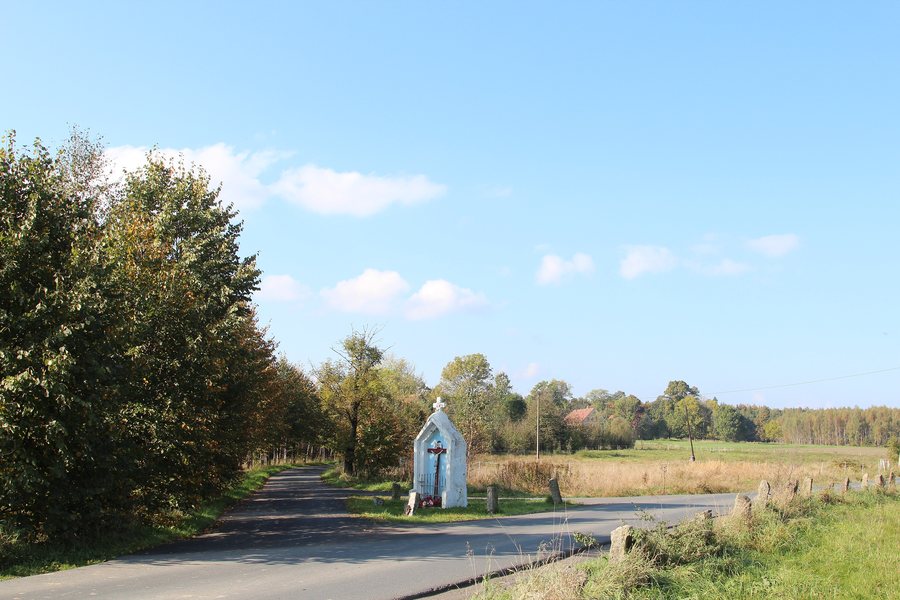
The brick-built chapel is also part of Kłopotnica’s architectural landscape. Its date is given broadly: it is from the 19th or 20th century. The stone outbuilding complements the houses mentioned above and is listed in the heritage register. Architectural interest thus extends beyond the numbered houses to include two other distinct buildings.
Discover more destinations: Pławna Górna, Chmieleń, Tarczyn, Wleń, Gajówka, Pokrzywnik, Pasiecznik and Golejów.
FAQ
When was Kłopotnica established?
Kłopotnica was established in the 17th century as a colony of Grudza.
How many historic houses are there in Kłopotnica?
There are around 20 historic houses. Most are made of masonry or combine masonry and half-timbering.
What portals are described for individual houses?
Houses nos. 3 and 9 each have a portal with a keystone. House no. 18 has three stone portals; house no. 3a has one portal.
For the main travel overview: Löwenberg In Schlesien.

