
Dobrzeń: Palace, Park and Route to Dobra
Accommodation in Dobrzeń
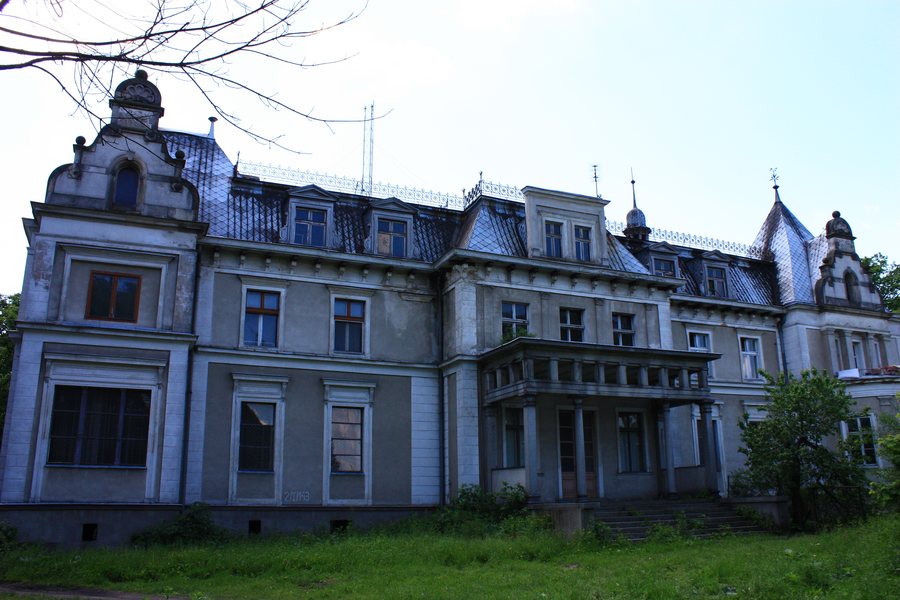
Dobrzeń combines a palace and park ensemble in the central part of the village with distinctive details from its architectural history. This gives you a clear choice when planning your trip: would you like to focus mainly on architecture, or also explore the start of the route to Dobra?
Dobrzeń at a glance
The palace was created in 1891 as a Neo-Renaissance adaptation of an earlier building for Rudolf von Kulmitz. Its features include a mansard roof, a tower, polygonal projections and terraces. Neo-Renaissance and Neo-Baroque stucco decorations have been preserved inside. An orangery is attached at the northern corner; a formal park extends to the northeast. North of the palace stands a brick pavilion from the 19th century. The Dobrzeń–Dobra route begins behind the primary school.
What makes the palace ensemble architecturally interesting?
The year 1891 refers to the adaptation of an earlier building, not its original construction. The palace’s Neo-Renaissance character is evident in its design; at the same time, its interiors retain stucco decorations from the Neo-Renaissance and Neo-Baroque periods. This brings different historical styles together in one place. The mansard roof and tower define the exterior, while the polygonal projections and terraces provide further clearly identifiable architectural features.
The locations of the individual buildings are also described separately: the orangery is attached at the palace’s northern corner. A brick pavilion stands to the north; it dates from the 19th century and has a pseudo-basilical form. Its façades feature clock faces. These details offer different points of interest if you are especially interested in architecture, façade design or historic interiors during your trip.
What traces and park details are part of the local landscape?
The formal park extends northeast of the palace. Remains of a greenhouse pavilion have been preserved in the immediate vicinity. Traces of a former swimming pool and fountain, as well as an aviary, are also visible in the former manor complex. The traces of the pool and fountain recall former features of the ensemble and should be distinguished from the aviary, which is also visible.
Farther away, within the palace ensemble, there is a granary and a stable. Together with the palace, orangery, pavilion and park, they form a varied local landscape that extends beyond a single building. If you are considering Dobrzeń as a destination, you can decide whether to focus mainly on the palace architecture, the surviving details of the former manor or the park.
How can the route to Dobra be understood in context?
The Dobrzeń–Dobra route begins behind the primary school in Dobrzeń. This specific starting point is a useful landmark when exploring the route. The route and the palace ensemble offer different themes for a stay: historic architecture and a park on the one hand, and a named connection to Dobra on the other. Information about the route’s length or duration is not part of this overview.
To compare other destinations in the area, you can also visit the pages for Oleśnica, Międzybórz, Jenkowice, Twardogóra, Domasławice, Olszówka, Sosnowka and Zawidowice.
FAQ
When was the palace in Dobrzeń built?
In 1891, it was created as a Neo-Renaissance adaptation of an earlier building for Rudolf von Kulmitz.
Which architectural features of the palace are mentioned?
Its features include a mansard roof, a tower, polygonal projections and terraces. Neo-Renaissance and Neo-Baroque stucco decorations have been preserved inside.
Where does the Dobrzeń–Dobra route begin?
It begins behind the primary school in Dobrzeń.
For the broader travel overview: Oleśnicki.

