
Składowice
Accommodation in Składowice
Składowice combines a small church with a history centred on its castle and rural settlement layout. Several trails pass through the village or connect it with other places; their different focuses can help you decide which ones suit your interests.
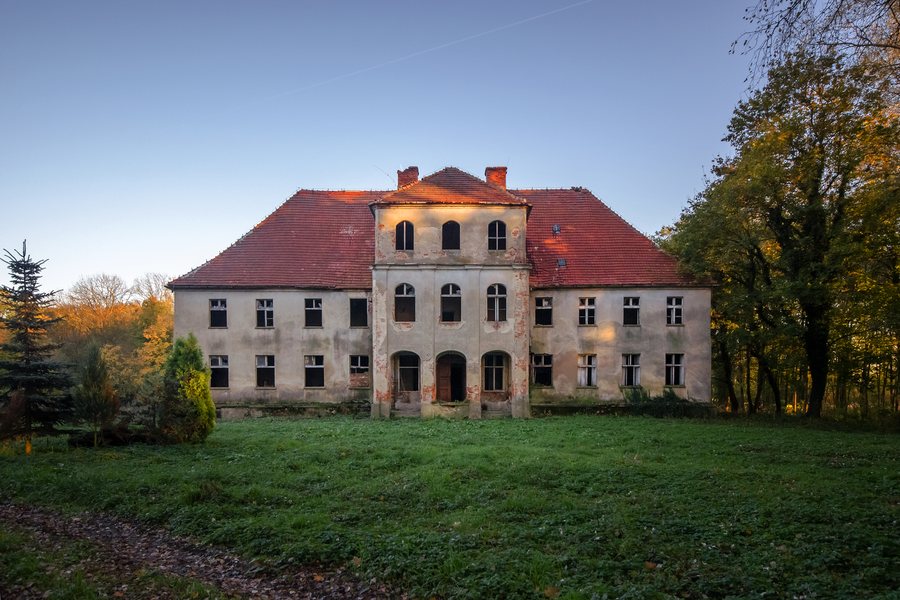 File:SM Składowice pałac (0) ID 595682.jpg
Photo: Sławomir Milejski via Wikimedia Commons, CC BY-SA 3.0 pl
File:SM Składowice pałac (0) ID 595682.jpg
Photo: Sławomir Milejski via Wikimedia Commons, CC BY-SA 3.0 pl
Składowice at a glance
- The Church of the Nativity of the Blessed Virgin Mary is a small, single-nave church without a tower.
- Johann Jonston, a physician, naturalist and historian, lived in Składowice Castle.
- A forest trail, a nature trail and a cycle route offer different ways to explore the area.
- The historic rural settlement layout contains archaeological layers.
What makes the church in Składowice distinctive?
The Church of the Nativity of the Blessed Virgin Mary is a filial church of the Parish of Our Lady of Perpetual Help in Mleczno. It is a small, contemporary building. Its rectangular ground plan, single-nave interior and lack of a tower shape its exterior and spatial form. There is no separately demarcated presbytery: this area is not set apart as a distinct section of the ground plan.
Inside, the church is surrounded by sculptural Stations of the Cross. Those interested in sacred art and the design of church interiors will find a specific reason to consider the architecture and the Stations as distinct features. The church’s affiliation also points to the parish in Mleczno; at the same time, the church in Składowice remains a distinct place in its own right as a filial church.
What history and local features define Składowice?
Johann Jonston, known as a physician, naturalist and historian, lived in Składowice Castle. These fields of work shape the castle’s historical significance. For a culturally focused trip, the castle offers a different point of interest from the church.
The historic rural settlement layout is also part of what makes the village distinctive. Archaeological layers add to its character, marking Składowice not merely as a collection of individual buildings, but also as a settlement that developed over time. Those interested in local history can therefore explore the castle’s history, the church and the character of the settlement as separate themes.
Which trails suit nature lovers, walkers or cyclists?
The green forest trail passes through Bolesławiec, Chocianów, Lisiec, Krzeczyn Wielki, Lubin, Składowice, Toszowice, Stara Rudna, Rozłogi, Miłogoszcz, Górki and Chobienia. Its sequence of places provides a point of reference for anyone interested in a trail that includes several named locations. A nature trail focusing on interesting natural sites, by contrast, connects Siedlce, Księginice and Składowice.
Cyclists have another option in the blue cycle route around Lubin, which passes through Składowice and Zalesie. The routes therefore include a green forest trail, a nature trail highlighting natural sites, and a route designated as a cycle path. If you would like to plan your trip around nature, a longer sequence of places or cycling, you can take these different types of trails into account when choosing. Find more local pages for Lubin and Karczowiska.
What contributes to the historic character of the village?
A chestnut-lined avenue follows the road leading from the south to the castle-park-manor complex in Składowice. It is a striking feature of this particular approach. The municipal cemetery, with its boundary wall, dates from 1925 and is now the cemetery of the Roman Catholic Parish of Our Lady of Perpetual Help in Mleczno. Alongside the church and castle, the village’s historic settlement layout and a cemetery with a precisely stated date are also part of its character.
FAQ
Which parish does the church in Składowice belong to?
The Church of the Nativity of the Blessed Virgin Mary is a filial church of the Parish of Our Lady of Perpetual Help in Mleczno.
Which trails pass through Składowice?
The green forest trail and the blue cycle route around Lubin pass through Składowice. A nature trail also connects the village with Siedlce and Księginice.
Who lived in Składowice Castle?
Johann Jonston, a physician, naturalist and historian, lived in the castle.
When was the cemetery with its boundary wall established?
The municipal cemetery in Składowice, with its boundary wall, dates from 1925.
For the broader travel overview: Lubin County.

_ID_595682.jpg)