
Ciecierzyn – Manor Park and Estate History
Accommodation in Ciecierzyn
Ciecierzyn can be explored through two distinct landmarks: a Neo-Gothic church and a former manor and park complex. Together with the historic buildings in the municipality of Byczyna, they provide a cultural and historical focus for planning your trip.
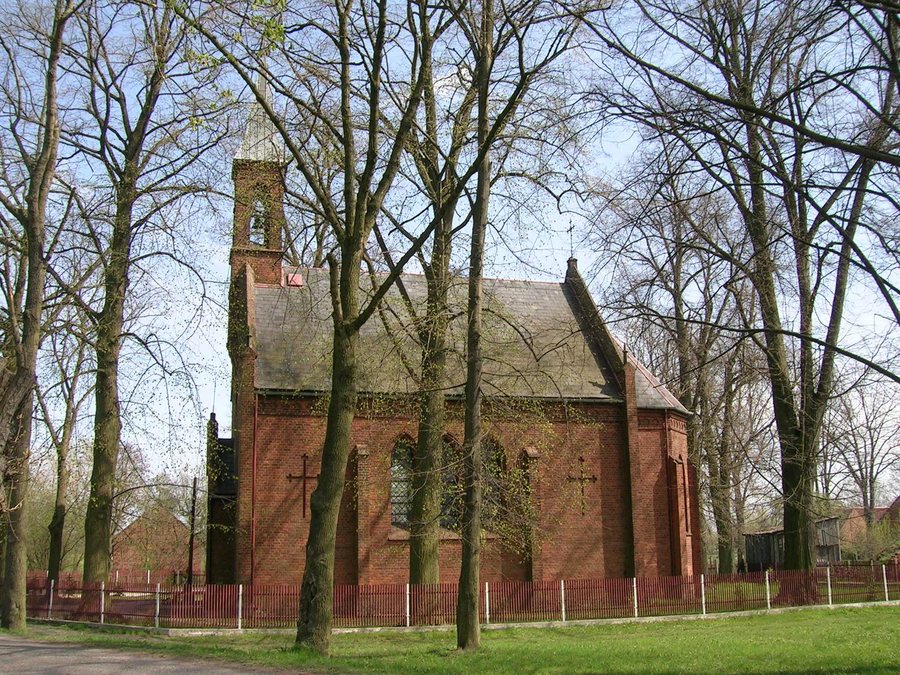 File:Kościół św. Stanisława Kostki w Ciecierzynie.jpg
Photo: gmina Byczyna via Wikimedia Commons, CC BY-SA 4.0
File:Kościół św. Stanisława Kostki w Ciecierzynie.jpg
Photo: gmina Byczyna via Wikimedia Commons, CC BY-SA 4.0
Ciecierzyn at a glance
- The village has a brick Neo-Gothic branch church dedicated to Saint Stanislaus Kostka, dating from 1878.
- The manor park lies to the west of Ciecierzyn and was entered in the Opole Voivodeship’s register of monuments in 1978.
- The park and manor complex dates to the mid-19th century and includes remnants of the residential area and an agricultural section.
- The municipality also includes the town of Byczyna, with its medieval town centre and town walls.
What traces of the estate’s history can you find?
The church of Saint Stanislaus Kostka is a distinct historical landmark in Ciecierzyn. It is described as a branch church, built of brick and designed in the Neo-Gothic style. Its construction date of 1878 places it in a different period from the park and manor complex, which dates to the mid-19th century. Travellers with a particular interest in architectural history can therefore find different types of buildings and historical periods in the same village.
The park and manor complex consisted of more than just a residential area. Its documented features also include an agricultural section with a farmyard and a former workers’ housing settlement. The complex’s palace was built in 1880 with a foundation from Artur von Prittwitz-Gaffron and was destroyed in 1945. These dates tell the story of a complex whose present-day historical significance encompasses both surviving features and lost buildings. The former manor chapel of the Exaltation of the Holy Cross was founded in 1796 and was already in ruins by the 1960s.
What characterises the manor park today?
The manor park lies to the west of the village. Deciduous trees predominate, with the largest share of trees aged 140 to 160 years. This age range refers to the trees in the park and makes the tree population a distinctive feature of the complex. The park also has walking paths. A partially preserved access road leads to the former manor and recalls its original function.
For orientation, the complex’s location along its southern side is also part of the description: there it borders the paved road between Kostów and Gołkowice. The park thus combines historic features with specific landscape characteristics. If you are considering a trip to Ciecierzyn, you can decide whether the manor park, the architectural history of the former estate or the church is your main interest.
What historic sites are in the municipality?
The town of Byczyna is another cultural landmark in the municipality, which also includes Ciecierzyn. Byczyna preserves a historic medieval town centre with town walls, defensive towers and 18th-century townhouses. These urban features are distinct from the characteristics of the park and manor complex in Ciecierzyn: Byczyna is about fortifications and urban architectural history, while Ciecierzyn is about a former manor with a park.
Byczyna’s town walls are 950 metres in circumference and up to 6 metres high. Remains of the town moat survive along the north side of the fortifications. The town hall houses a local history room and a viewing point in the town hall tower, offering views across the town. Byczyna thus complements Ciecierzyn’s rural historical focus with a town’s history of fortifications and its town hall. For planning your trip, these are two distinct themes: the estate’s history in the village and the historic buildings of the town within the same municipality.
FAQ
What historic church is there in Ciecierzyn?
The village has a brick Neo-Gothic branch church dedicated to Saint Stanislaus Kostka, dating from 1878.
What does the park and manor complex include?
It includes remnants of the residential area and an agricultural section with a farmyard and former workers’ housing settlement. The complex’s palace was built in 1880 and destroyed in 1945.
What are the features of the manor park?
Deciduous trees predominate in the park, with the largest share aged 140 to 160 years. There are also walking paths and a partially preserved access road to the former manor.
What can you discover in Byczyna?
The town in the municipality has a historic medieval town centre, town walls, defensive towers and 18th-century townhouses. The town hall houses a local history room and a viewing point in the town hall tower.
For the broader travel overview: Gołkowice.

