
Pokój: Discover Park History and Culture
Accommodation in Pokój
Pokój offers several specific points of interest to help you plan your trip: a historic park complex with different garden styles, Duchess Sophie’s Church and an annual music festival. The park’s history dates back to the start of construction in 1780; the church also preserves historic furnishings.
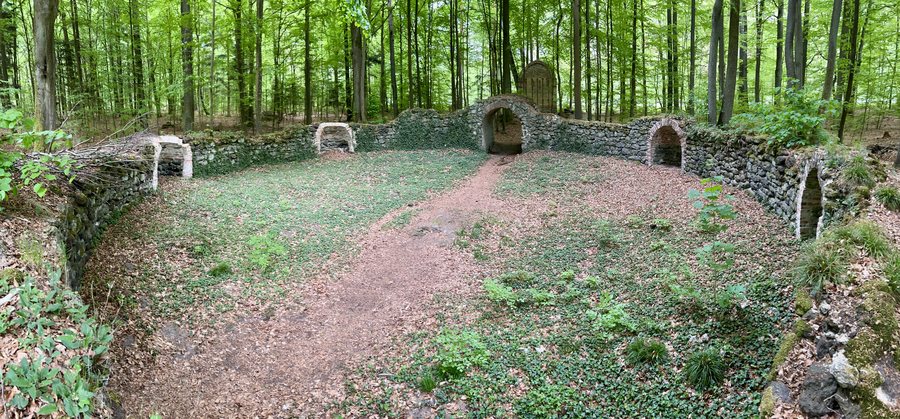 Ruiny Elizjum w parku przypałacowym, Pokój, woj. opolskie
Photo: Olgierd Rudak via Wikimedia Commons, CC BY-SA 4.0
Ruiny Elizjum w parku przypałacowym, Pokój, woj. opolskie
Photo: Olgierd Rudak via Wikimedia Commons, CC BY-SA 4.0
Pokój at a glance
- The historic park complex includes a Baroque-style French Garden, a 19th-century landscape park and an English Park on Winna Góra.
- In the French Garden, a tea pavilion stands on an island surrounded by water.
- Duchess Sophie’s Church has an elliptical floor plan on an east-west axis.
- Pokój hosts the annual Weber Festival of Music in Parks and Gardens.
How do the sections of the historic park differ?
The complex brings together three distinct garden styles: the Baroque French Garden, a 19th-century landscape park and the English Park on Winna Góra. This division helps you see the park not as a single, uniform design, but as a collection of distinct historical and landscaped features.
The French Garden includes a tea pavilion on an island surrounded by water. The English Park is described as having an evocative, sentimental character and features numerous elements of park architecture: ruins, obelisks, castles, temples, busts, pavilions and garden arbors. For orientation, these offer two distinct points of reference: the pavilion’s unusual setting in the French Garden and the varied architectural features of the English Park.
Construction of the park began in 1780. Websky initiated the start of the work, which was carried out under the direction of the gardener Klober. These names and the start of construction give the park a specific historical context, without implying that all three sections of the complex date from the same period.
What historical details does the church offer?
Duchess Sophie’s Church combines a distinctive floor plan with several preserved historical features. Its elliptical floor plan follows an east-west axis. Inside, notable features include historic 18th-century organs and richly decorated altars.
Above the sacristy is a library containing a ducal book collection that survived a castle fire. The library’s location and the collection’s survival of the fire make it a distinct part of the church’s history. If you are interested in historic architecture, you can distinguish the exterior floor plan from the furnishings and the library.
What connections are there to Weber and nature?
Carol Maria von Weber stayed in Pokój in 1806–1807. He was under the patronage of Prince Heinrich Friedrich Eugen, the second owner of Pokój. Pokój also hosts the annual Weber Festival of Music in Parks and Gardens. Festival details may vary from year to year, so check the dates for your intended year of travel when planning your visit.
Several natural features are also described: a large rhododendron stands in the historic park, with an information sign dedicated to it. Fishponds with dense vegetation add to the park landscape. A headless monument to Frederick the Great is also located in the area around Pokój. The monument is an additional historical point of interest beyond the park features described in more detail.
Discover more destinations: Namysłów, Dębnik.
FAQ
Which garden styles are included in the historic park complex?
The complex includes a Baroque-style French Garden, a 19th-century landscape park and an English Park on Winna Góra.
What is known about Duchess Sophie’s Church?
It has an elliptical floor plan on an east-west axis. Its features include historic 18th-century organs, richly decorated altars and a library above the sacristy.
When does the Weber Festival take place?
The Weber Festival of Music in Parks and Gardens takes place annually in Pokój. Dates and festival details may vary.
What natural features are described in the historic park?
They include a large rhododendron with its own information sign and fishponds with dense vegetation.
For the broader travel overview: Namysłów.

