
Starzno
Accommodation in Starzno
Starzno combines historic architecture with hiking trails that include the village in different routes. Two highlights are particularly relevant when planning your trip: St. Nicholas Church, with its distinctive architectural features and furnishings, and hikes where distance and trail surface are important factors.
Starzno at a glance
There is an erratic boulder in Starzno, and several wooden houses over a hundred years old have also been preserved. St. Nicholas Church dates from the late 16th or early 17th century. Two hiking trails pass through the village: a yellow-marked trail in the Brda Valley and the 26-kilometre Szafirowy Szlak, which is rated moderately difficult.
What makes St. Nicholas Church worth seeing?
St. Nicholas Church in Starzno was built on the site of an earlier church. That older church dates from the time when the area belonged to the Pomerelian princes. This means the history of the church site reaches further back than that of the building described today. Visitors interested in regional history and traditional architectural styles will find several specific features here that can be viewed individually.
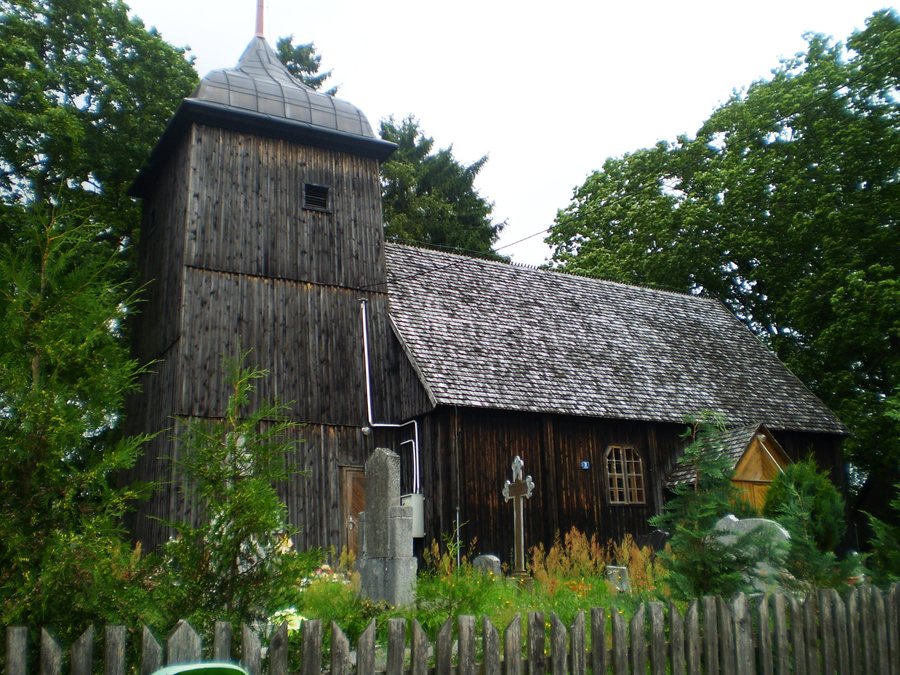
The church building has a timber-block construction. At the western end is a tower built using a post-and-beam structure, topped with a bulbous spire. The single-nave building has a gabled roof covered with wooden shingles. Timber-block construction, post-and-beam construction and shingle roofing refer to different elements: the construction method of the church building, the structure of the tower and the roofing material. Together, they give the church a clearly identifiable architectural profile.
The furnishings also include pieces from different centuries. The late Baroque high altar dates from the late 17th century and is decorated with abundant acanthus ornamentation and two paintings on leather. The furnishings also include a late Baroque pulpit and a chalice-shaped baptismal font with a cover from the first half of the 18th century. A crucifix is dated to around the turn of the 19th century. Two bells bear the years 1648 and 1824. These objects offer visitors with an interest in art history several points of interest, though they do not all date from the same period.
Which hiking trails pass through Starzno?
The yellow-marked hiking trail runs through the Brda Valley from Miastko to Przechlewo, passing through Starzno and Nowa Brda. This describes the route and the named places along it; no distance or difficulty rating is provided.
The Szafirowy Szlak is 26 kilometres long and rated moderately difficult. It runs from Koczała to Koczała via Dymin, Dźwierzno, Starzno and Ostrówek. The listed surfaces include cobblestones, asphalt, unpaved paths and concrete slabs. This sequence is more useful for planning than a general description: in addition to the stated distance and rating, you can take into account that the trail does not have the same surface throughout. Lake Starzeńskie is named as one of the attractions along this route.
The information available for the two hiking trails differs: the yellow-marked trail is described by its route and intermediate places, while the Szafirowy Szlak also has a stated distance, difficulty rating and surfaces. If you plan to include a hike in your trip, you can therefore make your choice based on the route information available for each trail. You can also include the destination page Swieszyno in your itinerary planning.
FAQ
How long is the Szafirowy Szlak?
The Szafirowy Szlak is 26 kilometres long and rated moderately difficult.
What surfaces are found on the Szafirowy Szlak?
The trail runs over cobblestones, asphalt, unpaved paths and concrete slabs.
What historic furnishings does St. Nicholas Church have?
The items mentioned include a late Baroque high altar, a late Baroque pulpit, a baptismal font from the first half of the 18th century, a crucifix from around the turn of the 19th century, and two bells from 1648 and 1824.
For the main travel overview: Schlochau.

