
Grabiny-Zameczek: Chapel, Park and Trails
Accommodation in Grabiny-Zameczek
Grabiny-Zameczek offers points of interest for a range of interests: a chapel in a former journeyman’s room, a brick gate with a stone coat of arms, and trails leading to a special natural landmark.
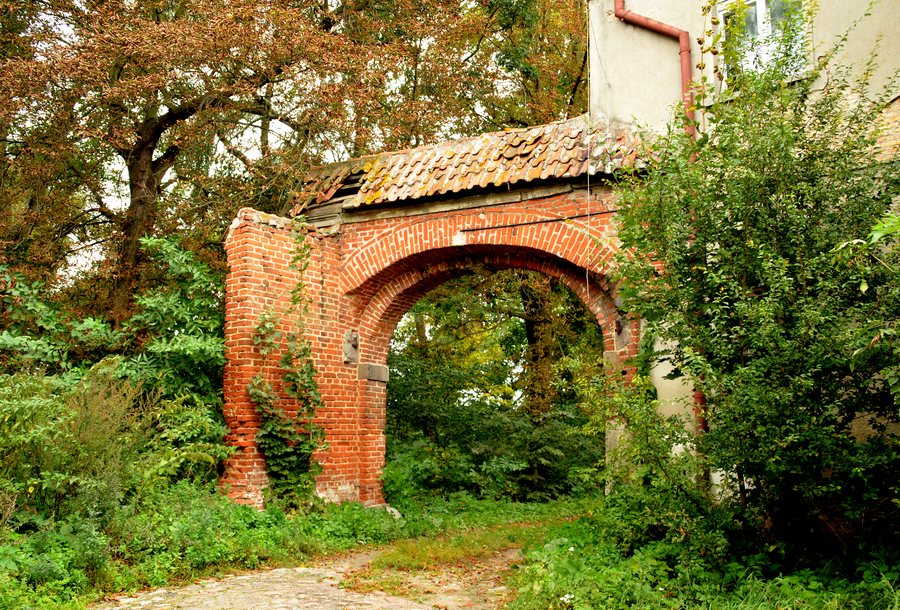 File:Grabiny ZAMECZEK -Brama z herbem Gdańsk.jpg
Photo: Wiesława Nowakowska via Wikimedia Commons, CC BY-SA 4.0
Grabiny-Zameczek at a glance
- A chapel in the former journeyman’s room of a farm building is dedicated to the Holy Trinity.
- The complex’s brick gate bears a stone coat of arms of Gdańsk.
- London planes and red-leaved beeches grow in the complex’s park.
- A signed, 500 m access trail leads from the Motławski Trail to Batorowy Ostaniec.
- The red-marked Motławski Trail is 40.4 km long and runs between Gdańsk and Tczew.
What architectural history can you discover?
Several different architectural features can be found at the complex. The stone coat of arms of Gdańsk makes a striking feature on the brick gate. The former farm building contains a chapel in what used to be the journeyman’s room, dedicated to the Holy Trinity.
Historical uses can also be found outside the complex: an unpaved access path from Młyńska Street leads to a wooden building that once housed a school and a mill. The remains of a Teutonic castle in Grabiny-Zameczek are highlighted as an attraction along the Motławski Trail. Together, these sites offer a range of themes—from a former farm building and its past use as a school and mill to the castle remains.
How do the park and trails differ?
Several London planes and red-leaved beeches grow in the complex’s park. These named tree species give the park a distinctive botanical feature. There is also a large rest area next to the park. When planning your trip around the area, you can consider these features of the park alongside the architectural sights.
A signed access trail from the Motławski Trail leads 500 m to Batorowy Ostaniec. At 14.6 m above sea level, this natural landmark is the highest point in the Żuławy Wiślane. The 500 m refers to the access trail to this destination; it is not the total length of the regional Motławski Trail. This distinction helps separate a specific nearby destination from a longer route.
What does the Motławski Trail offer in the region?
The red-marked Motławski Trail runs between Gdańsk (Urząd Marszałkowski) and Tczew and is 40.4 km long. Along the trail, Wróblewo, Krzywe Koło, Suchy Dąb and Koźliny have brick churches dating from the time of the Teutonic Order. These places are in the wider region and should be distinguished from the sights directly in Grabiny-Zameczek. If you plan to take the trail, check the trail conditions before setting off.
Discover more destinations
Discover more destinations: Gdańsk, Świbno, Buszkowy Górne, Przejazdowo, Wiślina, Miłowo, Juszkowo and Pszczółki.
FAQ
Where does the 500 m access trail lead?
It leads from the Motławski Trail to Batorowy Ostaniec, the highest natural point in the Żuławy Wiślane, at 14.6 m above sea level.
Which historical sites are mentioned along the Motławski Trail?
In Grabiny-Zameczek, the remains of a Teutonic castle are highlighted as an attraction along the trail. Further afield in the region, brick churches can be found in Wróblewo, Krzywe Koło, Suchy Dąb and Koźliny.
Who is the chapel in Grabiny-Zameczek dedicated to?
The chapel in the former journeyman’s room of a farm building is dedicated to the Holy Trinity.
To the main travel overview: Gdańsk.

