
Lublewo Gdanskie – Church, cultural heritage and cycling routes
Accommodation in Lublewo Gdanskie
Lublewo Gdanskie combines cultural and historical features with two signposted cycling routes that pass through the village. On your trip, you can choose to focus on architectural history, protected historic heritage or cycling routes.
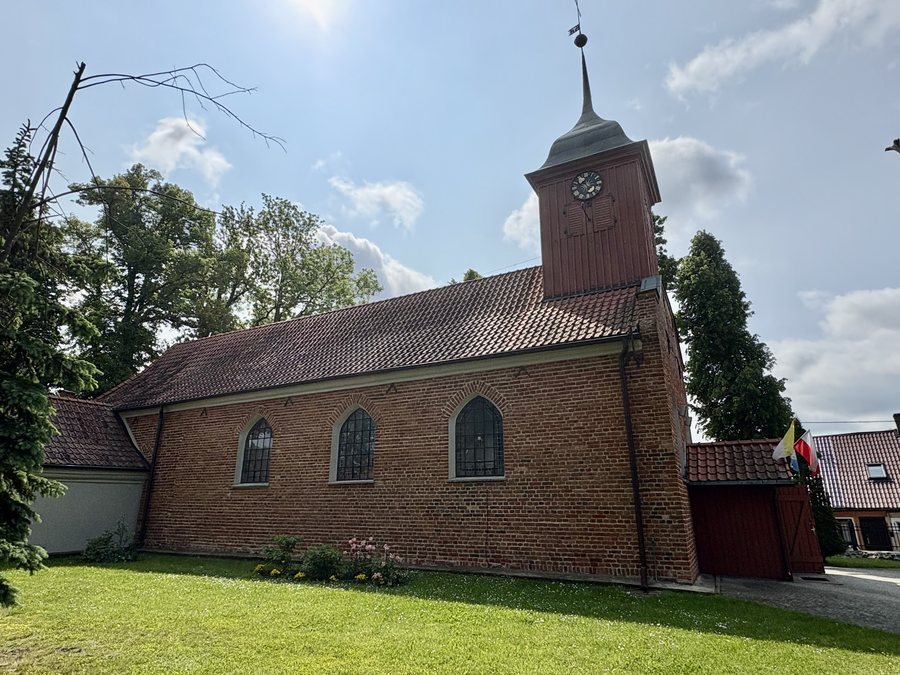 File:Kościół MB Królowej Korony Polskiej, Lublewo Gdańskie.jpg
Photo: PiotrMig via Wikimedia Commons, CC BY 4.0
File:Kościół MB Królowej Korony Polskiej, Lublewo Gdańskie.jpg
Photo: PiotrMig via Wikimedia Commons, CC BY 4.0
Lublewo Gdanskie facts at a glance
- The Church of NMP Królowej Polski is a Gothic-Baroque, east-facing brick church with a wooden tower clad in boards.
- Part of the planned area lies within the Dolina Raduni Landscape Protection Area.
- The Kashubian-Żuławy Cycling Route is 55.41 km long and marked in blue; Wolność jest w Naturze is 12.92 km long and marked in red. Both routes are signposted and pass through Lublewo Gdanskie.
- Lublewo lies on the fortified transport route between Gdańsk and Kościerzyna.
What does the church reveal about the village’s architectural history?
The Church of NMP Królowej Polski offers a concrete insight into the village’s architectural history. The walls of its chancel date from the second half of the 14th century. The building was remodelled in 1684 and is a Gothic-Baroque brick church. It faces east, and its tower is made of wood and clad in boards.
The furnishings provide another historical point of reference: the church has a wooden Baroque musicians’ gallery dating from 1782. Its balustrade consists of panels and rests on two chamfered posts. The chancel walls, remodelling and gallery belong to different periods.
What is included in the protected historic village setting?
The conservation zone for the rural settlement layout protects, preserves and maintains the historically designed greenery. Thus, in addition to the church, the designed greenery is also a feature of the historic village setting.
Another element is the Catholic parish cemetery, formerly a Protestant cemetery. The historic alignment of the avenues and the existing division into burial plots are protected there. These features describe the cemetery layout: in addition to the burial plots, the course and arrangement of the avenues are part of its protected historic design.
The older history of the village also includes an open settlement in Lublewo Gdanskie, dated to the Early Iron Age. This provides a separate point of reference alongside the church’s medieval architectural history and the later features of its remodelling and furnishings.
Which cycling routes pass through Lublewo Gdanskie?
The Kashubian-Żuławy Cycling Route passes through Lublewo Gdanskie. It is signposted, marked in blue and 55.41 km long overall. Wolność jest w Naturze also passes through the village: this signposted route is marked in red and covers 12.92 km.
The routes can be distinguished by their total length and markings. If the stated distance is important to your choice, Wolność jest w Naturze is the shorter of the two; the Kashubian-Żuławy Cycling Route covers a longer overall distance.
How is the village situated geographically?
Lublewo lies on the fortified transport route between Gdańsk and Kościerzyna. The landscape is another geographical feature: part of the planned area of Lublewo Gdanskie lies within the Dolina Raduni Landscape Protection Area. Together with the church, the protected historic village setting and the cycling routes, this gives a picture that encompasses architectural and local history, as well as the landscape and cycling.
If you would like to compare other destinations, you can also include Kolbudy Dolne in your selection.
FAQ
How long are the cycling routes through Lublewo Gdanskie?
The Kashubian-Żuławy Cycling Route is 55.41 km long. Wolność jest w Naturze covers 12.92 km.
What are the distinctive features of the Church of NMP Królowej Polski?
It is a Gothic-Baroque, east-facing brick church with a wooden tower clad in boards. The chancel walls date from the second half of the 14th century; the church was remodelled in 1684 and has a musicians’ gallery dating from 1782.
What is protected at the Catholic parish cemetery?
The historic alignment of the avenues and the existing division into burial plots are protected.
For the wider travel overview: Widlino.

