
Karwia
Accommodation in Karwia
Karwia combines a beach along a dune belt with evergreen pine forest and paths for walks and bike rides. The history of the church is also part of the town: a postwar land donation and three named bells give it a specific historical connection.
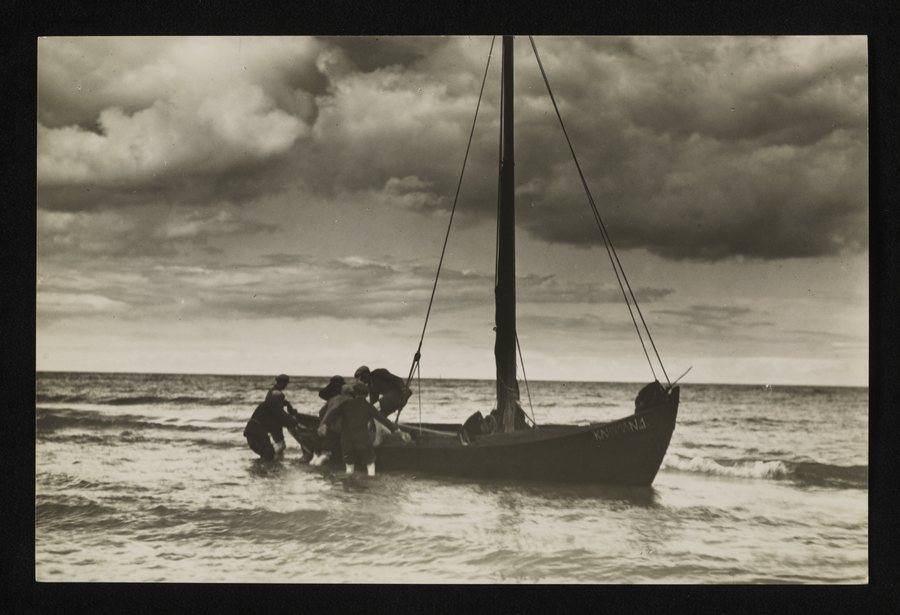 File:Karwia, rybacy ante 1939 (67263975).jpg
Photo: Henryk Poddębski via Wikimedia Commons, Public domain
Karwia at a glance
- A dune belt with evergreen pine forest separates the beach from the land.
- A walking trail runs through the coastal forest; a cycle path leads from Karwia to Jastrzębia Góra.
- At Bielawskie Błota, below Ostrowo, an educational walking trail passes through two floristic reserves.
- In 1947, Maria and Ksawery Wittbrodt of Karwia donated a plot of land for the present-day church. The shell of the building was completed at the end of 1950.
What makes Karwia’s beach distinctive?
The beach is not simply described as an open stretch at the edge of town: a dune belt with evergreen pine forest lies between it and the land. The beach and forest are therefore both part of Karwia’s landscape. Those considering a stay here may be interested in time at the beach as well as walks in the coastal forest.
Which paths shape a stay?
A walking trail runs through the coastal forest near Karwia’s beach, making longer walks possible. This suits travelers who want to explore on foot as well as spend time at the beach. No distance or walking time is specified, so it is best to think of the trail as an option for longer walks rather than a route with a set length.
There is a specific option for a bike ride: a cycle path leads from Karwia to Jastrzębia Góra. This distinguishes walks in the coastal forest from a ride between two named places. If you choose your trip based on activities, Karwia thus offers concrete options for both walking and cycling, without implying that they form a single route.
What does the trail at Bielawskie Błota offer?
Nearby, at Bielawskie Błota below Ostrowo, Nadmorski Landscape Park has created an educational walking trail. It passes through the two floristic reserves “Woskownicy Bielawskiego Błota” and “Moroszka Bielawskiego Błota.” The trail thus connects two areas, each with its own name, and is also described as an educational walking trail. Those interested in nature reserves and plant life as well as the beach and coastal forest will find another natural attraction to consider when planning their trip.
What story does the church tell?
In 1947, Maria and Ksawery Wittbrodt, residents of Karwia, donated a 2,754 m² plot of land for the present-day church in Karwia. After the war, the shell of the building was completed at the end of 1950. The dates refer to different stages: 1947 to the land donation and the end of 1950 to completion of the building shell. The church has three bells named “Edmund,” “Jan,” and “Antoni.” Those interested in local history can use these details to trace both the construction of the church and a specific feature of its furnishings.
For comparison with other pages about nearby places, you can also visit Dębki, Mechelinki, Rekowo Górne, Darzlubie, Mieroszyno, Krokowa, Słuchowo and Karwienskie Bloto Pierwsze.
FAQ
How is Karwia’s beach separated from the land?
A dune belt with evergreen pine forest separates the beach from the land.
What paths are there in Karwia?
A walking trail for longer walks runs through the coastal forest. A cycle path also leads from Karwia to Jastrzębia Góra.
What is known about the church in Karwia?
The plot of land for the present-day church was donated in 1947; the building shell was completed at the end of 1950. The church has three bells named “Edmund,” “Jan,” and “Antoni.”
For the broader travel overview: Puck.

