
Pinczyn: Local Culture and History
Accommodation in Pinczyn
Pinczyn offers several specific points of interest for anyone interested in architecture, archaeological history, and distinctive natural landmarks. The facts about the church, banners, urns, and erratic boulder reveal different sides of the village and provide a factual basis for deciding which subjects appeal to you most.
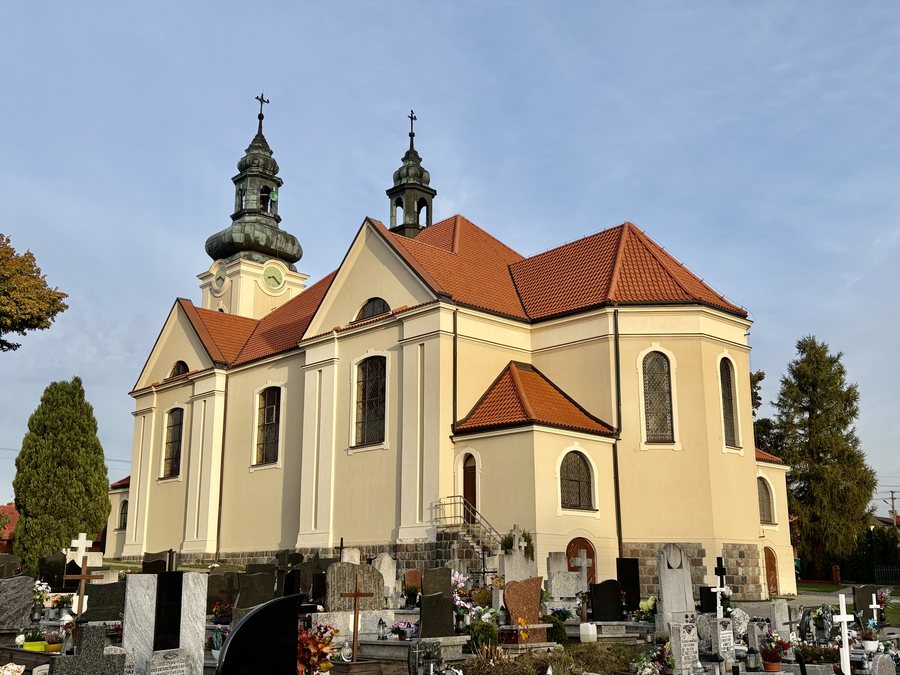 File:Kościół w Pinczynie z południowego wschodu.jpg
Photo: PiotrMig via Wikimedia Commons, CC BY 4.0
File:Kościół w Pinczynie z południowego wschodu.jpg
Photo: PiotrMig via Wikimedia Commons, CC BY 4.0
Key facts about Pinczyn
- The Neo-Gothic Church of St. Elizabeth was built in 1926–1927 on the site of an older wooden church.
- Two historic processional banners returned to the parish church after thorough conservation and are listed in the Register of Movable Monuments of the Pomeranian Voivodeship.
- An ancient cemetery was located on the site of today’s village; urns dating from 700 to 400 BC were excavated there after the Second World War.
- The Diabelski Kamień erratic boulder has a circumference of 14 metres and is 2.2 metres high. It is considered the largest erratic boulder in Kociewie.
Which historical traces shape Pinczyn?
The Church of St. Elizabeth brings together two clearly identifiable building phases: its Neo-Gothic structure was built in 1926–1927 on the site of an older wooden church. Those interested in the development of church architecture will find a concrete connection here between the present building and its predecessor. The dates place the construction in time, while the former wooden church connects the site of the new building to local architectural history.
The processional banners are also part of the parish church’s history. Two historic banners returned there after thorough conservation and are listed in the Pomeranian Register of Movable Monuments. Pinczyn thus brings together architectural history and movable cultural heritage: the church represents a dated new building on an older site, while the banners are historic objects whose condition was addressed through conservation.
What do the archaeological finds tell us?
The archaeological history reaches back to the period from 700 to 400 BC. An ancient cemetery stood on the site of today’s village; urns from this period were excavated there after the Second World War. They were later transferred to the Archaeological Museum in Gdańsk. This makes it possible to distinguish the findspot in Pinczyn, the dating of the urns, and their subsequent journey to the museum.
For choosing a theme, this offers a different perspective from the architecture of the Church of St. Elizabeth or the history of the banners. The urns point to archaeological finds and a distant past; the church and banners represent ecclesiastical architectural and object history. These differences help you consider Pinczyn in light of your own interests, without combining the different evidence into a single story.
Which subjects match your interests?
If you are primarily interested in Neo-Gothic architecture, the Church of St. Elizabeth offers a clearly dated starting point. Its connection to the site of the older wooden church adds the architectural history that preceded the present building. Those more interested in historic objects can consider the processional banners as a subject in their own right: their return after conservation and their entry in the monuments register are their key features.
For those interested in archaeology, the context of the finds at the site of today’s village is the key point. The date range of 700 to 400 BC and the transfer of the urns to the Archaeological Museum in Gdańsk give this subject a distinct chronological and thematic context. The Diabelski Kamień is another, quite different point of interest. Its dimensions and status as the largest erratic boulder in Kociewie make it a specific natural landmark in this selection. You can thus distinguish between architecture, movable cultural heritage, archaeological finds, and an erratic boulder, rather than grouping all the sights under a single general heading.
Discover more destinations: Smętówko, Rynkówka, Lubichowo, Linowiec.
FAQ
When was the Church of St. Elizabeth built?
The Neo-Gothic church was built in 1926–1927 on the site of an older wooden church.
What happened to the urns from the ancient cemetery?
Urns dating from 700 to 400 BC were excavated after the Second World War on the site of today’s village and transferred to the Archaeological Museum in Gdańsk.
How large is the Diabelski Kamień?
The erratic boulder has a circumference of 14 metres and a height of 2.2 metres. It is considered the largest erratic boulder in Kociewie.
For the broader travel overview: Starogard County.

