
Huta Kalna: Church, village history and Lake Szarmachy
Accommodation in Huta Kalna
Two aspects are particularly central to a trip to Huta Kalna: the protected historic village layout and its cultural history, as well as Lake Szarmachy and the Szlak Arboretum. The lake is in the Sołectwo Huta Kalna and serves as a bathing spot; the route runs for 26 kilometres to the arboretum and dendrological garden in Wirty.
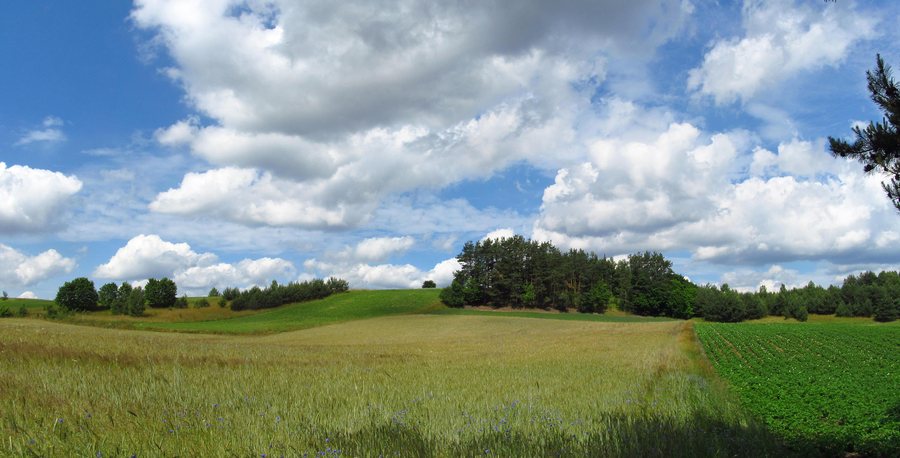 Panorama pól za kościołem w Hucie Kalnej
Photo: Ryszard Wojdowski via Wikimedia Commons, CC BY-SA 4.0
Huta Kalna at a glance
- The entire village is protected as a historic rural settlement.
- The Neo-Gothic Church of St. Joseph was built in 1894 by members of the Evangelical Church of the Old Prussian Union.
- Lake Szarmachy in the Sołectwo Huta Kalna serves as a bathing spot; check seasonal conditions locally.
- The 26-kilometre-long Szlak Arboretum is an unmarked cycling and walking route through Huta Kalna.
What does protection of the village include?
Protection applies to Huta Kalna as a whole village, not just to a single building. The historic rural settlement includes its spatial layout and historic plot divisions, as well as its historic network of roads and the arrangement of farmsteads. Small historic features and historic greenery associated with the buildings and road network are also part of this context.
This makes it possible to explore the village’s history beyond individual buildings: the way roads, plots and farmsteads form the settlement is also important. Anyone interested in rural cultural history will find a concrete reason here to consider this wider perspective alongside individual historic buildings.
What story does the Church of St. Joseph tell?
The Neo-Gothic Church of St. Joseph was built in 1894 by members of the Evangelical Church of the Old Prussian Union. Its movable historic furnishings include objects from different periods. These include a wooden choir loft from the 1940s and a baptismal font from the late 19th century.
Another distinctive feature is a wooden Christ on the Cross, which may date from the 18th century. This dating is uncertain and should therefore be understood as a possibility, not as a confirmed date. The objects mentioned thus span a period from a possible 18th-century origin to an object from the 1940s.
How should the cemetery and rectory be understood?
The former Evangelical cemetery dates from 1894. It lies east of the village centre on a gentle natural slope. A path runs north–south through its middle towards the chapel. This describes the site more precisely than simply giving a compass direction: the slope and the path’s course are also part of its location.
Another historic building is the present-day rectory of the Parish of St. Joseph. It was formerly the parsonage and dates from 1907. The church, former cemetery and rectory offer different chronological and local reference points for Huta Kalna’s cultural history; each date should be associated with its own building or site.
What do the lake and the Szlak Arboretum offer?
Lake Szarmachy is in the Sołectwo Huta Kalna and serves as a bathing spot. As bathing conditions vary by season, it is advisable to check them locally before your trip. The lake is a separate point of interest for travellers who would like to include a bathing spot in their plans.
The Szlak Arboretum offers another way to include Huta Kalna in a trip. The 26-kilometre cycling and walking route runs from Huta Kalna via Mały Bukowiec and Twardy Dół to the arboretum and dendrological garden in Wirty. It is unmarked. Take this into account when planning your route; no walking or cycling time is specified.
Discover more destinations: Mermet, Ocypel and Piece.
FAQ
What is included in Huta Kalna’s protected village layout?
Protected features include the historic spatial layout, plot divisions, road network, arrangement of farmsteads, small historic features and associated historic greenery.
What historic furnishings are in the Church of St. Joseph?
They include a wooden choir loft from the 1940s, a baptismal font from the late 19th century and a wooden Christ on the Cross that may date from the 18th century.
Is the Szlak Arboretum marked?
No. The 26-kilometre cycling and walking route is unmarked and runs via Mały Bukowiec and Twardy Dół to the arboretum and dendrological garden in Wirty.
What should you know about the bathing spot at Lake Szarmachy?
The lake serves as a bathing spot. Check seasonal bathing conditions locally before your trip.
For the broader travel overview: Czarna Woda.

