
Accommodation in Krasna for church and local history
Accommodation in Krasna
Krasna combines a hilly landscape along the Mała Krasna stream with a church whose history touches on two Christian traditions. A historic cemetery is also part of the village landscape. If you are looking for a room as a base, you can choose between a peaceful stay in the countryside and a visit focused on the area’s architectural and commemorative history. The actual routes depend on the address; the available facts about the village do not establish either a tourist visitor centre or any particular accommodation amenities.
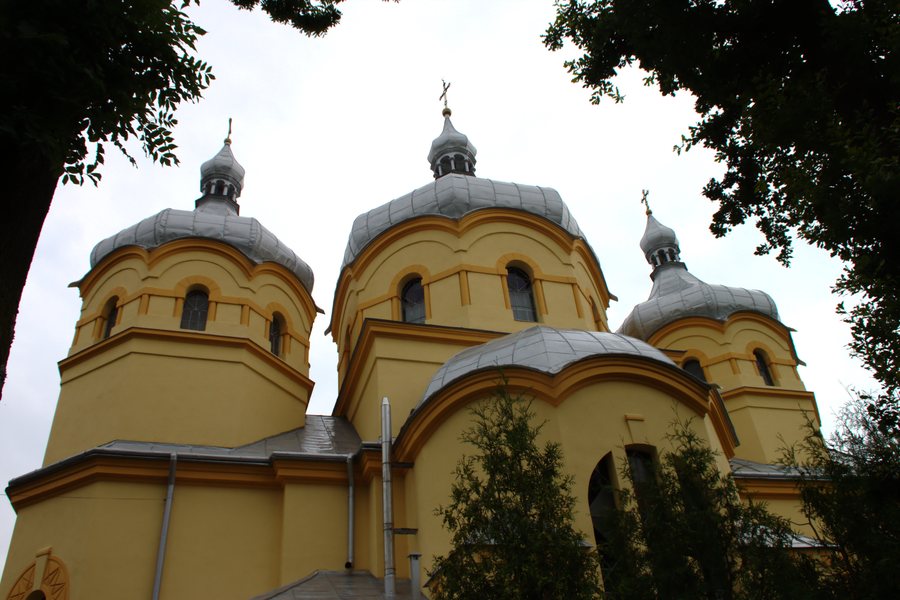 File:Krasna, kostel.jpg
Photo: I would appreciate being notified if you use my work outside Wikimedia. More of my work can be found in my personal gallery . via Source, CC BY 3.0
Krasna at a glance
- The Mała Krasna stream flows through the village and joins the Stobnica.
- Hills rise along the stream and to its east and north, within Krasna.
- The brick church was built from 1912 to 1914.
- Originally Greek Catholic, it was taken over by the Roman Catholic parish after the Second World War.
- A particularly large number of stone graves have been preserved in the historic part of the cemetery.
The church and its changing use
The parish church is a good example of how a village’s history can be read in a single building. The brick structure was built between 1912 and 1914 as a Greek Catholic church. It was not taken over by the Roman Catholic parish until after the Second World War. This chronology matters: these are not two different churches, and the building’s present use should not be projected back onto the time when it was built. The church is therefore of interest to visitors both for its architecture and its cultural history. The available facts do not establish opening hours or guided tour times.
Historic cemetery
Many stone graves have been preserved in the historic part of the cemetery. One documented example is the grave of Father Aleksander Prysłopski, who died in 1942 and commissioned the church’s construction; his gravestone was renovated in 2014. This connects the church’s construction with local history through one person. However, the cemetery is first and foremost a place of remembrance, not a freely available exhibition space. A respectful visit acknowledges its religious significance and avoids drawing unverified conclusions about the village as a whole from individual gravestones.
The hills and stream as the village’s setting
The Mała Krasna flows through Krasna and later joins the Stobnica. Within the village, hills extend along the stream and to its east and north. This describes a varied landscape setting without promising a marked hiking trail, viewpoint or swimming spot. If you want to stay here because of the hilly surroundings, consider the exact address: one house in the village may be very differently located in relation to the church, stream or a walk of your choice than another. For more travel ideas in the Krosno region, there is also a separate page about Kombornia; the link does not make Kombornia a sight within Krasna.
Choosing suitable accommodation
If you plan to visit the church and cemetery, staying a short actual distance from them is helpful. For a landscape-focused stay, consider a location in the hills and near the stream. Compare the address, dates, price and explicitly listed amenities for each offer. Neither the historic church nor the course of the stream establishes that a particular property offers a room, parking, guided tours or leisure activities. Krasna is of interest above all for its distinctive cultural and landscape setting.
FAQ
When was the church in Krasna built?
The brick structure was built between 1912 and 1914 and was initially Greek Catholic.
What has been preserved in the old cemetery?
The historic section contains a particularly large number of stone graves, including the renovated gravestone of the church’s builder, Father Aleksander Prysłopski.
What kind of landscape characterises Krasna?
The Mała Krasna stream runs through the village, while hills lie along the stream and to its east and north.

