
Chorzelów: Churches, Pilgrimage and Manor-House History
Accommodation in Chorzelów
Chorzelów brings together a Neo-Gothic parish church, a pilgrimage tradition and traces of its manor-house history. For trip planning, the town offers several distinct cultural themes: sacred architecture, regional dance and music traditions, and historic sites.
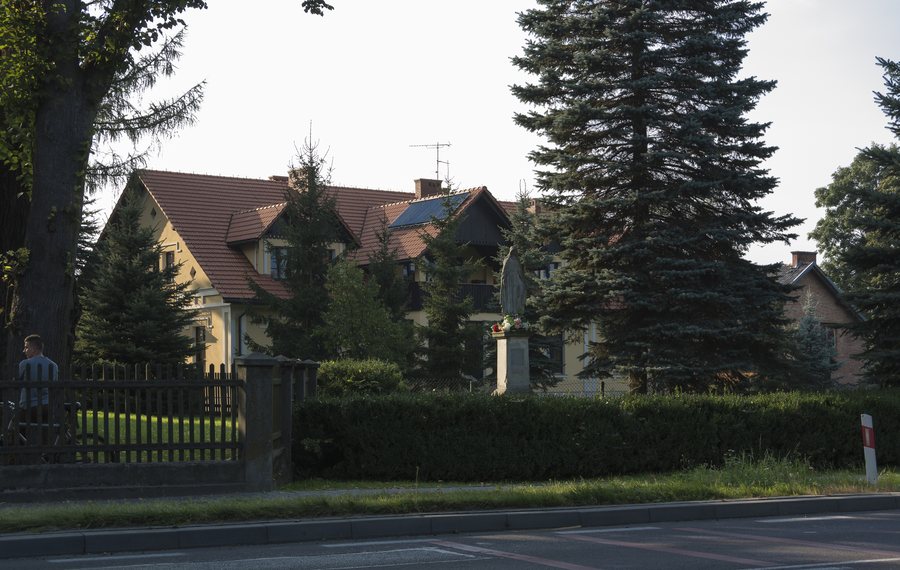
Chorzelów at a glance
- The present-day parish church was built between 1900 and 1907 to a design by Teodor Talowski. It is Neo-Gothic, built of brick, has three naves and features a transept.
- On 7 September 2008, the church was elevated to the status of the Sanctuary of Our Lady Queen of Families (Sanktuarium Matki Bożej Królowej Rodzin).
- Chorzelów is home to a landscape park on a former manor estate, an outbuilding of the Tarnowski manor complex dating from the second half of the 17th century, and the administrator’s house, “Biały Dworek,” from the early 20th century.
- The folk ensemble “Chorzelowiacy” has Polish national dances, as well as dances, songs and customs from Silesia, the Lublin region and Podkarpacie in its repertoire.
What do the church and pilgrimage tradition tell us?
The present-day parish church in Chorzelów was built between 1900 and 1907 to a design by the architect Teodor Talowski. Its Neo-Gothic brick architecture has three naves and is complemented by a transept. Its construction dates, material and floor plan give the church a clearly defined architectural profile. For visitors interested in church architecture, both its style and specific design are central features.
The church is also associated with the veneration of the image of Our Lady of Chorzelów. The image drew the faithful to the church on pilgrimages and became a spiritual focus for Marian devotion. On 7 September 2008, the church was elevated to the status of the Sanctuary of Our Lady Queen of Families (Sanktuarium Matki Bożej Królowej Rodzin). The architecture and religious significance thus represent two distinct aspects of the town’s history: its early-20th-century design and its pilgrimage tradition.
What historic traces of the manor estate can be found?
The historic landscape of Chorzelów includes a landscape park on a former manor estate. Its origins are dated from the 17th to the 19th/20th century. The Tarnowski manor complex also includes an outbuilding from the second half of the 17th century. These details offer different perspectives on the timeline of the local manor-house history, without reducing it to a single building or construction phase.
Another historic building is the administrator’s house, known as “Biały Dworek.” It dates from the early 20th century. Together with the landscape park and the outbuilding of the Tarnowski manor complex, it broadens the picture beyond the parish church to include architectural traces from different centuries. These dates help put the town’s historic themes into context.
Which cultural traditions shape Chorzelów?
The folk ensemble “Chorzelowiacy,” based in Chorzelów, brings together various Polish dance and music traditions in its repertoire. These include Polish national dances and dances from Silesia and the Lublin region. The repertoire also features dances, songs and customs from Podkarpacie. Visitors interested in regional culture can therefore find several distinct traditions represented in a single ensemble’s repertoire. The range extends from national dances to regional songs and customs.
What other themes does the wider destination of Mielec offer?
The wider destination of Mielec offers additional, distinct cultural and leisure themes. The Sala Królewska (Royal Hall) displays a frieze with 44 portraits of Polish rulers, as well as depictions of Tadeusz Kościuszko and Kazimierz Pułaski. The former meeting hall of the County Council in Mielec was decorated in 1907–1909 with the coats of arms of all Polish lands and voivodeships within the borders of 1795. These offer two distinct historical perspectives: portraits and images of rulers on the one hand, and the territorial divisions of the time on the other.
The permanent exhibition at the Muzeum Historii Fotografii “Jadernówka” is another cultural attraction in Mielec. It features the interior rooms of the former photography business: the photographic studio, waiting room and Jaderny family living room. For outdoor activities, the city also describes features of the Leśny “Góra Cyranowska” Park: a cycle path runs through the entire park and makes it possible to ride up Góra Cyranowska. Beneath a pedestrian bridge several metres high is a 116-metre-long toboggan run. It starts in the central part of the park, runs along the northern slope and is described as a winter attraction for the city’s youngest residents. Mielec therefore offers a choice of both cultural and historical themes and the park activities described here.
Discover more destinations: Partynia, Mielec, Sarnów, Radomyśl Wielki and Przecław.
FAQ
When was the parish church in Chorzelów built?
The present-day parish church was built between 1900 and 1907 to a design by the architect Teodor Talowski. It is a Neo-Gothic brick church with three naves and a transept.
What is the image of Our Lady of Chorzelów known for?
It drew the faithful to the church in Chorzelów on pilgrimages and became a spiritual focus for Marian devotion.
What traditions are in “Chorzelowiacy’s” repertoire?
The ensemble performs Polish national dances, as well as dances from Silesia and the Lublin region. Its repertoire also includes dances, songs and customs from Podkarpacie.
Go to the wider travel guide: Mielec.

