
Discover Zarzecze
Accommodation in Zarzecze
Get to know Zarzecze through two cultural highlights: the palace and park complex with its museum, and the church complex comprising a church and bell tower. The palace and park complex is the town’s main attraction. Its architecture and museum themes offer different perspectives on family history and Polish history.
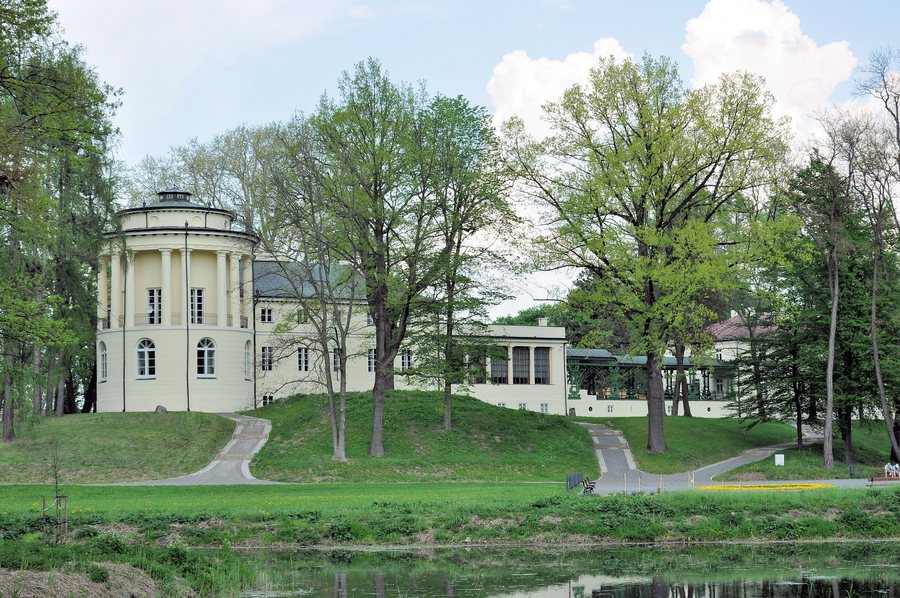 File:PL - Zarzecze - pałac - 2012-05-02--12-58-11-08.jpg
Photo: Kroton via Wikimedia Commons, CC BY-SA 3.0 PL
Zarzecze at a glance
- The Dzieduszycki Palace and Park Complex is Zarzecze’s main attraction.
- The Muzeum Dzieduszyckich is located on the upper floor of the palace. Its exhibition covers the Dzieduszycki family and aspects of Polish history during the Partitions of Poland.
- The palace is designed in the classicist style, has an irregular pre-Romantic architectural form and features a corner rotunda with a ballroom.
- The church and bell tower form a stylistically cohesive complex with Neo-Romanesque features. The church complex was endowed by the Dzieduszycki family in the 19th century.
What makes the palace and park complex distinctive?
The palace combines several architectural descriptions: it is designed in the classicist style while also having an irregular pre-Romantic architectural form. These terms refer to different aspects—the style and the characteristic form. In addition, it has a corner rotunda and a ballroom. This makes it possible to understand the complex not only as the main attraction, but also through specific architectural features.
For a cultural trip, the palace offers a clear starting point for exploring architecture in Zarzecze. If you enjoy considering buildings by style and form, you can read the classicist design, irregular form and corner rotunda as distinct clues. The ballroom adds a specifically named room to this description. Together, these details give a more precise picture of the palace without requiring a long list of further architectural information.
What themes does the museum cover?
The Muzeum Dzieduszyckich is located on the upper floor of the palace. Its exhibition is devoted to the Dzieduszycki family and aspects of Polish history during the Partitions of Poland. It therefore focuses on two subjects: a family perspective and a broader historical context. For travelers interested in cultural history, the museum’s content complements an architectural look at the palace with historical themes.
The museum’s location on the upper floor is a specific part of its place within the palace complex. If you are planning a visit, check the current visitor information and exhibitions in advance. This lets you plan around the actual visitor arrangements rather than infer opening hours or access options from the museum’s location.
What defines the church complex?
The church complex offers both a historical and an architectural perspective. The Dzieduszycki family endowed it in the 19th century. The church and bell tower form a stylistically cohesive complex with Neo-Romanesque features. The endowment places the complex in its historical context, while the description of the ensemble makes its architectural character clear.
Different features come to the fore here than at the palace: the palace is described in terms of its classicist design, pre-Romantic architectural form, corner rotunda and ballroom. The church complex, by contrast, is notable for the shared stylistic effect of the church and bell tower, as well as its Neo-Romanesque features. Those considering Zarzecze for its cultural history will find different ways to place the town’s buildings in context.
Discover more destinations: Kańczuga, Sieniawa, Przeworsk, Gać.
FAQ
Where is the Muzeum Dzieduszyckich located?
The museum is on the upper floor of the palace in Zarzecze. Check the current visitor information before your visit.
What themes does the exhibition cover?
It covers the Dzieduszycki family and aspects of Polish history during the Partitions of Poland. Check which exhibitions are currently on display before your visit.
What is known about the church and bell tower?
They form a stylistically cohesive complex with Neo-Romanesque features. The church complex was endowed by the Dzieduszycki family in the 19th century.
For the broader travel overview: Przeworsk County.

