
Rydzewo: Lake Boczne, village history and cycling routes
Accommodation in Rydzewo
Rydzewo lies on Lake Boczne and the Szlak Wielkich Jezior Mazurskich, the Masurian Great Lakes Waterway. The village has a church that was put into use in 1591, a former half-timbered inn and two cycling routes described in different ways. This makes Rydzewo easy to place in your travel plans in terms of its waterside setting, village history and cycling.
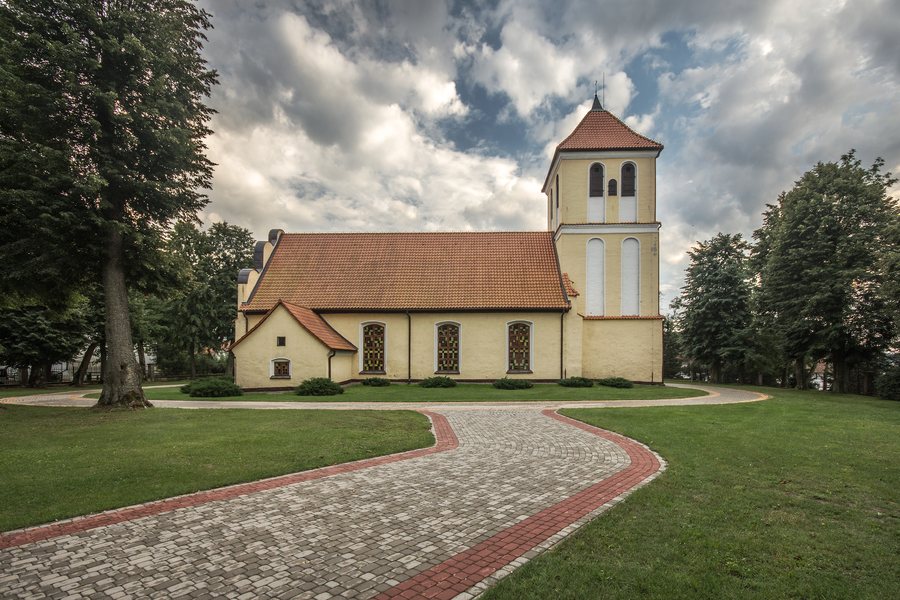 File:SM Rydzewo Kościół św Andrzeja Boboli 2016 (3) ID 645555.jpg
Photo: Sławomir Milejski via Wikimedia Commons, CC BY 3.0
Rydzewo at a glance
- Location: on Lake Boczne and the Szlak Wielkich Jezior Mazurskich.
- Church: St. Andrew Bobola, originally Protestant; put into use in 1591.
- Village character: a large half-timbered building that was once an inn and is now the village community center.
- Cycling routes: “Wokół jeziora Niegocin” runs for 39.2 km to Rydzewo; the 32 km blue-marked “Niegocińska” runs through the village.
How should you understand its waterside setting?
The two names complement each other, but they do not refer to the same thing: Lake Boczne is the specific lake, while the Szlak Wielkich Jezior Mazurskich refers to the Masurian Great Lakes Waterway. This lets you locate Rydzewo both on the lake and in the context of the named waterway. A specific waterside location and a broader geographical connection are presented side by side. These give you two reference points when adding Rydzewo to your travel plans for the Masurian Lakes.
What do the church and half-timbered building reveal about the village’s history?
The Church of St. Andrew Bobola was put into use in 1591 and was originally Protestant. The year and its original denomination mark different aspects of its history: its opening and its former religious affiliation. For travelers interested in the history of religious architecture, the church offers a specific local point of interest.
A large half-timbered building was once an inn and now serves as the village community center. Half-timbering is a building method that uses a load-bearing timber frame with infilled spaces. The former inn therefore illustrates two distinct aspects: its construction and its change from a former inn to its current community use. The church and the half-timbered building offer different ways to explore the village’s history—through the church’s original denomination and the year it opened, on the one hand, and through a building’s past and present uses, on the other.
How do the cycling routes differ?
The 39.2 km cycling route “Wokół jeziora Niegocin” leads to Rydzewo. The village’s built-up area extends along the eastern shore of Lake Boczne. The blue-marked “Niegocińska” cycling route is 32 km long and is described as passing through Rydzewo. Check current route conditions before setting off.
The routes differ in how they relate to the village: “Wokół jeziora Niegocin” leads to Rydzewo, while “Niegocińska” passes through it. Their lengths can also be compared directly: 39.2 km versus 32 km, a difference of 7.2 km. This lets you consider route length and connection to the village as two separate planning criteria.
If you are looking for a hotel in Rydzewo, first consider whether the waterside setting, village history or cycling is the main factor for your trip. This keeps your choice of destination separate from selecting a particular property.
Discover more destinations: Jagodne Małe, Mioduńskie, Brożówka, Łękuk Mały, Gawliki Wielkie, Kozin, Konopki Wielkie, Bogacko.
FAQ
Which cycling route passes through Rydzewo?
The blue-marked “Niegocińska” is 32 km long and is described as passing through Rydzewo. “Wokół jeziora Niegocin” leads to Rydzewo.
When was the Church of St. Andrew Bobola put into use?
The church was put into use in 1591 and was originally Protestant.
What is the former inn used for today?
The large half-timbered building that was formerly an inn now serves as the village community center.
For the broader travel overview: Lötzen.

