
Szabruk: Church, Agricultural Machinery and Cycling Route
Accommodation in Szabruk
Szabruk brings together a late medieval church, a private agricultural machinery museum and the red cycling route of the Gietrzwałd municipality. The surrounding landscape is also shaped by lakes, small bodies of water and copses. You can therefore explore culture, technology and nature as distinct themes for your trip.
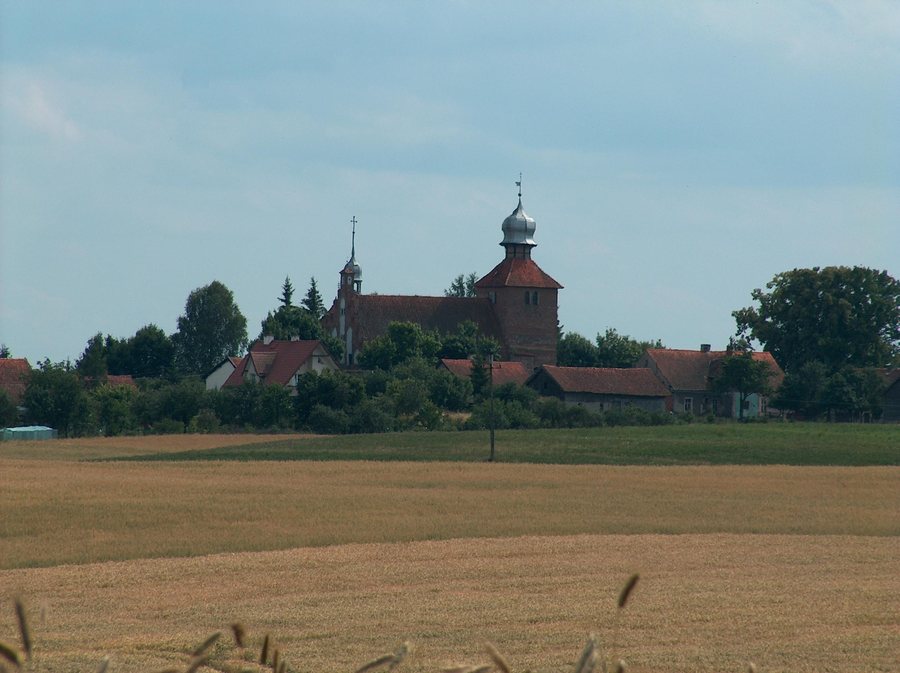
Szabruk at a glance
- The Church of St. Nicholas and St. John the Evangelist is built of fieldstone and brick.
- The private Dramiński Museum of Agricultural Machinery is dedicated to historic machines and their preservation.
- The red cycling route of the Gietrzwałd municipality passes through Szabruk and is signposted in both directions within the municipality.
What architectural history and technology shape Szabruk?
The Church of St. Nicholas and St. John the Evangelist was built towards the end of the 15th century. From 1911 to 1913, a new three-aisled church building was added to the church, based on a design by Fritz Heitmann of Königsberg. Fieldstone and brick identify the building materials; the two dates help distinguish the original construction from the later addition as separate building phases.
The Dramiński Museum of Agricultural Machinery also offers a tangible insight into regional technological history. The private museum has more than 200 historic machines. The Foundation for the Protection of the Technical Agricultural Heritage of Warmia and Masuria established a collection of agricultural machinery through the museum to preserve it from destruction for future generations. The collection includes 277 horse-powered treadmills, which were entered in the Guinness Book of Records in 2019. The focus is therefore on both the machines themselves and the preservation of the region’s technical agricultural heritage.
How can you understand the red cycling route?
The red cycling route of the Gietrzwałd municipality passes through Gronity, Naterki, Szabruk and Unieszewo. Within the municipality, it is well signposted in both directions. Sections can be ridden from Olsztyn, Stare Jabłonki or Unieszewo. When planning, it is helpful to distinguish the route itself from the named starting points for individual sections. Unieszewo appears in both contexts: as a place on the route and as a possible starting point for a section.
What is the surrounding landscape like?
Lakes Wulpińskie and Świętajno are in the vicinity of Szabruk. The nearby area is considered a hilly glacial landscape with lakes, small bodies of water and copses. These landscape features complement the themes of the church and agricultural technology. If you plan your trip around your interests, you can take these different highlights into account without combining them into a single destination.
What should you know about visiting and accommodation?
A prior telephone arrangement is required to visit the Church of St. Nicholas in Szabruk. Call before your visit and make arrangements before including the visit in your plans.
An accommodation address in Szabruk is listed as 200 m from a sandy beach with a swimming area and a playground for small children. Check the current facilities before relying on them in your plans.
The “Urodziny Sząbruka” event took place from 25 to 27 July 2025 and from 17 to 18 July 2026. If a festival is important to your stay, check the dates for your travel period.
Discover more destinations: Rentyny, Dłużki.
FAQ
What building materials were used for the church in Szabruk?
The Church of St. Nicholas and St. John the Evangelist is built of fieldstone and brick.
Where can you start sections of the red cycling route?
Olsztyn, Stare Jabłonki and Unieszewo are listed as starting points for sections.
How do you plan a visit to the church?
A prior telephone arrangement is required. Call ahead to arrange your visit.
Back to the main travel overview: Łajsy.

