
Wolin
Accommodation in Wolin
Wolin offers several starting points for a culturally and historically focused trip: archaeological topics at the Regional Museum, traces of the early Middle Ages, and historic buildings. The swing bridge over the Dziwna is also important for getting around, as road traffic is stopped when it opens to shipping.
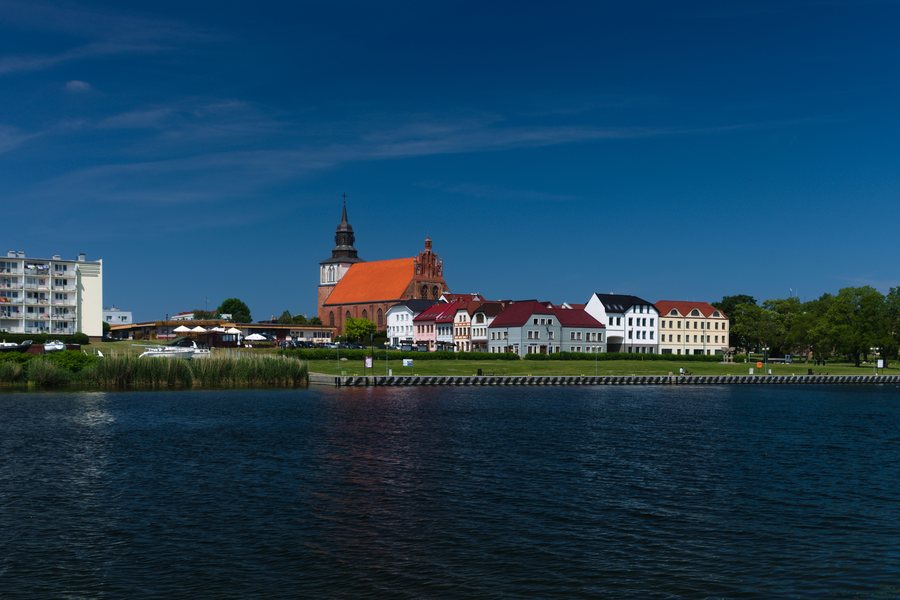
Wolin at a glance
The Muzeum Regionalne im. Andrzeja Kaubego was founded in 1966 and is one of Wolin’s oldest cultural institutions. Its permanent exhibitions cover archaeological topics from the city’s heyday in the 9th to 11th centuries, as well as the earliest settlement history of Wolin Island. On Wzgórze Wisielców, 34 of the 93 burial mounds counted at the end of the 19th century have been preserved.
What insights does Wolin’s early history offer?
The Regional Museum brings together two time periods: its exhibitions focus on both the earliest settlement of the island and Wolin’s heyday from the 9th to 11th centuries. A model depicts the city at the turn of the 19th and 20th centuries. This places archaeological topics alongside a later view of the cityscape, without suggesting that they belong to the same period.
Another stop on the town’s historical trail is the burial ground on Wzgórze Wisielców. It is one of the oldest early medieval necropolises in West Pomerania. The recorded figures make the change in its size tangible: 93 burial mounds were counted there at the end of the 19th century, and 34 remain today. In the 9th century, a large industrial and commercial district was established on Srebrne Wzgórze. It was fortified with a defensive rampart and had its own harbor. The processing of horn and amber was particularly prominent there.
Which buildings tell the story of Wolin’s history?
The town hall was built in 1881 after the old town hall on the market square was demolished. Its Neo-Gothic brick style and tower with a coat of arms and clock face give the building distinctive architectural features. The town walls date from the 14th and 15th centuries; only fragments remain in the northeast of the city near “Dworku Wolińskim.”
The Dutch windmill is also part of Wolin’s architectural history. It was built on the southwestern outskirts of the city in the second half of the 19th century and served as an industrial mill from the 1950s to the 1970s. The three-storey building is 14 meters high. Another well-known city landmark is the granary on the Dziwna at the northeastern entrance to the city, which has long appeared on the city’s postcards.
The runestone commemorating the Danish king Harald Bluetooth recalls a ruler who is credited with having ruled over Wolin and founded the fortified camp of Jomsborg. A group of Vikings was stationed in this camp. This cautious attribution is part of the monument’s story and should be retained when placing local history in context.
What should you know about the swing bridge?
Wolin’s swing bridge over the Dziwna connects Wolin Island to the mainland. It is one of five swing bridges operating in Poland. Road traffic is stopped when it opens to shipping. When planning your journey, it is therefore important to allow for this possible interruption to road traffic; this does not imply any specific opening times.
What experiences and landscapes are there to discover?
During the Jarmark Wikinga, stalls, tents, and a large stage fill the Wolińskie Błonia in Wolin for three days. The program includes performances and concerts. Visitors can also sample medieval and contemporary baked goods there. The market thus brings together a variety of cultural offerings and a culinary specialty.
For geographical context, the western part of the municipality lies within Woliński National Park, which is located on Wolin Island. If you are looking for a hotel in Wolin, you could first consider whether you want to focus your stay on city history, archaeological topics, or a visit connected with the Jarmark.
To broaden your choice of places, here is the associated page for Łubczewo Łubczewo, along with other place pages in the same higher-level directory: Miedzywodzie Miedzywodzie, Piaski Wielkie Piaski Wielkie, Lukecin Lukecin, Dziwnów Dziwnów, Sierosław Sierosław, and Swinemünde Swinemünde.
FAQ
What do the Regional Museum’s permanent exhibitions show?
They cover archaeological topics from Wolin’s heyday in the 9th to 11th centuries and the earliest settlement history of Wolin Island. A model of the city around the turn of the 19th and 20th centuries is also on display.
How many burial mounds remain on Wzgórze Wisielców?
Of the 93 burial mounds counted at the end of the 19th century, 34 have been preserved.
What happens when the swing bridge opens to ships?
Road traffic is stopped while the bridge is open to shipping.
For the main travel overview: Cammin.
More about the destination
Useful information for planning your trip:

