
Łozice: Village Layout, Churchyard and History
Accommodation in Łozice
Łozice combines a partially preserved oval village layout with tangible architectural and commemorative traces in the churchyard. To get your bearings, it is worth looking at both scales: the layout describes the shape of the village, while the cemetery gate, church and monument reveal individual historical layers.
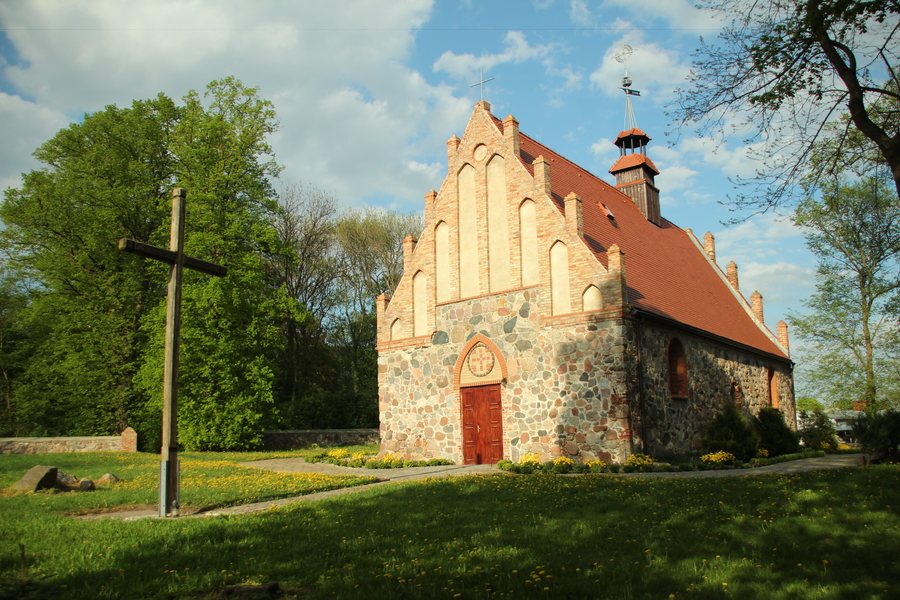
Łozice at a glance
- The oval village layout is partially preserved.
- The late Gothic brick cemetery gate is dated to no earlier than around 1550.
- The Church of the Exaltation of the Holy Cross (Podwyższenia Krzyża Świętego) was rebuilt between 2006 and 2011.
- Remains of a monument to Łozice residents who died in the First World War are located in the churchyard.
What does the oval village layout reveal about Łozice?
The partially preserved oval village layout offers a perspective on Łozice that goes beyond individual buildings. In this context, a village layout refers to the shape of the settlement plan. The oval form is therefore a description of the village’s shape, not something to be equated with a single attraction. Since the layout is only partially preserved, it is a recognisable feature of the village, not a fully preserved historical whole.
This distinction can be useful when planning a trip: those interested in the development of villages will find that the village’s shape offers a different perspective from examining a particular gate or church. The two perspectives complement one another without telling the same story.
What do the cemetery gate and church tell us?
A late Gothic brick gate stands at the churchyard. Its decorated niche features complex net tracery—a network-like ornament whose name helps explain the design detail. The gate is dated to no earlier than around 1550. “No earlier than” and “around” qualify the date: it is not an exact year of construction, but an approximate earliest dating.
The Church of the Exaltation of the Holy Cross (Podwyższenia Krzyża Świętego) marks a different period. It was rebuilt between 2006 and 2011 together with the churchyard, stone wall and cemetery gate. This building phase should not be confused with the age of the late Gothic gate: the date of around 1550 concerns its historical classification, while 2006 to 2011 refers to the rebuilding of the aforementioned group of structures. This makes it possible to distinguish the older architectural form from the later construction work.
What commemorative and landscape features shape the village?
The memory of local residents is also part of the village’s history. The churchyard contains remains of a destroyed monument to people from Łozice who died during the First World War. This draws attention both to the remains and to the people commemorated by the monument. This commemorative aspect is distinct from the gate’s construction history and the church’s rebuilding. If you are planning a visit to the churchyard, check access in advance.
The Kozielice municipality lists Łozice as the site of a cemetery park. The municipality’s parks are also home to valuable pedunculate oaks, Norway maples, European beeches, small-leaved lime trees, yews and common ashes. These tree species relate to the municipality-wide park perspective and add a landscape dimension to the architectural and commemorative history.
Discover more destinations: Karsko, Pyrzyce, Warnice, Brzesko Szczecinskie and Lipiany.
FAQ
Is the oval village layout fully preserved?
No. The oval village layout in Łozice is partially preserved.
How is the cemetery gate dated?
The late Gothic brick gate is dated to no earlier than around 1550. Its decorated niche features complex net tracery.
What was rebuilt between 2006 and 2011?
The Church of the Exaltation of the Holy Cross (Podwyższenia Krzyża Świętego) was rebuilt together with the churchyard, stone wall and cemetery gate.
Whom does the monument in the churchyard commemorate?
It commemorates Łozice residents who died during the First World War. Remains of the destroyed monument are located in the churchyard.
For the broader travel overview: Pyrzyce.

