
Discover Świdwin: Gothic architecture and landscapes
Accommodation in Świdwin
Świdwin combines the town’s Gothic history with lakes and nature in the Gmina Świdwin.
Świdwin at a glance
- The Church of St. Mary remains one of the town’s most important Gothic monuments.
- Forests cover 28 percent of the Gmina Świdwin; lakes and ponds account for 1.7 percent.
- The “Jezioro czapli” nature trail by Lake Oparzno is about 1.5 kilometres long and has seven information boards.
- The municipality lies in the Rega Valley, in the central part of the West Pomeranian Voivodeship and on the Łobez Upland, near the Drawsko Lake District.
How do the town and its landscape differ?
The landscape information refers to the Gmina Świdwin. Forests line the Rega and Mołstowa valleys and are also found in scattered stands on the moraine upland. Around Lakes Oparzno and Bystrzyno Wielkie and the Rusinowo and Klępczewo peat bogs, there are wet, marshy hollows with wet woodland and alder carr habitats.
Lakes and ponds in the municipality are considered attractive to anglers. These include Lakes Lekowo Duże and Lekowo Małe near Lekowo, described as rich in fish and surrounded by parkland and woodland. Lake Oparzno near Oparzno is the largest lake in the Gmina. These waters and landscapes give the area a different focus from the architectural history of the town of Świdwin.
Which buildings and cultural themes shape Świdwin?
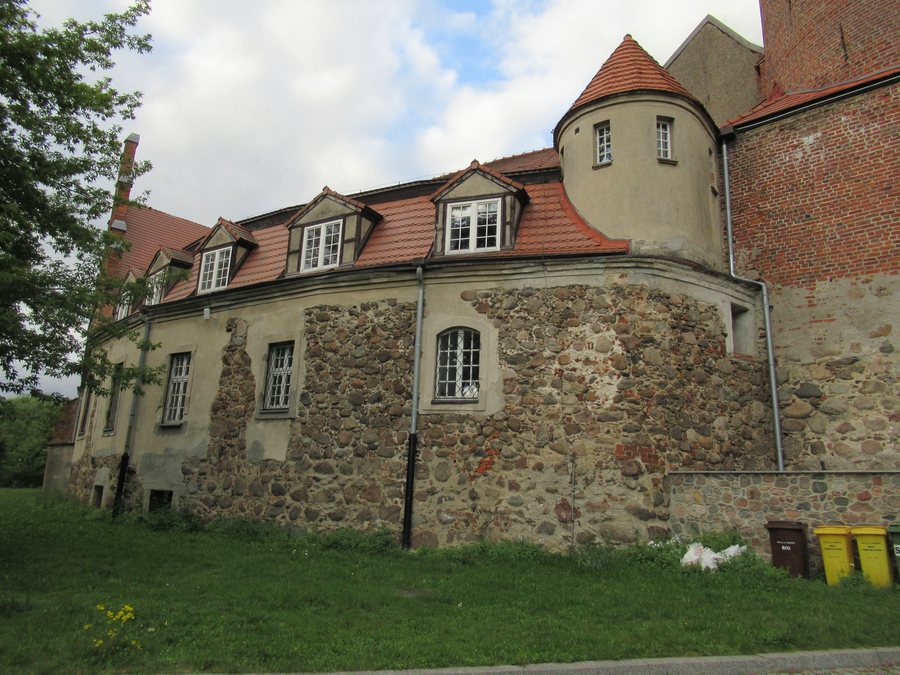
The Church of St. Mary in Świdwin is one of the town’s most important Gothic monuments. The Wedel family had the Stone Gate built in the mid-14th century as one of two entrances to Świdwin. A 14-metre section of the medieval town walls survives by the Rega. It is made of fieldstone and medieval brickwork in the so-called Wendish bond. The origins of Świdwin Castle date back to the late 13th century.
The municipality also has historic buildings with a range of architectural features. In Lekowo, St Peter and Paul’s timber-framed church dates from 1751. Its furnishings include a triptych of Saint Anne with the Virgin and Child dated 1500, a Baroque chandelier from the 18th century, a Renaissance baptismal font and patronal pews from the mid-17th century. Nearby Oparzno has a brick church dating from 1729 and a churchyard established in the early 18th century. It is also home to a naturalistic-eclectic park dating from 1870.
What trails and nature attractions are there?
The “Jezioro czapli” nature trail runs along the shore of Lake Oparzno. It is about 1.5 kilometres long, and seven information boards share facts about nature. One board covers nesting grey herons and bitterns. Another hiking trail follows key sites of the fighting between the 1st Polish Army and German units from 4 to 7 March 1945. It passes through the town of Świdwin and the municipalities of Świdwin, Ostrowice and Brzeżno.
A black-marked route dedicated to technical and architectural heritage runs through the municipalities of Świdwin and Brzeżno. Its length within Powiat świdwiński is 12.7 kilometres. At county level, canoe routes follow the Rega, Dębica and Mołstowa rivers. A 147-kilometre lowland kayaking route also starts in Cieszeniewo. The route lengths span different scales: from the approximately 1.5-kilometre nature trail, through the technical heritage route, to the long kayaking route.
Which other destinations would you like to discover?
Discover more destinations: Slawa, Brzeźno, Redło, Lipie, Czarnkowie, Jastrzębniki, Świdwin, Kocury, Bad Polzin, Brusno and Slawoborze.
FAQ
How long is the “Jezioro czapli” nature trail?
It is about 1.5 kilometres long and has seven information boards. One of them covers nesting grey herons and bitterns.
What is known about the Church of St. Mary in Świdwin?
It remains one of the town’s most important Gothic monuments.
Does the “Bitwa o krowę” take place in Świdwin every year?
The annual event alternates between Świdwin and Białogard. If you are planning a trip around it, check which town is scheduled for your dates.
Go to the main travel overview: West Pomerania.

