
Kyiv: Cultural traces in Chokolivka
Accommodation in Kyiv
The verified information about places in Kyiv relates primarily to Chokolivka, not all districts of the Ukrainian capital. There, postwar residential architecture, a mosaic by Oleksandr Dubovyk, and the history of the Deaf community come together. This page contextualizes these specific traces. It is not a current travel or safety guide and does not confirm that any venues are open or accommodation is available; practical decisions require up-to-date official information.
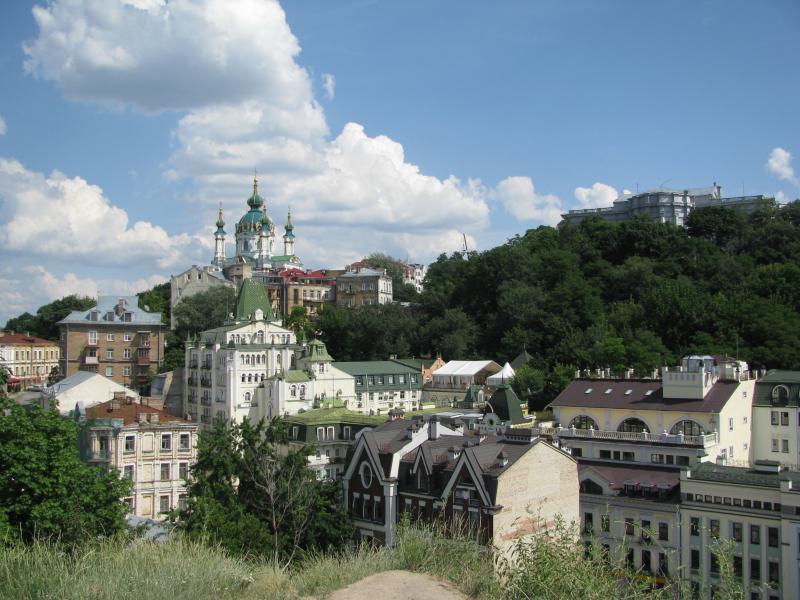
Kyiv at a glance: Chokolivka
- The cultural platform “Острів” has been active in Chokolivka since 2013.
- Among other things, it focuses on remembering the Sixtiers movement in the district.
- The “Першотравневий” residential complex was an early example of glazed ceramics on Khrushchev-era apartment buildings.
- The mosaic “Світ техніки” by Oleksandr Dubovyk is located at 15-a General Vorobyov Street, as it is known today.
- In 1955, a cultural palace of the Ukrainian Society of the Deaf was established on what was then Kurska Street.
Residential architecture and public art
The “Першотравневий” residential complex is described as the first residential complex with Khrushchev-era apartment buildings decorated with glazed ceramics. This is a specific statement about a building and design practice, not a claim that all residential buildings in Kyiv look this way. Oleksandr Dubovyk’s mosaic “Світ техніки,” or “World of Technology,” is also located at 15-a General Vorobyov Street, as it is known today. It was originally created for the “Станція юних техніків.” The original commission and its current location help put the work in historical context. However, these facts do not establish unrestricted access to every building or a tour of the residential complex.
The Deaf community and the cultural palace
In 1955, a cultural palace of the Ukrainian Society of the Deaf was established on what was then Kurska Street, now General Vorobyov Street. In the 1960s, the first museum of the history of deaf people in the Soviet Union opened in a building there. The street’s renaming is important for finding the location: historical sources and current addresses use different names. The museum’s founding is part of the institution’s history; it does not establish that the museum is currently operating or has specific opening hours. The distinct cultural and commemorative history of the Deaf community is central to the site’s significance, not just the building as a sight to see.
The “Острів” platform and remembrance of the Sixtiers
Since 2013, the “Острів” platform has worked in Chokolivka as a local space for informal culture and creative practice. A longstanding focus is remembrance of the Sixtiers movement, fostered through events for the community and spatial forms of commemoration. This description points to an active cultural role but does not provide a current event calendar. Anyone with a professional interest in this work should check the platform’s latest announcements; its founding year does not mean that it is a visitor center open every day.
Geographical and practical limitations
These sources present a coherent picture of Chokolivka, but not a representative guide to all of Kyiv. The historic grove “Шулявський гай,” mentioned in the wider surrounding region, is also not a documented point of interest directly at the Chokolivka addresses. If you are interested in a specific location, use only verified addresses and check current access arrangements. The page for the parent catalog region provides geographical context, not confirmation of travel conditions or accommodation.
FAQ
Are the places mentioned spread across all of Kyiv?
No. The verified facts about specific places focus on Chokolivka.
Where is Dubovyk’s mosaic located?
“Світ техніки” is documented at 15-a General Vorobyov Street, as it is known today.
Is the historic museum open today?
That has not been established. The sources document its opening in the 1960s, not current visiting hours.
