
Municipality of Marija Bistrica
Accommodation in Municipality of Marija Bistrica
The Municipality of Marija Bistrica combines a significant pilgrimage tradition with church art, crafts, and routes through a hilly landscape.
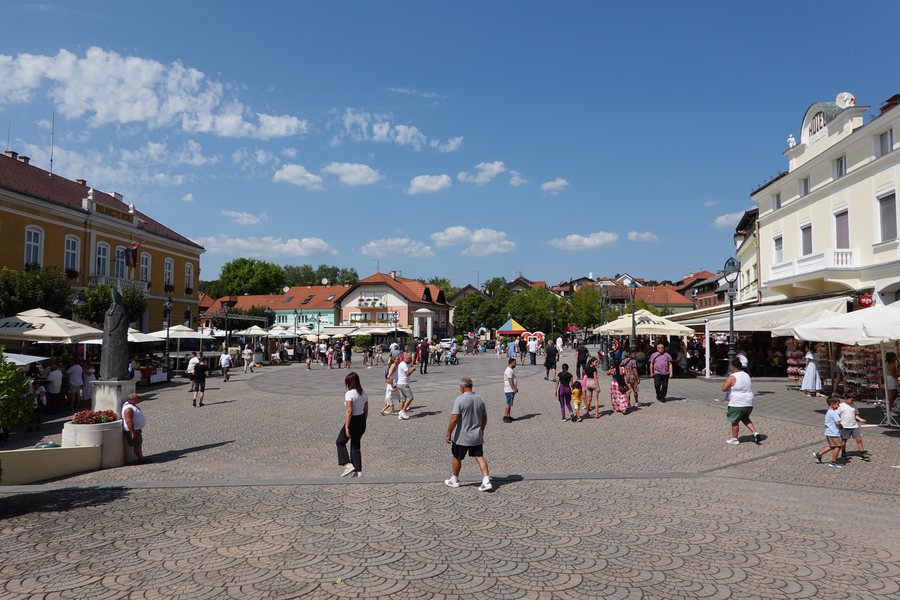 File:Feast of the Assumption of Mary 2025 in Marija Bistrica 15.jpg
Photo: Janezdrilc via Wikimedia Commons, CC0
File:Feast of the Assumption of Mary 2025 in Marija Bistrica 15.jpg
Photo: Janezdrilc via Wikimedia Commons, CC0
Key facts about the Municipality of Marija Bistrica
The municipality’s settlements and hamlets lie at various elevations on the northeastern slopes of Medvednica. Marija Bistrica is the destination of Marian pilgrimage routes from Slovenia and Croatia. The main attractions for visitors include the shrine, Bistrička Kalvarija, cycling routes, traditional crafts, and seasonal events. Part of the southern foothills below Sv. Matej, within Medvednica Nature Park, also belongs to the municipality.
What defines its pilgrimage tradition and church art?
The history of the pilgrimages is closely tied to the statue of Majka Božja Bistrička: it was found for the second time on 15 July 1684, after which pilgrimages to Marija Bistrica began without interruption. The shrine is open to the faithful from early spring until late autumn. The pilgrimage church was expanded and redesigned according to plans by Friedrich von Schmidt and Hermann Bollé, creating a church in the Neo-Renaissance style.
Opposite the basilica is Bistrička Kalvarija, with fifteen Stations of the Cross. They were installed in two phases, between 1943 and 1990. The sculpture complex is a collaborative work by Ante Orlić, Marija Ujević, Stanko Jančić, Krunoslav Bošnjak, Ante Starčević, and Josip Poljan. If you are interested in religious art, Kalvarija offers a distinct artistic focus alongside the pilgrimage church. The Chapel of St. Mary Magdalene in Hum Bistrički is also historically noteworthy: it dates from the 16th century, was restored in 1876, and contains a wooden Baroque retable with a painting of St. Mary Magdalene and statues of St. Joseph and St. John the Baptist.
Which routes connect churches, nature, and culture?
The Four Chapels route starts in Marija Bistrica at the shrine of Majka Božja Bistrička and is described as an easy circular ride for recreational cyclists and families. It connects the chapels of St. Ladislaus, St. Mary Magdalene, and St. Roch with the chapel on Vinski Vrh; there are rest stops for cyclists along the route. If you are interested in a pilgrimage route extending beyond the municipality, the Camino Hrvatsko Zagorje offers a 56-kilometre route from Lepoglava to Marija Bistrica. It passes through Hrvatsko Zagorje and links nature and cultural attractions such as natural areas, thermal springs, museums, castles, and wine roads.
The Marijanski hodočasnički put connects Marian shrines in Slovenia and Croatia and leads to Marija Bistrica as a pilgrimage route. The Zagrebački romarski put runs from Ksaver via Medvednica to Marija Bistrica and returns via Marija Snježna to Markuševac; along the way, it follows former pilgrimage routes of Blessed Alojzije Stepinac. A hiking route in the municipality includes, among other places, Bistrička Kalvarija, the Ladislaus Chapel, a rest stop, Vinarija Micak, a hunting reserve, and the Park skulptura.
Where can you discover licitar crafts and sculptures?
The Marija Bistrica Visitor Centre is dedicated to traditional skills related to wooden children’s toys and licitar. These craft traditions have been included on UNESCO’s Representative List of the Intangible Cultural Heritage of Humanity. The Ethno Collection of Licitar Crafts presents the history of production, the tools and specialist terminology used, and traditional production techniques. Licitar crafts in the town centre also include an interactive demonstration, a workshop on making licitars, and a tasting of Gvirc, a special honey drink.
The Park drvenih skulptura Marija Bistrica is located on the Vinski Vrh tourist road, 500 metres from the main square in Marija Bistrica. It features more than 100 sculptures, most of them with religious themes. Another place to experience sound is Zvonosvir, near the open-air church of Blessed Alojzije Stepinac: its metal structure consists of 23 large and small bells, which can be heard every day. Another cultural heritage site is Dvorac Hellenbach in Marija Bistrica, a protected immovable individual cultural asset; the park by the castle is a protected monument of park architecture. Vinarija Micak in Hum Bistrički welcomes visitors and offers wine.
When do events take place, and how do you get there?
Advent u Mariji Bistrici has been held every December since 2010. The programme includes cultural and artistic events, a Christmas market, and numerous workshops for children and adults. Ljeto u Mariji Bistrici features cultural, spiritual, sporting, and entertainment events from June to August.
From Zagreb, the stated driving route follows the A2 towards Zabok-Oroslavje, then road 24 through Bedekovčina and Zlatar Bistrica to Marija Bistrica. There are frequent bus and train connections between Marija Bistrica and Zagreb. The train connection goes via Zlatar Bistrica, with onward travel by bus or taxi.
Within the municipality, you can also visit the local pages for Zlatar Bistrica, Podgrađe, and Marija Bistrica. To compare other municipalities in the same higher-level area: Municipality of Bedekovčina, Municipality of Stubičke Toplice, Municipality of Veliko Trgovišće, Municipality of Hrašćina, and Municipality of Sveti Križ Začretje.
FAQ
When is the shrine open?
It is open to the faithful from early spring until late autumn.
What does the Four Chapels route offer?
The easy circular ride connects four chapels, starts at the shrine in Marija Bistrica, and has rest stops for cyclists along the route.
How do you get from Zagreb to Marija Bistrica?
The stated driving route follows the A2 and road 24. Bus and train connections are also available; the train connection goes via Zlatar Bistrica, followed by a bus or taxi ride.
When do Advent u Mariji Bistrici and Ljeto u Mariji Bistrici take place?
Advent u Mariji Bistrici takes place every December. Ljeto u Mariji Bistrici features events from June to August.
For the broader travel overview: Krapinsko-Zagorska.

