
Discover the Municipality of Nerežišća
Accommodation in Municipality of Nerežišća
The Municipality of Nerežišća brings together protected landscapes on Brač, historic sites, traditional water systems and trails for hikers and cyclists. When planning your trip, it is especially worthwhile to choose from a range of different experiences: explore the landscape of Vidova Gora, discover cultural sites in Nerežišća and Dračevica, or consider routes on Brač.
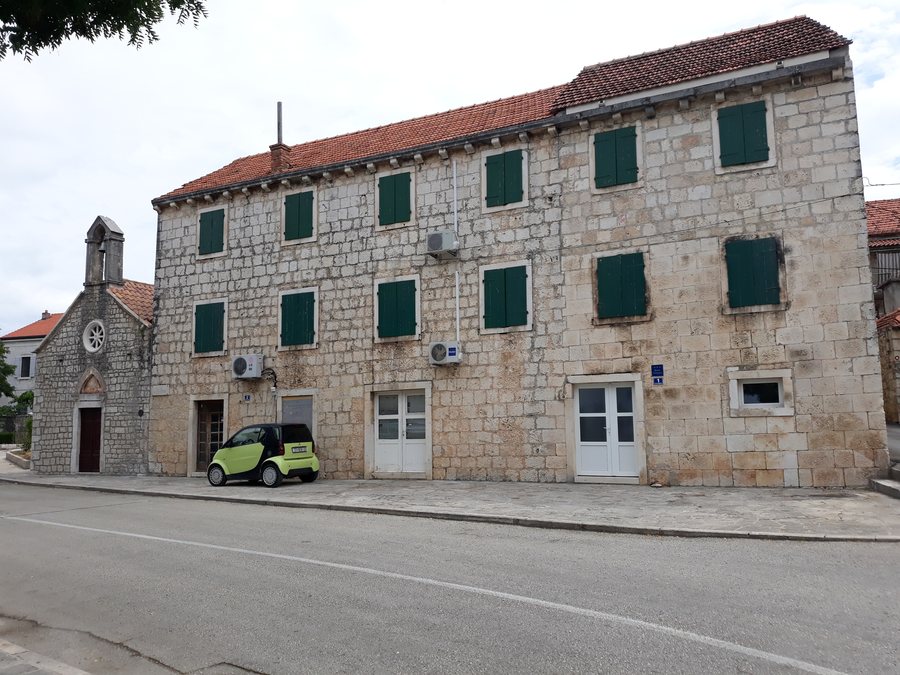
Key facts about the Municipality of Nerežišća
- Nerežišća lies at the crossroads of Brač’s main roads and on the slopes of the island’s largest plain.
- Vidova Gora is a protected landscape; most of the mountain lies within the municipality of Nerežišća.
- Blaca Valley is protected as a significant landscape.
- The “Vidova gora” educational trail is intended for pedestrians and cyclists. A cycling route called “Biking Vidova Gora–Dol” runs for 22 kilometres through Nerežišća.
- The cultural heritage includes the Blaca Hermitage, churches, traditional water supply systems and historic sites on Brač.
What defines the landscape and nature?
Vidova Gora provides a scenic setting for hiking and mountain walks. Since most of the mountain lies within the municipality, it is one of the region’s distinctive natural features. The “Vidova gora” educational trail starts at the second kilometre of the Nerežišća–Bol road and is specifically intended for pedestrians and cyclists. It is distinct from the 22-kilometre “Biking Vidova Gora–Dol” cycling route, which passes through Nerežišća.
Blaca Valley is also protected as a significant landscape. Several routes for climbing or abseiling are designated at the Blaca Hermitage. You can reach the hermitage via a wide road from Blaca Bay or via a hiking trail from the island’s interior. This trail passes through Nerežišća, by Žurmo Pond and through the hamlet of Dragovode.
Which cultural sites and stories can you discover?
In Nerežišća, the tradition of the ball game balun o ruke has been preserved as one of the few surviving traditions of its kind. Symmetrically arranged, richly decorated stone manor houses stand by the Church of Our Lady of Mount Carmel. The Chapel of St Peter contains a relief by the Brač sculptor Lazaneo. Nerežišća also has significant examples of traditional water supply, based on the collection of rainwater.
In Dračevica, the old town centre is laid out in Mediterranean style around a central square. The settlement is also known for its many Bucala fountains. Dračevica once had the largest windmill on Brač; it ground grain for the entire island. The references to the fountains, town centre and windmill tell different aspects of local history. Dračevica is therefore a distinct point of interest if you are interested in townscapes and the traditional structures of Brač.
The parish church of St Fabian and St Sebastian in Donji Humac preserves a 13th-century fresco, considered one of the oldest frescoes in southern Croatia. It continues to attract many pilgrims. The Kopačina Cave, a prehistoric archaeological site, is also near Donji Humac. It contains the oldest known traces of prehistoric people on Brač, as well as animal bones and stone artefacts. The cave is 500 metres west of the Gnjilac quarry, northwest of Donji Humac. From a plateau on its southern side, the view extends across the valley of Donji Humac to Bobovišća and over part of Brač’s west coast.
The Blaca Hermitage has preserved its furnishings, which are now displayed in a museum collection. Another historic feature on Brač is Dragon’s Cave above Murvica: in the 15th century, it served as a dwelling and temple for Glagolitic priests. They decorated the cave with unusual sculptures whose meaning has not yet been determined.
Which routes and regional specialities can you plan for?
For a cycling trip, the 22-kilometre “Biking Vidova Gora–Dol” route offers a specific reference point for planning your journey. If you prefer to travel on foot, the “Vidova gora” educational trail is another named option; it is also intended for cyclists. When visiting the Blaca Hermitage, choosing between the approach from the bay and the hiking trail from the island’s interior is a planning consideration in its own right. The routes described should not be confused with information about duration or difficulty.
Regional dishes include Brač specialities served at the “Vladimir Nazor” mountain lodge: spit-roasted lamb, Vitalac, Dalmatian pršut, Brač wine and cheese. A tourist offering in Nerežišća also mentions meat cooked under the peka in a family restaurant and Vitalac in a local tavern. The “Frane Senjković” Memorial is held in Nerežišća as part of a festival in honour of Saint Margaret.
If you would like to compare other destinations, you can also find information about the Municipality of Imotski, the Municipality of Kaštela, the Municipality of Sinj, the Municipality of Runovići, the Municipality of Trilj, the Municipality of Vrgorac and the Municipality of Zmijavci.
FAQ
Where does the “Vidova gora” educational trail start?
It starts at the second kilometre of the Nerežišća–Bol road and is intended for pedestrians and cyclists.
How long is the “Biking Vidova Gora–Dol” cycling route?
The route is 22 kilometres long and passes through Nerežišća.
How do you get to the Blaca Hermitage?
It can be reached via a wide road from Blaca Bay or via a hiking trail from the island’s interior. The hiking trail passes through Nerežišća, by Žurmo Pond and through the hamlet of Dragovode.
What prehistoric finds are associated with Kopačina Cave?
The site contains animal bones and stone artefacts, as well as the oldest known traces of prehistoric people on Brač.
For the broader travel overview: Split-Dalmatia.

