
Municipality of Zmijavci
Accommodation in Municipality of Zmijavci
The Municipality of Zmijavci combines a karst landscape and the Vrljika River with archaeological sites and traditional architecture. If you are looking for accommodation, these different features can help you assess whether the municipality suits your travel interests.
Key facts about the Municipality of Zmijavci
The municipal area is characterised by karst terrain, and the Vrljika flows through Zmijavci. Archaeological sites include the prehistoric hillfort of Liskovac, the multi-layered Radež site and the Brižine-Balinjača site. Architectural highlights include the Mrkonjić House, Bublin Bridge and the parish church of All Saints.
What characterises the landscape of Zmijavci?
The municipality’s karst terrain includes numerous limestone ridges, sinkholes, lakes, flat areas and shafts. The landscape is therefore not defined by a single landform: ridges and sinkholes sit alongside flat areas and other karst features. The Vrljika flows through Zmijavci and is a habitat for the endemic softmouth trout. The landscape and the river thus represent two distinct aspects of local nature.
Those especially interested in nature will find a concrete thematic focus in these details: the karst terrain on the one hand, and the Vrljika and its endemic fish on the other. No specific route can be inferred from this; these are distinct features of the municipal area.
What archaeological traces can be found?
The Liskovac site lies on the hill of the same name in the municipality and is considered one of the best-preserved prehistoric hillforts in Dalmatia. It measures approximately 80 × 80 metres. A rampart surrounds the entire plateau in a ring. There is also a later ancient or late antique wall made of lime mortar, along with visible remains of prehistoric houses. Its approximate area, the course of the rampart and the different building remains make Liskovac a multi-layered archaeological site.
Radež also has several historical layers. The site lies northwest of the hamlet of Kraljevići, south of Kamenmost on the Vrljika. Its first phase of development was a prehistoric hillfort in a strategic position for controlling the surrounding routes and the bridge over the Vrljika. Use of the hillfort continued in the late Middle Ages and/or the early modern period; a small necropolis was established there at that time. Two stećci at Brižine-Balinjača are particularly notable: one bears a Greek cross, while another depicts a couple holding hands.
Which buildings and traditions are characteristic?
The Mrkonjić House is in the hamlet of Mrkonjići in Zmijavci and was built in the style of traditional architecture from the 18th and 19th centuries. Its distinctive features include elements of beekeeping: a bee entrance is set into the outer wall, and wooden flaps inside were used to remove honey. The Mrkonjić family kept bees in this way until the 1980s.
Donji Karoglani is another example of a traditional rural settlement. The hamlet is on a hill south of the road through Zmijavci and consists of several family homesteads with single-storey and two-storey houses. The layout and architectural elements of individual houses are well preserved, although some buildings have collapsed or been damaged. The settlement is therefore considered a very good example of preserved traditional heritage.
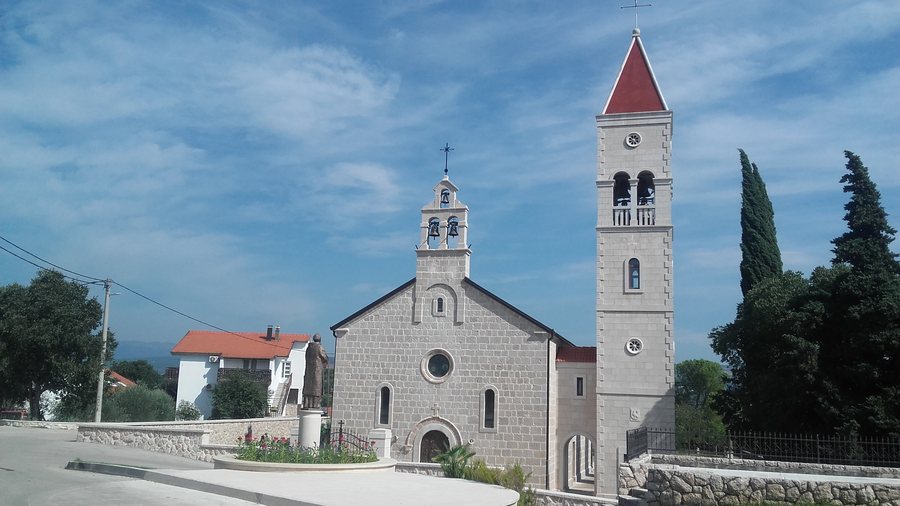
Bublin Bridge over the Vrljika is a stone-built bridge with seven arches. It was built at the end of the 19th century and is listed as a cultural asset. Crkvina is home to an early Christian basilica with three naves, two east-facing apses, one of which is emphasised, and a tripartite narthex to the west. The parish church of All Saints was built in 1895 on the site of an older church. Inside stands a wooden high altar made in a Tyrolean workshop in 1903.
The “Dikovača” Cultural and Artistic Association works to preserve and care for local heritage, traditions and customs. Its activities include amateur music and theatre, as well as musical and theatrical events and festivals.
There is a separate page for the place that gives the municipality its name: Zmijavci. You can also visit other locality pages independently: Municipality of Runovići, Municipality of Klis, Municipality of Zagvozd, Municipality of Okrug, Municipality of Vrgorac, Municipality of Imotski and Municipality of Hrvace.
FAQ
How large is the Liskovac hillfort?
The archaeological site measures approximately 80 × 80 metres. A rampart surrounds the plateau in a ring.
What is special about the Mrkonjić House?
The house has a bee entrance in the outer wall and wooden flaps inside through which honey was removed. The Mrkonjić family kept bees there until the 1980s.
What historical layers does Radež have?
Its first phase of development was a prehistoric hillfort. It continued to be used in the late Middle Ages and/or the early modern period; a small necropolis dates from that time.
For the broader travel overview: Split-Dalmatia.

