
Sobotin: Hotels and Accommodation
Accommodation in Sobotin
In Sobotín, the 17 km-long Sobotín Circular Trail leads to 14 stations with information boards; some stations have benches. The boards provide interesting information about local history, present-day life, and the flora and fauna of the area.
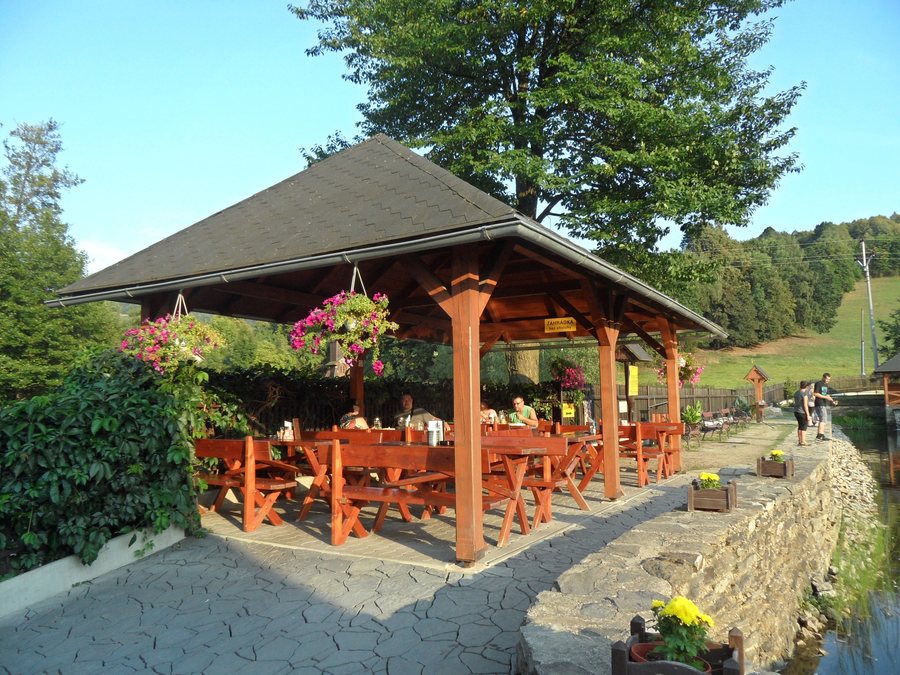 File:Rudoltice (Sobotín) 06 Rybářská bašta.jpg
Photo: Stribrohorak via Wikimedia Commons, CC BY-SA 3.0
File:Rudoltice (Sobotín) 06 Rybářská bašta.jpg
Photo: Stribrohorak via Wikimedia Commons, CC BY-SA 3.0
Trails and Landscape
Maps for the Sobotín Circular Trail are available at four points along the route: in front of Motorest Permoník, in front of Motorest Ztracenka, in Rudoltice at house number 133, and at the Klein family mausoleum. The maps are also available from the Sobotín Municipal Office.
One station on the circular trail is located approximately 100 m from the Smrčina Nature Monument. The lesser horseshoe bat spends the winter there in a local mine adit. In the forest section of the Sobotín Circular Trail, white helleborine and the protected martagon lily can be found. The hills above Sobotín offer views of the Hrubý Jeseník panorama.
Traťovka is a junction of hiking, cycling, and winter cross-country skiing routes. Access points to the Mineralogical Educational Trail include Sobotín railway station, the Vernířovice Municipal Office with the car park by the church, and the Sobotín Resort with the car park near Motorest Permoník.
Sobotín also has a rescue station for native crayfish. There, crayfish conservation is presented to the public through training sessions, excursions, and educational activities.
History and Culture
The Church of St Lawrence was built in 1605 on the site of a former Protestant prayer house. An incident in the Church of St Lawrence was connected with the witch trials, which claimed the lives of hundreds more people.
Sobotín Chateau was built on the site of an old ironworks. During its reconstruction in the 1840s, it acquired a Romantic historicist design and was surrounded by a chateau park, an ornamental pond, and several small park buildings.
The tradition of iron production in Sobotín dates back to the beginning of the 17th century and included bloomery furnaces, iron hammers, and foundries. At the height of its prosperity in 1852–1853, Sobotín became a centre of the Austrian iron industry; the operation, with a branch in Štěpánov near Olomouc, employed 2,000 workers.
Other Places
Other places: Bušín, Chromeč, Hynčice Pod Sušinou, Líšnice U Mohelnice, Jindrichov, Nemile, Mährisch-Schönberg, Starý Maletín
To the higher-level travel overview: Šumperk District.

_06_Ryb%C3%A1%C5%99sk%C3%A1_ba%C5%A1ta.jpg)