
Discover Kunszentmiklós
Accommodation in Kunszentmiklós
The town hall, main square and collections give Kunszentmiklós its cultural and historical character.
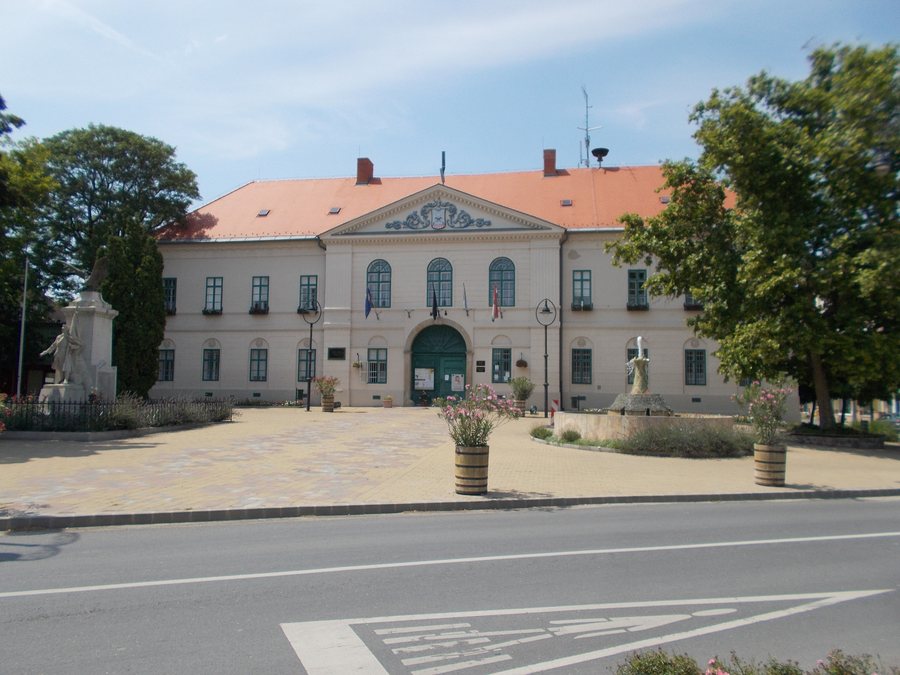 Town Hall, WWI memorial and the Ceramic fountain, 2019 Kunszentmiklós
Photo: Globetrotter19 via Wikimedia Commons, CC BY-SA 3.0
Key facts about Kunszentmiklós
- The Neoclassical town hall is a protected monument; a plaque commemorates Sándor Petőfi and his stay there in 1845.
- The main square is home to a monument erected in 1925 to the soldiers from Kunszentmiklós who fell in the First World War, a decorative fountain and a Kunbaba.
- The Virágh-kúria houses local history and ethnographic collections, as well as exhibits on the flora and fauna of the Upper Kiskunság. Visiting hours are seasonal.
- For Kunszentmiklósi birkapörkölt, the ingredients are added to the cauldron in layers; the meat is not stirred as it cooks over an open fire.
What cultural sites and collections are there?
The Virágh-kúria brings together local history and ethnography. Its collections recall the social and religious life of the local Cumans. Visitors can also learn about the flora and fauna of the Upper Kiskunság. Historical ways of life are thus presented alongside a look at the natural environment of this landscape. Opening hours are seasonal; check the current times before your visit.
The Catholic Church of Szent Miklós also offers a range of architectural features: it has a transept, a Neo-Romanesque exterior, a Neo-Gothic interior and Baroque-style altars. A transept runs across the nave, extending the church space to the sides. The different stylistic features can therefore be seen in different parts of the building, rather than reducing the church to a single period.
How do the town hall and main square tell the story of the past?
Architecture and remembrance meet at the Neoclassical town hall. The plaque recalls that Sándor Petőfi spent happy days and hours there in 1845. The monument erected in 1925 adds a different historical note to the main square: it commemorates the soldiers from Kunszentmiklós who fell in the First World War.
The square also presents two different forms of public art and remembrance. The decorative fountain was designed by ceramic artist Nemes Tímea Izabella. A Kunbaba refers to a Cuman tradition of commemoration: they erected figures of this kind from stone or granite in memory of their dead. This general tradition explains the cultural context without specifying the material of this particular figure.
Another story of construction concerns the church nave in Kunszentmiklós, which still stands today: construction began in 1786 and was completed in 1792. József Hild brought the tower to its present height in 1819–1820. These dates distinguish the construction phase of the nave from the later work on the tower.
What makes the local cuisine distinctive?
For Kunszentmiklósi birkapörkölt, the meat is cooked in a cauldron over an open fire and is not stirred. Instead, the ingredients are added in layers. The town names the surrounding saline steppe as grazing land for the animals and links it to the flavor of the meat. The dish can therefore be understood through two specific aspects: its distinctive preparation method and the connection the town makes between the grazing landscape and the flavor.
What other themes does Bács-Kiskun offer?
If you would like to explore beyond Kunszentmiklós, the wider Bács-Kiskun destination offers other distinct cultural themes. In Tiszaalpár, the Tiszaalpár, Földvár educational trail presents the history of a Bronze Age fortification and the way of life of people in the Bronze Age. Tiszaalpári Földvár is also a specially protected archaeological site. In Kiskunhalas, Csipkeház and the Csipkemúzeum focus on Halas lace: its history began in 1902, and visitors can see historic lacework and learn about the lace-making process.
Nature offers other points of interest in Bács-Kiskun, too. The Boróka educational trail in Bugac is 1,100 metres long and combines information boards with interactive features, including a forest xylophone and a play telescope. Lake Szelidi, meanwhile, is a natural oxbow lake that developed from a branch of the Danube after the Ice Age. You can compare Kunszentmiklós’s cultural sites with regional themes such as the Bronze Age, lace-making and nature interpretation, without conflating these distinct focuses.
Discover more destinations: Kiskunfélegyháza, Kiskunhalas.
FAQ
What does the plaque at the town hall commemorate?
It recalls that Sándor Petőfi spent happy days and hours there in 1845.
What collections are housed in the Virágh-kúria?
A local history collection and an ethnographic collection explore the life of the local Cumans; you can also learn about the flora and fauna of the Upper Kiskunság there. Visiting hours are seasonal.
How is Kunszentmiklósi birkapörkölt prepared?
The ingredients are added in layers to a cauldron over an open fire; the meat is not stirred.
To the wider travel overview: Bács-Kiskun.

