
Discover Szalkszentmárton
Accommodation in Szalkszentmárton
Petőfi memorial sites, a historic square and distinctive buildings give Szalkszentmárton a clear cultural identity. The town’s history and the memorial exhibition offer ways to decide whether the town matches your travel interests.
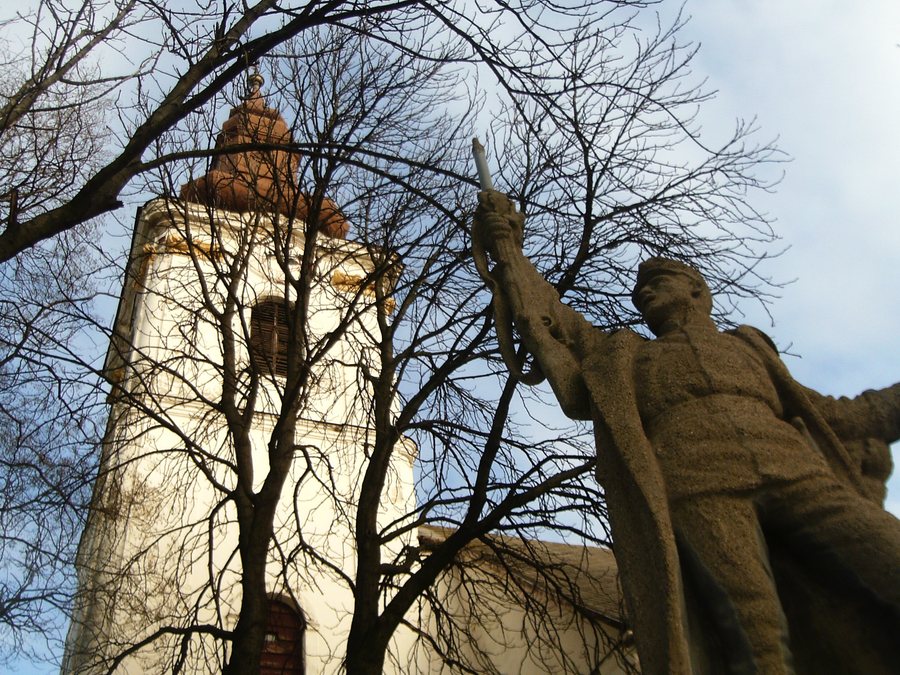 I. világháborús emlékmű és Református templom (1767), Petőfi tér, Szalkszentmárton
Photo: DF1977 via Source, CC BY-SA 3.0
I. világháborús emlékmű és Református templom (1767), Petőfi tér, Szalkszentmárton
Photo: DF1977 via Source, CC BY-SA 3.0
Quick facts about Szalkszentmárton
- The artesian well on Petőfi tér was built in 1928 and renovated in 2012 with donations from local residents.
- A square enclosed by buildings in the centre retains its centuries-old character thanks to renovations and reconstructions.
- The Sándor Petőfi Memorial Exhibition includes historical costumes, a hand mill and a cimbalom.
- In the centre stands a former coaching inn with a butcher’s shop, dating from 1810.
What do the town centre and its buildings tell us?
The square in the centre is a good starting point for exploring Szalkszentmárton’s history: buildings enclose it, and renovations and reconstructions have preserved its centuries-old character. On Petőfi tér, the artesian well recalls two different moments in its history. It was built in 1928 and renovated in 2012 with donations from local residents.
Also in the centre is the former coaching inn with a butcher’s shop. Count György Festetics, then the town’s landowner, had the building constructed in 1810 in the Classical style. Its whitewashed walls are part of its described appearance.
Another memorial stands on Szent Márton tér: a bronze statue of Saint Martin, the bishop. It is a work by sculptor György Benedek and was unveiled in 2000. Together with the well and the former inn, it conveys different aspects of the town’s history, without requiring a single attraction to tell the whole story.
What Petőfi connections can you discover?
Szalkszentmárton is also connected with the writer Sándor Petőfi. He wrote the poem “Fekete kenyér” (“Black Bread”), two plays and a novel here. Szalkszentmárton is listed as the place of composition for 112 of his poems. If you are interested in literature, this figure offers a concrete way to explore Petőfi’s connection with the town.
The Szalkszentmárton Sándor Petőfi Memorial Exhibition includes historical costumes, a hand mill and a cimbalom. An animated short film can be shown in a screening room. Museum education programmes on literature, crafts and a demonstration kitchen are offered for groups of different ages. Check the specific arrangements with the museum before visiting as a group.
What other cultural themes shape Szalkszentmárton?
The Reformed Church has a uniform Baroque design and brings together furnishings from different building periods. These include a baptismal font set into the communion table and the “Sick Woman’s Pew,” described as exceptional nationwide. The church has a uniform Baroque design, although its furnishings come from different building periods.
This gives you a choice of cultural themes to weigh up: literature and its memorial exhibition, church art, a historic town centre and monuments in the centre. You can decide which aspects matter most to you—Petőfi, architectural history or the town’s development—and assess Szalkszentmárton as a travel destination based on these interests.
What other themes does the wider destination of Bács-Kiskun offer?
The wider destination of Bács-Kiskun offers other distinct cultural and nature-related themes. The Tiszaalpár, Földvár educational trail tells the story of a Bronze Age fortified settlement and the way of life of people in the Bronze Age. In Tiszaalpár, a reconstruction of an Árpád-era village, built to mark the millennium, also depicts the settlement structure discovered in local excavations.
The Boróka educational trail in Bugac offers a different experience: it is 1,100 metres long and features information boards and activity stations, including a forest xylophone and a play telescope. The Boróka educational trail in Bugac is also part of the wider destination of Bács-Kiskun.
Discover more destinations: Szabadszallas, Apostag, Tass.
FAQ
What is known about the well on Petőfi tér?
The artesian well was originally built in 1928 and renovated in 2012 with donations from local residents.
What does the Sándor Petőfi Memorial Exhibition include?
The exhibits mentioned include historical costumes, a hand mill and a cimbalom. An animated short film can be shown in a screening room.
What distinctive furnishings are in the Reformed Church?
The church brings together furnishings from different building periods, including a baptismal font set into the communion table and the “Sick Woman’s Pew.”
To the wider travel overview: Kunszentmiklósi.

,_Pet%C5%91fi_t%C3%A9r,_Szalkszentm%C3%A1rton_47f.jpg)