
Kisecset: Village Character and Church Architecture
Accommodation in Kisecset
Kisecset combines a village-style townscape with a single-nave, towerless Baroque church, a Neoclassical bell tower, and the route of the Kék túra.
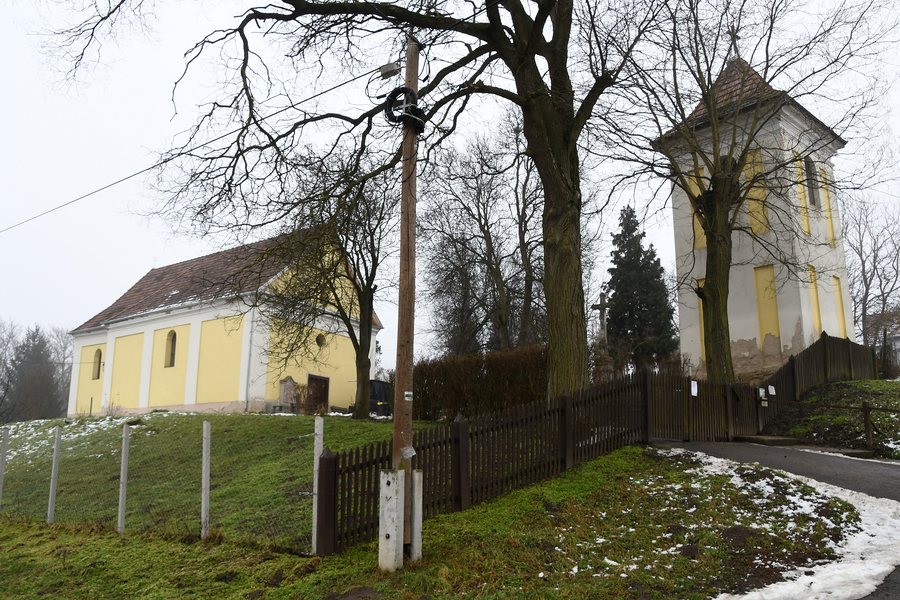 File:Kisecset, római katolikus templom és harangtorony 2021 01.jpg
Photo: Pasztilla aka Attila Terbócs via Wikimedia Commons, CC BY-SA 4.0
Kisecset at a glance
- The central built-up area has a traditional village character; there is no center in the classical sense.
- The Roman Catholic Baroque church has a single nave, no tower, and is oriented from southeast to northwest.
- A Neoclassical bell tower stands on the church’s axis; between them is a stone cross bearing the year 1795.
- The Kék túra passes through Kisecset.
What defines the church architecture in Kisecset?
The Baroque church and the bell tower are two separate buildings. The church has a single nave and no tower. It is oriented from southeast to northwest. On its axis stands the Neoclassical bell tower, which has a square ground plan. The single-storey structure has four semicircular openings at the top and a multiply articulated eaves cornice.
A late Baroque stone cross stands between the church and the bell tower. Its base is shaped like a rock, and the year 1795 is inscribed on it. The townscape can therefore be viewed through its different details: the church’s form and orientation, the bell tower’s design, and the cross with its distinctive base.
How is the village laid out?
Kisecset has no center in the classical sense. The central built-up area has a traditional village character. Residential areas lie along Kossuth utca and Petőfi utca on both sides of the stream valley; in places, they branch off into side streets.
The municipal office and the community center opposite it, as well as the Catholic church and the cemetery, serve as local institutional areas and important meeting places for residents. This description helps put the village’s layout in context without assuming there is a single central square.
What role does the Kék túra play?
The Kék túra passes through Kisecset and offers a different point of reference for planning a trip than the buildings and village layout.
How should you focus your accommodation search?
Consider which destination is most relevant to your travel plans before comparing hotels. This helps keep your accommodation choice aligned with your actual focus, rather than treating local features and regional attractions as if they were the same.
What cultural and nature-related themes does the wider destination of Neuburg offer?
The old village of Hollókő is part of the wider destination of Neuburg, not Kisecset. This Palóc settlement in Nógrád County in northern Hungary is a deliberately preserved, living example of rural life before the 20th-century agricultural revolution. For literature and history, several museums in the wider destination of Neuburg, not Kisecset, offer different perspectives: the Madách Imre Memorial House in Csesztve has a permanent exhibition on the history of the Madách family, with a focus on “Az ember tragédiája.” The Mikszáth Kálmán Memorial Museum in Horpács is also part of the wider destination of Neuburg, not Kisecset; its permanent literary history exhibition is titled “MIKSZÁTH.”
The Pásztói Museum is part of the wider destination of Neuburg, not Kisecset. It uses a Baroque Cistercian monastery building, rebuilt in 1717–1718, for permanent and temporary exhibitions. The Pásztói Museum in the wider destination of Neuburg, not Kisecset, also presents a medieval glassworks and smithy as an open-air exhibition, considered a unique industrial heritage monument in Hungary.
The Boszorkány-kő educational trail is part of the wider destination of Neuburg, not Kisecset, and lies within the Karancs-Medves Landscape Protection Area. Established in 1989, the area currently covers 6,928.6 hectares. The trail illustrates basalt volcanism from 2.4 to 5.2 million years ago. Features include rocks from a small fissure volcano, sediment inclusions torn from the depths, curved lava plates, and basalt columns formed by weathering.
The Ipolytarnóc Fossils Nature Reserve is part of the wider destination of Neuburg, not Kisecset, and has been protected since 1944. This world-famous fossil site preserves evidence of a prehistoric world destroyed by a volcanic catastrophe 17 million years ago, including shark teeth, petrified trees, leaf impressions, and fossilized animal tracks. The reserve is also a gateway to the cross-border UNESCO Global Geopark Novohrad-Nógrád. In the wider destination of Neuburg, not Kisecset, Boszorkány-kő and the Ipolytarnóc Fossils Nature Reserve offer two different ways to explore geology: volcanic rock formations in one place, fossils and traces of a past world in the other.
The Geocsodák House in Salgótarján is part of the wider destination of Neuburg, not Kisecset. It offers interactive exhibitions and lectures on geology. There are also more than 30 waymarked hiking trails with information boards that can be explored independently or with a hiking guide. Another historical attraction in the wider destination of Neuburg, not Kisecset, is the underground mining museum in Salgótarján. It was established in the preserved tunnels of the József Incline Shaft, built in 1937, and opened to the public in 1965 as Europe’s second museum in an original mine.
Mátraverebély-Szentkút and the Szécsényi Franciscan Church and Monastery are also part of the wider destination of Neuburg, not Kisecset. Mátraverebély-Szentkút was solemnly declared a national shrine by Cardinal Primate Erdő Péter in 2006 during the pilgrimage for the Feast of the Assumption. Szentkút can be reached from Route 21 via Mátraverebély, followed by a five-kilometer access road into the Szentkút Valley. The Szécsényi Franciscan Church and Monastery can be visited with a guide; according to tradition, the Rákóczi Hall is associated with Francis II Rákóczi having slept there during the Diet of 1705.
Discover more destinations: Bánk, Diósjenő, Legend, Berkenye, Romhány, Ősagárd, Nagyoroszi, Kétbodony.
FAQ
What is the Baroque church in Kisecset like?
It has a single nave, no tower, and is oriented from southeast to northwest. A Neoclassical bell tower stands on its axis.
Does Kisecset have a traditional town center?
No. The municipal office and the community center opposite it, as well as the Catholic church and the cemetery, serve as local institutional areas and important meeting places for residents.
Does the Kék túra pass through Kisecset?
Yes, the Kék túra passes through Kisecset.
What themes define the wider destination of Neuburg?
The destinations mentioned belong to the wider destination of Neuburg, not Kisecset.
To the wider travel overview: Rétsági.

