
Discover Tihany: Lavender, Landscapes and History
Accommodation in Tihany
Tihany combines the landscape of Lake Balaton with lavender culture, distinctive walking trails and sites from the peninsula’s history. When planning your trip, you can choose from nature experiences, themed trails and a visit to the Benedictine Abbey.
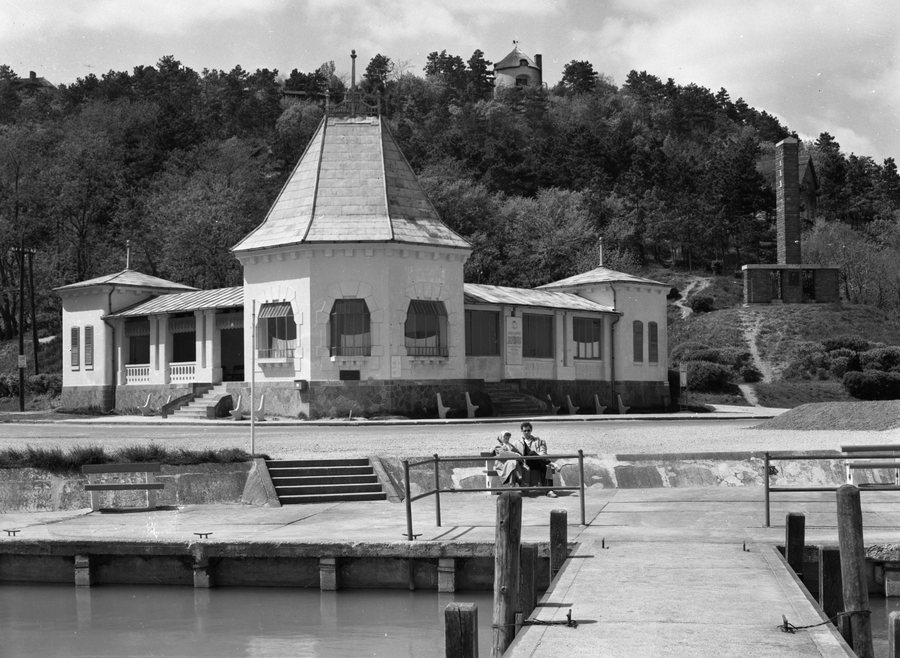 File:Tihany 1960, kikötő. Jobboldalt a Darányi emlékmű. Fortepan 2487.jpg
Photo: FOTO:Fortepan — ID 287 : Adományozó/Donor: UVATERV. via Source, CC BY-SA 3.0
File:Tihany 1960, kikötő. Jobboldalt a Darányi emlékmű. Fortepan 2487.jpg
Photo: FOTO:Fortepan — ID 287 : Adományozó/Donor: UVATERV. via Source, CC BY-SA 3.0
Tihany at a glance
- Lake Balaton and the Külső-tó and Belső-tó lakes shape the landscape.
- The Tihany Landscape Protection Area covers 1,658 hectares.
- The Legenda Loop is 4.7 km long and passes, among other places, Echo Hill, the abbey and the Barátlakások.
- Around 50 geyser cones are still visible on the peninsula.
What shapes the peninsula’s landscape?
The Külső-tó and Belső-tó lakes formed in the craters of former volcanoes, where rainwater collected. Together with Lake Balaton, they shape the landscape of Tihany. Today, the Tihany Landscape Protection Area is a landscape unit within the Balaton Uplands National Park. Within the protected area, Bozsai Bay and Külső-tó are the two strictly protected zones.
The geyser cones are another distinctive natural feature of the peninsula: around 50 are still visible today. The largest is the Aranyház geyser cone. It gets its name from the yellow lichens that grow densely on it. Visitors interested in geological formations and protected landscapes can discover several aspects of Tihany’s natural environment, from the waters of the crater lakes to the cones.
Which walking trails can you choose in Tihany?
The 4.7 km Legenda Loop starts at the Tihany ferry landing. The places it passes include Echo Hill, the Benedictine Abbey and the Barátlakások. The walking trail therefore connects several well-known sites on the peninsula in one route. At Echo Hill, shouted words are reflected back from the north side of the abbey, about 300 m away. The sound takes approximately two seconds to travel there and back, covering almost 700 m.
The Lóczy educational trail offers a different kind of route: it takes hikers past seven stations, each linked to a point of interest. The Legenda Loop is described as 4.7 km long and names specific places along the way; the Lóczy educational trail, by contrast, focuses on its seven stations and their connection to points of interest.
The Levendula Loop follows its own route: it begins at the Lavender House and ends at Lavender Tihany and its distillery. Along the loop, visitors can see Hungarian Grey cattle and ground squirrels introduced by the Balaton Uplands National Park. The route thus connects lavender-related sites with an opportunity to see the animals introduced there.
What can you learn about lavender in Tihany?
In a short film and an interactive exhibition, the Lavender House Visitor Centre explains how the volcanic landscape and centuries of coexistence between people and nature are connected to lavender culture. The centre also offers an adventure park and craft programmes. It caters to a range of interests: the exhibition and film explore the history of the landscape, while the park and crafts offer other activities.
The Lavender Tihany visitor centre invites you to see an exhibition about lavender and its processing, as well as the Tihany distillery. The distillery produces trademark-protected lavender oils. Together with the Levendula Loop’s start and finish at the Lavender House and Lavender Tihany, respectively, these sites offer a chance to discover two different parts of local lavender culture.
Which historic sites are part of Tihany?
The Remetetelep, locally known as the Barátlakások, consists of cells carved into the rock, a chapel and a refectory. Orthodox monks of the Greek rite created these rooms on the eastern side of Óvár between the 11th and 14th centuries. The settlement is considered the only relatively well-preserved hermitage settlement in the Carpathian Basin and Central Europe.
The caves of the Barátlakások are cut into 20-metre-high basalt tuff. Following a rockfall in 1952, only three of the cave group remain visible. The name Barátlakások therefore refers to a historic site with specific architectural features and a long history of construction.
You can learn more about the Benedictine Abbey of Tihany on an exclusive guided tour. It includes a detailed tour of the Baroque church and a visit to the crypt of King Andrew I. The tour also includes a tasting of various monastic products: the “King Andrew” liqueur at 40% alcohol and the “Queen Anastasia” liqueur at 35%, as well as salted snacks from the abbey. In winter, herbal tea from Father Gellért is added; in summer, lavender and lemongrass syrup.
To compare other destinations, you can also explore Zánka, Lovas, Balatonakali, Dörgicse, Szentantalfa, Óbudavár and Paloznak.
FAQ
How long is the Legenda Loop?
The Legenda Loop is 4.7 km long. It starts at the Tihany ferry landing.
What are the Barátlakások?
The Barátlakások are cells, a chapel and a refectory carved into the rock face at Óvár by Orthodox monks of the Greek rite.
What is included in the exclusive guided tour of the Benedictine Abbey?
The tour includes the Baroque church, the crypt of King Andrew I and a tasting of various monastic products.
For the broader travel overview: Balatonfüredi.
More about the destination
Information to help plan your trip:

