
Hévíz
Accommodation in Hévíz
Hévíz is shaped by its thermal lake; in the Egregy district, you can encounter Roman traces and a centuries-old wine-growing culture. These different highlights provide a practical guide for planning your trip.
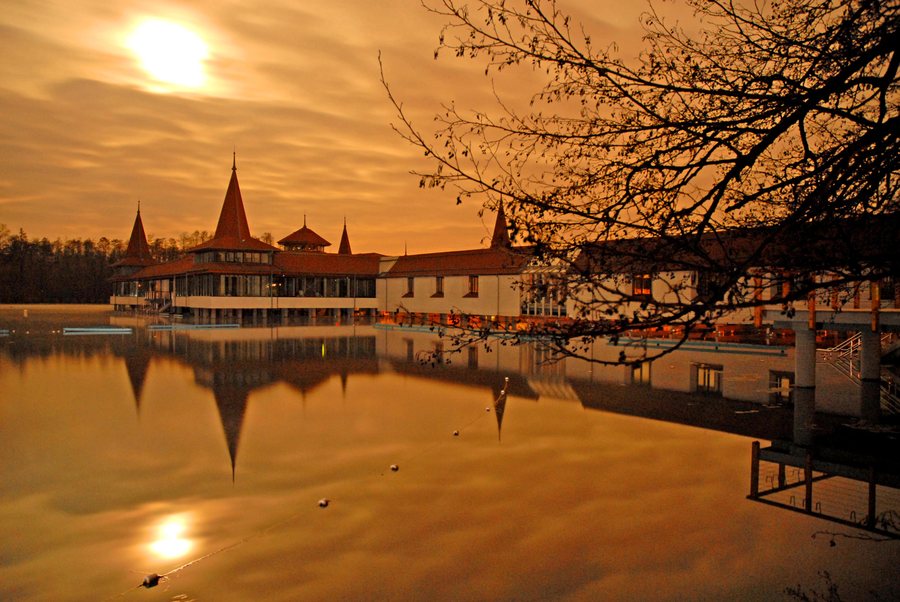 File:Hévízi-tó ősszel.jpg
Photo: Hévízi Turisztikai Nonprofit Kft. via Wikimedia Commons, CC BY-SA 3.0
File:Hévízi-tó ősszel.jpg
Photo: Hévízi Turisztikai Nonprofit Kft. via Wikimedia Commons, CC BY-SA 3.0
Key facts about Hévíz
Lake Hévíz is the world's largest biologically active natural thermal lake. Its water combines the properties of carbonated, sulphurous, calcium-, magnesium- and hydrocarbonate-rich medicinal waters. Pink and purple water lilies float on the surface. Egregy, a district of Hévíz, brings together historical evidence and archaeological finds, wine-growing culture, and a vineyard landscape.
What makes the thermal lake distinctive?
The lake is Hévíz's central natural feature. Its water is carbonated and sulphurous, as well as rich in calcium, magnesium and hydrocarbonate. The water lilies add a visible splash of colour: pink and purple flowers float on the surface. Together, these features give the lake a distinctive character, setting it apart from the historical themes in Egregy.
If you would like to discover Hévíz primarily for its lake, you can make this natural feature the focus of your trip. Those also interested in history and regional culture will find a different side of the town in Egregy.
What historical and cultural experiences does Egregy offer?
The Roman villa remains in the Egregy district of Hévíz were inhabited from the first half of the 1st century until the beginning of the 5th century. An early imperial-period villa in the Roman Ruin Garden of Hévíz had warm, lukewarm and cold bathing pools. These three pool temperatures are among the villa's described features; they also make the site interesting to travellers exploring Roman architecture and bathing culture.
The “Korok és borok” (Ages and Wines) themed walking trail presents historical evidence and archaeological finds dating back to Roman times, as well as Egregy's centuries-old wine-growing culture. The trail passes through the picturesque vineyard landscape. History and wine-growing are thus brought together along this walk, while the Roman Ruin Garden, with its villa and bathing pools, offers a separate point of historical interest.
A dry Kneipp walking path also runs through the Roman Ruin Garden, over the floor plans of Roman building walls preserved underground. Here, the path intersects with the archaeological floor plans. When deciding what to visit, you can therefore choose whether you would most like to explore the themed trail through the vineyard landscape, the Roman villa remains, or the walking path.
How can you get to Egregy and the Kálvária?
From Hévíz town centre, you can reach Egregy on foot via Attila or Zrínyi Street. The distance is 1.5 kilometres, and the walk takes about 20–30 minutes. The Dottó train and E-go also run a circular route of about 45 minutes, which includes Egregy and returns to the respective starting points. When planning, you can weigh up the described walking route against a circular route that returns to its starting point.
The Hévíz Kálvária in the Egregy district can be reached on foot, by bicycle, by car, or as part of a guided walk. If you would like to include this place in your stay, you can choose the option that best suits your travel plans.
Compare other destinations: Nemesbük, Felsőpáhok, Sármellék, Rezi, Cserszegtomaj and Alsópáhok.
FAQ
What makes Lake Hévíz special?
It is the world's largest biologically active natural thermal lake. Its water combines several properties, including being carbonated and sulphurous, as well as rich in calcium, magnesium and hydrocarbonate.
What can you discover in Egregy?
Highlights there include Roman villa remains, the Roman Ruin Garden, the “Korok és borok” walking trail, and the centuries-old wine-growing culture.
How far is Egregy from the town centre?
It is 1.5 kilometres on foot from Hévíz town centre via Attila or Zrínyi Street; the walk takes about 20–30 minutes.
For the broader travel overview: Hévíz.
More about the destination
Useful information for planning your trip:

