
Karaganda: Mountain Steppe, Lakes and Bronze Age Sites
Accommodation in Karaganda
Karaganda combines mountain steppe and lakes with landscapes, rock formations and important Bronze Age sites. For planning your trip, it helps to choose a clear focus: nature experiences around Karkaraly and Aksoran differ considerably from the archaeological remains in Shet District.
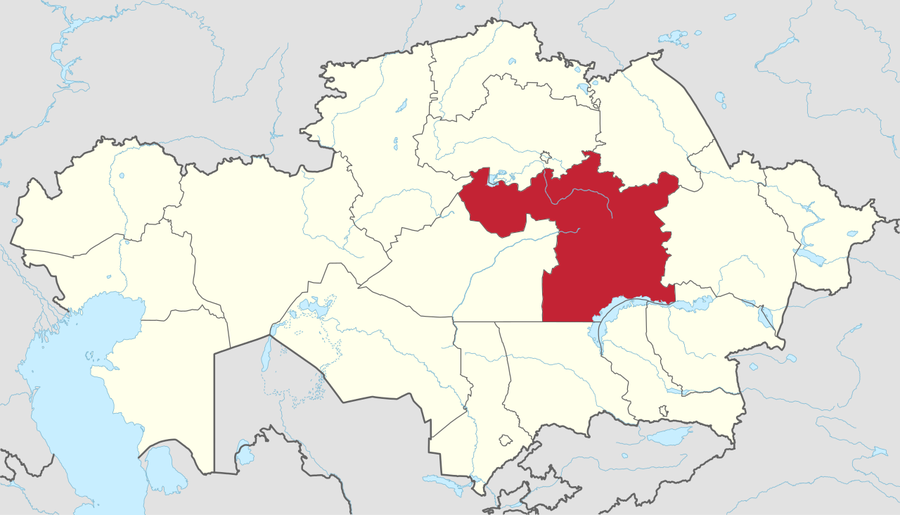 File:Karaganda Region in Kazakhstan.png
Photo: Malik Nursultan B via Wikimedia Commons, CC BY-SA 4.0
File:Karaganda Region in Kazakhstan.png
Photo: Malik Nursultan B via Wikimedia Commons, CC BY-SA 4.0
Karaganda at a glance
Popular recreation destinations in the region include Karkaraly National Park and the shore of Lake Balkhash. The Great Lake near Karkaraly is a frequently visited freshwater lake covering 2.5 km², with a maximum depth of about 4.6 m. Aksoran, in the Kyzylray Mountains, reaches 1,565 m and is their highest point as well as the highest point in the Saryarka Kazakh Uplands. The region also includes archaeological sites from the Late Bronze Age, including the Begazy-Dandybay Complex.
What nature experiences define Karaganda?
Karkaraly National Park has a variety of rock formations and scenic destinations. The Three Caves, also known as the Cave of Primitive Man, are in the Maliksay tract, about 3 km from Karkaraly. There, three entrances to the underground area, a stream and slopes with sparse pine growth form a small granite canyon. The Great Chamber, north of Karkaraly, is a rock overhang: its recess is 8–10 m deep, 15–20 m wide and up to 8 m high.
Basin Lake in the national park can only be reached on foot via the Stone Fairy Tales route. At Great Lake, the north or west shore is recommended as a beach area. These destinations offer different natural attractions: rock formations and caves alongside a freshwater lake and a site accessible only on foot.
The landscapes also vary beyond Karkaraly. Bektau-Ata in Aktogay District is a granite mountain massif with unusual rock formations, gorges and caves, and is part of the Bektau-Ata State Zoological Nature Reserve. Visitors come to the massif for its climbing and rock routes, photography and panoramic views across the steppe. In the Kyzylray Mountains, visitors can hike and trek, observe nature and wildlife, and photograph mountain and steppe landscapes. The ascent from the Torkora tract to the summit of Aksoran is about 3.4 km long, with an elevation gain of approximately 560–600 m. From the summit, the mountain-steppe panorama extends up to 100 km.
What Bronze Age traces can you discover?
The settlement of Kent in Karkaraly District is an important archaeological site from the Late Bronze Age. It lies about 6 km from the village of Kent, in the valley of the Kyzylkenysh River, and is associated with the Begazy-Dandybay culture. Remains of residential and utility buildings, production facilities and traces of ancient metallurgy have been preserved. The Karazhartas burial site in the Taldy River valley and the Begazy-Dandybay Complex in Shet District are also associated with this culture.
The Begazy-Dandybay Complex consists of granite mausoleums and is a megalithic burial complex from the Late Bronze Age. It reflects the social hierarchy of ancient Central Asian societies and was added to the UNESCO World Heritage Tentative List in 1998. Karkaraly National Park also has a two-storey wooden house in the Tasbulak tract, with exhibition halls on the flora and fauna of the Karkaraly region.
To compare other district pages, you can also open Ulytau District and Bukhar-Zhyrau District. Other pages in the same directory are Qostanai, Astana, Zhambyl, Pavlodar, West Kazakhstan and Zhangeldi District.
FAQ
How do you get to Basin Lake?
Basin Lake in Karkaraly National Park can only be reached on foot via the Stone Fairy Tales route.
How long is the ascent to Aksoran?
The ascent from the Torkora tract to the summit is about 3.4 km long. The elevation gain is approximately 560–600 m.
What makes Great Lake near Karkaraly distinctive?
The frequently visited freshwater lake covers 2.5 km² and is about 4.6 m deep at its deepest point. The north or west shore is recommended as a beach area.
What is the status of the Begazy-Dandybay Complex?
The complex was added to the UNESCO World Heritage Tentative List in 1998.
For the broader travel overview: Kazakhstan.

