
Vangaži: Church, Cultural History and Archaeological Traces
Accommodation in Vangaži
St George's Vangaži Church was built in 1789. Gauja Livonians already lived in the area around Vangaži in the first millennium BC; protected archaeological burial grounds also shape the town’s history. An orienteering tour is an additional planning consideration, and you should take note of its time limit.
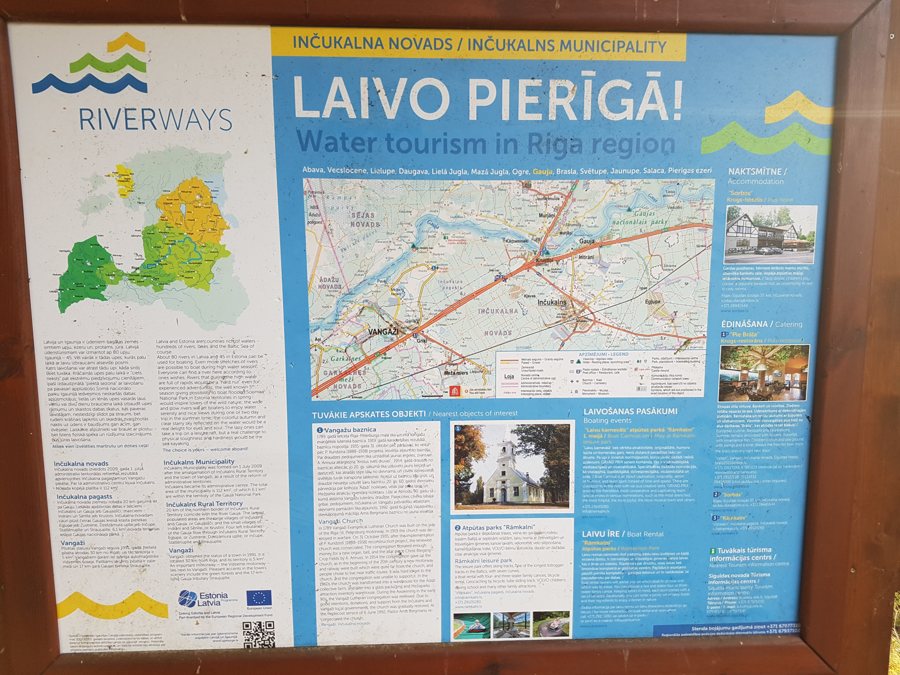 File:Boat tourism information board in Vangaži, Latvia.jpg
Photo: SockWithACamera via Wikimedia Commons, CC0-1.0
Key facts about Vangaži
- St George's Vangaži Church was built in 1789, destroyed in June 1919 during the Latvian War of Independence and restored in 1935.
- The church is designated a state-significant cultural and architectural monument.
- Archaeological burial grounds were discovered near Vangaži Cemetery and by the houses of Melķerti; today, they are protected cultural and historical sites of state significance.
- The municipal announcement presented BRĪV(Ā)LAIKA as an orienteering experience with three routes open year-round and stated that it would run until 30 September 2026.
What story does the church tell?
The church offers a chronology that is easy to date: construction in 1789 was followed by its destruction in June 1919 during the Latvian War of Independence and its restoration in 1935. Sixteen years separate the destruction and restoration, so the building’s history is not reduced to its year of construction. Its designation as a state-significant cultural and architectural monument reflects its importance to local heritage. The church complements the archaeological sites with its own architectural history and a clear timeline.
How do the historical traces extend beyond the church?
The history of the area has several layers. Gauja Livonians already lived in the area around Vangaži in the first millennium BC. Archaeological burial grounds discovered later are located at two named sites: near Vangaži Cemetery and by the houses of Melķerti. Today, these sites are protected cultural and historical sites of state significance. They are distinct from the church, which is designated as an individual cultural and architectural monument. Together, they offer an overview of different historical points of reference, without suggesting that all the traces belong to the same building or place.
The name Vangaži adds a linguistic perspective to the picture. It derives from the Livonian word “vang,” meaning “stream meadow.” This interpretation of the name sits alongside the area’s historical references and specific archaeological sites. There has also been a school history room at Vangažu vidusskola since 1974. If you are considering a visit, check access with the school in advance.
What should you bear in mind when planning your trip?
Two details about BRĪV(Ā)LAIKA should be distinguished: the municipal announcement described three routes that could be walked year-round, but set 30 September 2026 as the end date for the orienteering experience. The routes being walkable year-round does not mean that the announced experience will continue beyond that date. If you are planning a later trip around BRĪV(Ā)LAIKA, check whether the experience is still available.
The church and protected burial grounds offer historical points of reference; because of its stated end date, the tour is a separate planning detail to check. This can help you decide whether the town’s history alone will be the focus of your stay or whether a confirmed orienteering tour should also be part of your plans.
Discover more destinations: Inčukalns, Krustiņi.
FAQ
When was St George's Vangaži Church built?
It was built in 1789, destroyed in June 1919 during the Latvian War of Independence and restored in 1935.
Where were the archaeological burial grounds discovered?
They were discovered near Vangaži Cemetery and by the houses of Melķerti. Today, both sites are protected cultural and historical sites of state significance.
What does the name Vangaži mean?
The name derives from the Livonian word “vang,” meaning “stream meadow.”
What is the timeframe for BRĪV(Ā)LAIKA?
The municipal announcement mentioned three routes that could be walked year-round and stated that the orienteering experience would run until 30 September 2026. For trips after that date, check whether the experience is still available.
Go to the main travel overview: Inčukalna Novads.

