
Budzyń – Churches, Market Square and Cycling Route
Accommodation in Budzyń
Budzyń offers specific points of interest for a cultural trip: 19th-century churches, historic houses around the Market Square and an unusually designed sundial. The Budzyń–Dziewoklucz cycling route may also be of interest. This can help you decide whether you are primarily interested in church architecture and the townscape, or in cycling as well.
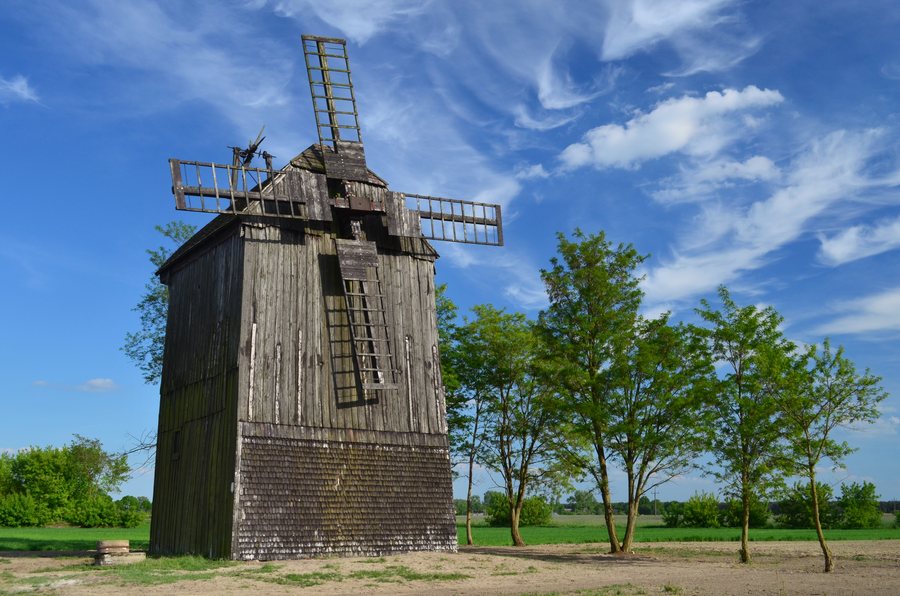 File:Budzyń, wiatrak paltrak, XIX-XX w.
Photo: Tomasz Stachowiak via Wikimedia Commons, CC BY-SA 3.0 PL
File:Budzyń, wiatrak paltrak, XIX-XX w.
Photo: Tomasz Stachowiak via Wikimedia Commons, CC BY-SA 3.0 PL
Budzyń at a glance
- St. Barbara’s Church dates from 1849 and was built on the site of an earlier wooden church.
- Its main altar is in the Late Renaissance style and dates from the 17th century; two Baroque side altars date from the 18th century.
- St. Andrew Bobola’s Church was built in 1881. The former Evangelical St. Andrew Bobola’s Church stands in the middle of the Market Square.
- Houses dating from the first half of the 19th century stand around the Market Square; there is also a sundial with a brick, pyramid-shaped gnomon.
- The Budzyń–Dziewoklucz cycling route was funded by the Powiat Starost Office and the Municipal Office.
Which churches shape the town’s cultural character?
St. Barbara’s Church brings together several historical layers. The building dates from 1849 and was built on the site of an earlier wooden church. The altars also reflect different periods: the main altar is in the Late Renaissance style and dates from the 17th century, while the two side altars are Baroque and date from the 18th century. If you are interested in sacred architecture, you can take these differences in period and style into account when exploring the church.
St. Andrew Bobola’s Church offers another chapter in the town’s architectural history. It was built in 1881. The former Evangelical St. Andrew Bobola’s Church stands in the Market Square. Together with St. Barbara’s, it offers another way to explore the history of churches in Budzyń. The different dates and names help distinguish the two churches and correctly attribute each historical detail to the right building.
What makes the Market Square worth seeing?
Houses dating from the first half of the 19th century stand around the Market Square. Some are oriented with their eaves facing the street, while others have their gables facing it; their infill is made of brick or clay. “Eaves-facing” means that the roof eaves face the street; on gable-fronted houses, the gable faces the street. These different orientations give the houses varied facades, while the infill materials are another architectural detail. If you look closely at townscapes, you can notice the building forms and materials here rather than seeing the buildings simply as a general backdrop.
There is also a sundial in the Market Square with a brick, pyramid-shaped gnomon. A gnomon is the shadow-casting pointer of a sundial. Its dial surface is made of paving stones. This design differs from a small, raised dial: the surface itself forms part of the sundial’s structure. If you are interested in urban design, it is a specific detail to look for alongside the buildings.
Does Budzyń fit your travel plans?
Budzyń is worth considering, especially if you are interested in historic churches and local architecture. The churches offer different historical reference points, while the Market Square features both older houses and the sundial. If you would also like to plan a bike ride, you can consider the Budzyń–Dziewoklucz cycling route. The route was funded by the Powiat Starost Office and the Municipal Office. When choosing a hotel in Budzyń, you can first consider whether culture and architecture or cycling better matches your interests; the places to visit provide a specific thematic framework to help you decide.
If you would like to compare other destinations, you can also explore Chodzież, Podanin, Laskowo, Dziewoklucz, Szamocin and Margonin.
FAQ
When was St. Barbara’s Church built?
St. Barbara’s Church in Budzyń dates from 1849. It was built on the site of an earlier wooden church.
What altars does St. Barbara’s Church have?
It has a Late Renaissance main altar dating from the 17th century and two Baroque side altars dating from the 18th century.
Who funded the Budzyń–Dziewoklucz cycling route?
The cycling route was funded by the Powiat Starost Office and the Municipal Office.
To the main travel overview: Colmar.

