
Odolanów
Accommodation in Odolanów
Odolanów offers several distinct points of interest to consider when planning your trip: churches and a town hall dating from different centuries, a regional museum, a park, and named cycling and leisure options. This lets you explore the town through the themes that interest you most.
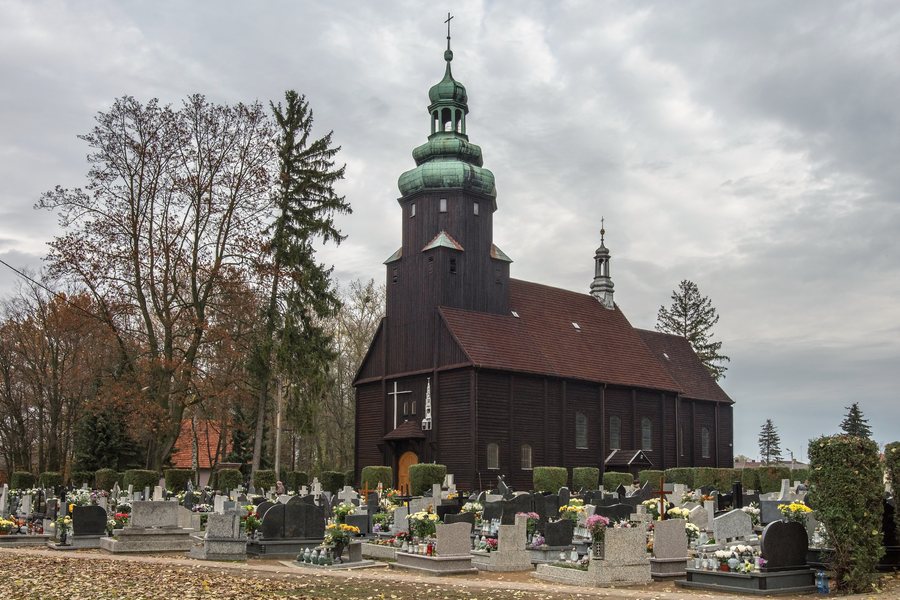 File:SM Odolanów Kościół św Barbary 2016 (18) ID 653761.jpg
Photo: Sławomir Milejski via Wikimedia Commons, CC BY 3.0
Odolanów at a glance
- St. Martin’s Church was built between 1790 and 1794; the wooden St. Barbara’s Church in Odolanów-Górka dates from 1784.
- The town hall was built in 1898–1899 in the Neo-Gothic style.
- The regional museum’s permanent exhibition is devoted entirely to the events of the Greater Poland Uprising.
- On the edge of town stands a water tower built in 1903, measuring 28 metres to the roof cupola.
- The orange-marked “Dolina Baryczy” cycling route includes the Odolanów–Grabownica section.
Which buildings mark different periods?
The dates of the churches and the town hall make it possible to compare buildings spanning more than a century. The wooden St. Barbara’s Church in Odolanów-Górka dates from 1784; St. Martin’s Church in Odolanów was built between 1790 and 1794. Later, in 1898–1899, the Neo-Gothic town hall was built. The timber construction, church architecture, and Neo-Gothic town hall offer different points of reference for understanding Odolanów’s architectural history.
Individual details of St. Martin’s Church also contribute to this picture: fragments of carvings from destroyed crosses have been preserved there. St. Barbara’s Church is located in the cemetery on ul. Spokojna. This location adds a specific point of reference in Odolanów-Górka to its date.
What themes does the regional museum cover?
The regional museum’s permanent exhibition is devoted entirely to the events of the Greater Poland Uprising. An extensive ethnographic section includes significant works by the 19th-century folk sculptor Paweł Bryliński. This brings together two distinct museum themes: the events of the uprising and works of folk sculpture.
If the museum is one of your travel interests, you can check the exhibition details before your trip. The two main areas are already clearly distinguishable: a permanent exhibition about historical events and an ethnographic section featuring Bryliński’s works.
What other landmarks and landscape connections are there?
The water tower, built in 1903, stands on the edge of Odolanów. It measures 28 metres from the ground to the roof cupola. This measurement specifies exactly how its height is defined. Another kind of urban landmark is Park 600-lecia: it stretches along Kaliska Street, and a monument to St. Martin stands above the park.
The Dolina Baryczy Landscape Park is part of a wider geographical context: within the municipality of Odolanów, it covers 5,400 hectares. This figure for the municipality is distinct from the town-scale setting of the churches, town hall, and Park 600-lecia. As you explore Odolanów, you can distinguish between its urban buildings and the landscape at the municipal level.
Which activities are mentioned for your planning?
The orange-marked “Dolina Baryczy” cycling route includes the Odolanów–Grabownica section. This name identifies a specific section of the route without indicating a particular journey time or difficulty level. A walk through Odolanów offers insights into the town’s secrets and tells you who its most famous resident was and what made them known. If you plan to take this walk, check in advance whether an app or audio version is available.
Odolanów also has a high ropes park. Check the current opening hours when planning a visit. The named options range from architectural and cultural history to a walk, a cycling route, and a high ropes park; which ones matter to you depends on your travel interests.
Tailor your search to the themes you want to explore in Odolanów.
Discover more destinations: Antonin, Przygodzice, Nowe Skalmierzyce, Kopalina, Korytnica, Czarnylas, Sławin, Radłów.
FAQ
Which buildings date from the 18th century?
The wooden St. Barbara’s Church in Odolanów-Górka dates from 1784. St. Martin’s Church was built between 1790 and 1794.
What is the regional museum’s permanent exhibition about?
It is devoted entirely to the events of the Greater Poland Uprising. The museum also has an extensive ethnographic section featuring significant works by Paweł Bryliński from the 19th century.
What will you learn on the walk through Odolanów?
The walk offers insights into the town’s secrets and covers who its most famous resident was and what made them known. Check in advance whether an app or audio version is available.
Go to the broader travel overview: Ostrów.

