
Mąkowarsko – St. Lawrence Church and Cycling Route
Accommodation in Mąkowarsko
Mąkowarsko can be explored for trip planning through two specific topics: St. Lawrence Church and a cycling route that passes through the town. The church features historical markers and a distinctive detail on its facade. The route places Mąkowarsko along a circuit that starts and ends in Koronowo. You can therefore view the town from a cultural and historical perspective or consider it a stop on a cycling tour through several named places.
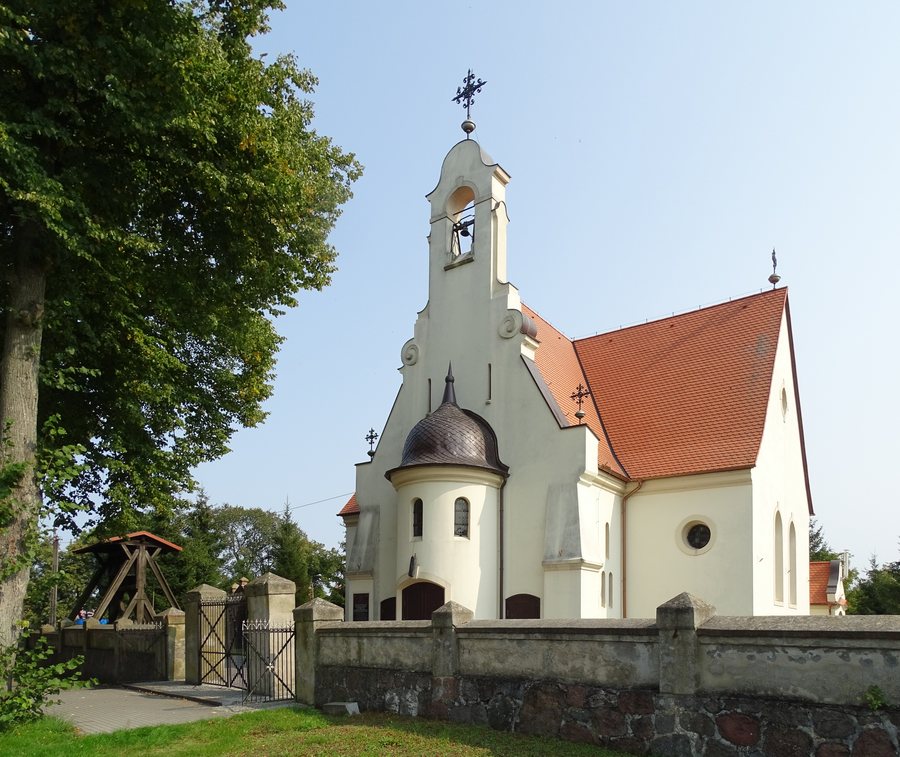 File:Mąkowarsko, Bydgoszcz county, Poland.jpg
Photo: Andreas Ederus Thorunensis via Wikimedia Commons, CC BY-SA 4.0
Mąkowarsko at a glance
- An original wooden St. Lawrence Church was built between 1328 and 1350; its attribution to the Cistercians is probable.
- The parish church of St. Lawrence dates from 1790–1791 and was extended and remodeled at the end of the 19th century.
- A Baroque crucifix from the 18th century is located on the semicircular western facade.
- A cycling route starts and ends in Koronowo and passes through Mąkowarsko and four other places.
Which historical periods are reflected in St. Lawrence Church?
The history of St. Lawrence Church can be traced through several dates. An original wooden church in Mąkowarsko was built between 1328 and 1350. The Cistercians probably built and furnished it in the first half of the 14th century; this attribution remains probable. The parish church of St. Lawrence dates from 1790–1791. It was extended and remodeled at the end of the 19th century.
To put the dates into context, it is worth matching each one to what it refers to: 1328 to 1350 applies to the original wooden church, 1790–1791 to the parish church, and the extension and remodeling belong to a later period. This gives you a perspective spanning from the early 14th century to changes made at the end of the 19th century.
What stands out on the western facade?
A Baroque crucifix from the 18th century is located on the semicircular western facade of the parish church. The building’s distinctive shape and a religious artwork with a known date therefore complement its architectural history. If you are interested in sacred architecture, these details offer two different points of interest: the rounded design of the western side and the crucifix. They take your attention beyond the construction dates to a specific feature of the building.
How does the cycling route pass through Mąkowarsko?
The cycling route starts and ends in Koronowo and passes through Mąkowarsko, Łąsko Wielkie, Wierzchucin Królewski, Byszewo, and Wtelno. Traces of the former abbey can still be seen in the architecture of these places. Mąkowarsko is therefore one stop on a route through several places; the route starts and ends in Koronowo. The architectural traces also give the route a cultural and historical dimension. If you include this route in your plans, check the current route conditions before setting out.
Discover more destinations: Ciele, Wiskitno, Gzin, Niemcz, Koronowo, Maksymilianowo, Osielsko, and Solec Kujawski.
FAQ
When was the original wooden church built?
It was built between 1328 and 1350. The Cistercians probably built and furnished it.
What feature is on the western facade?
A Baroque crucifix from the 18th century is located there; the facade is semicircular.
Where does the cycling route start and end?
It starts and ends in Koronowo. Among other places, the route passes through Mąkowarsko, Łąsko Wielkie, Wierzchucin Królewski, Byszewo, and Wtelno.
For the broader travel overview: Bydgoski.

