
Discover Brzesko: Culture Between Town and Countryside
Accommodation in Brzesko
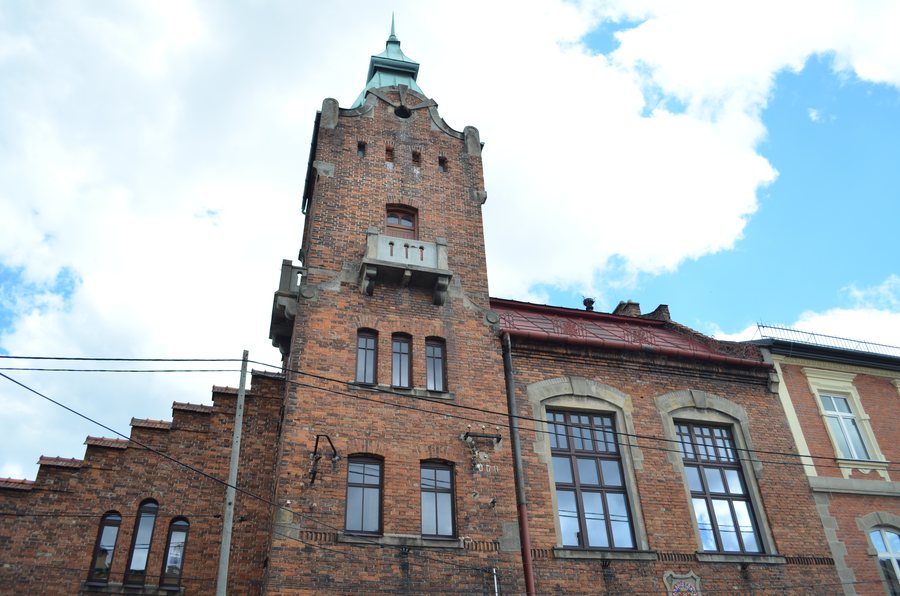 Brzesko, town hall, now Municipal Cultural Centre
Photo: Fmbar22 via Wikimedia Commons, CC BY-SA 3.0 PL
Brzesko at a glance
- Bocheniec, at 394 metres above sea level, is the highest point in the Brzesko area.
- The eclectic town hall, with its four-storey tower, was built in 1909–1910.
- The Jewish cemetery in Brzesko was entered in the register of historic monuments in 1992.
What architectural history shapes Brzesko?
The town hall stands on the market square. Its eclectic design and four-storey tower illustrate the architectural history of the early 20th century. Brzesko’s Church of St James the Apostle also has a historic section, dating from the mid-15th century. These two dates thus mark different periods in the town’s history.
The Regional Museum displays two bourgeois interiors, landscapes, portraits and local-history memorabilia. Domestic life, visual depictions and memories of local history are represented side by side. Another historic site is the Jewish cemetery in Brzesko, which was entered in the register of historic monuments in 1992.
How does Okocim fit into the region’s architectural history?
Both the brewery surroundings and the Goetz-Okocimski family’s palace and park complex are significant to Okocim’s architectural history. The Brzesko–Okocim Brewery’s urban and architectural complex, its surrounding buildings and the adjacent palace and park complex were built from 1845 onwards and expanded through the 1930s.
The palace complex and park are considered an important historic monument. The palace itself was built in 1898–1900 in the Neo-Baroque and Neo-Rococo styles. This construction period should be distinguished from the longer development of the brewery and its surrounding complex. An English landscape garden dating from 1900 surrounds the palace, with native and exotic trees and shrubs.
What does Bocheniec reveal about the landscape and history?
The eastern rampart remnant of a Wiślan hillfort dating from the turn of the 9th and 10th centuries survives on Bocheniec. The remnant is about four metres high and 18 metres wide at its base. The Church of St Anne on Bocheniec also has historical roots: it dates from 1596.
An observation tower on Bocheniec opened in October 2023. It is 25 metres tall and has six storeys. Check whether it is currently accessible before visiting. This makes the historic fortification, the church and the more recent tower clearly distinguishable as different points of interest for an excursion.
Which trails and stops can you explore?
The Via Regia pilgrimage route runs from Brzesko through Jasień Brzeski and Brzeźnica to Bochnia. The signposted Szlak wokół Brzeska hiking trail is another option for visitors interested in marked walking routes. The two names help distinguish different travel interests: one refers to a pilgrimage route with named stops, the other to a signposted hiking trail.
The discovery route through Brzesko Municipality also has named stops. These include the Pantheon of Saints in Szczepanów, the “Romeo i Julia” natural monument in Mokrzyska and the Pavimentum Copernicanum in Brzesko. The named places make the route easy to follow, even though not every stop is the same kind of attraction.
What religious heritage can you find in Szczepanów?
On 6 September 2003, Pope John Paul II elevated the parish church in Szczepanów to the status of a minor basilica. In the old church building, a late-15th-century triptych is located in the south side chapel. The artwork’s date and the date the church was elevated refer to two different historical periods in the town’s story.
When researching hotels in Brzesko, the topics described here can help guide your travel planning: town history and collections, religious heritage, or countryside and trails offer different ways to explore the area.
Discover more destinations: Mokrzyska, Brzesko, Czchów, Uszew, Szczepanów, Łysa Góra, Biesiadki, Iwkowa and Połom Mały.
FAQ
How high is Bocheniec?
Bocheniec reaches 394 metres above sea level and is the highest point in the Brzesko area.
When was Brzesko town hall built?
The eclectic town hall, with its four-storey tower, was built in 1909–1910.
Which route is signposted as a hiking trail?
Szlak wokół Brzeska is a signposted hiking trail. The Via Regia is a pilgrimage route from Brzesko through Jasień Brzeski and Brzeźnica to Bochnia.
What is of particular historical interest in Szczepanów?
The parish church was elevated to the status of a minor basilica in 2003. A late-15th-century triptych is located in the south side chapel of the old church building.
For the broader travel overview: Lesser Poland.

