
Czernichów: Vistula Route and Cultural Heritage
Accommodation in Czernichów
The Vistula Route, a network of paths within the municipality and historic buildings give Czernichów several points of interest for a trip. When planning, it is worth distinguishing the annual kayak event from the water route, which has designated endpoints. The distances involved also matter for land routes: the cycling time is specifically for experienced cyclists riding without a stop.
Czernichów at a glance
- The Municipality of Czernichów organizes an annual nationwide kayak trip on the Vistula from Czernichów to Kraków.
- Experienced cyclists can complete the Vistula Route without stopping in one hour; it runs mainly along the top of the embankment and on paved and gravel paths.
- The listed manor complex near the agricultural school includes 19th-century buildings and a landscape park.
What water and cycling routes are described?
The kayak trip is an annual event organized by the Municipality of Czernichów. It is distinct from the Upper Vistula water route: the route starts at the ferry on the Vistula in Czernichów and ends at the landing stage of the Kolejowy Klub Wodny in Kraków. These details therefore describe two different ways of experiencing the Vistula as a travel destination: an organized trip and a route with named endpoints. If you want to take part in a particular edition of the kayak trip, check the event dates before planning.
The cycling time is clearly qualified: experienced cyclists can complete the route without stopping in one hour. The actual duration may vary depending on pace and conditions. Most of the route runs along the top of the Vistula embankment and on paved and gravel paths. Touring or mountain bikes are recommended. This estimate helps with planning, but it is not a general duration for every person or every ride with breaks.
What paths are there within the municipality?
Around 120 kilometers of cycling, horse-riding and hiking paths run through the Municipality of Czernichów. This figure refers to the municipal area and covers three types of paths; it does not describe a single route in the locality. Another specific hiking option is near the Kajasówka Nature Reserve, also within the municipality. A 5.1-kilometer red circular trail runs around the reserve and its northern edge. There is also a 100-meter access path to Przegińska Cave.
These figures cover different scales: a municipality-wide network of paths, a cycling route with a time estimate for experienced cyclists, and two precisely described paths near Kajasówka. This makes it possible to distinguish the length of an individual route from the overall extent of the network when planning. The details for Kajasówka also list a circular trail and a short access path to the cave separately, rather than treating them as one continuous route.
Which buildings and stories shape the locality?
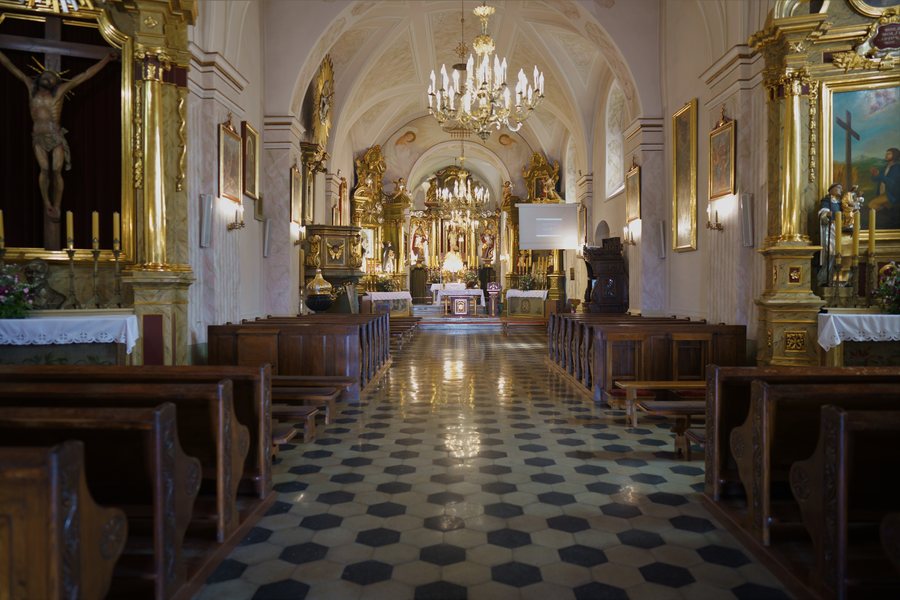
Places of interest in Czernichów on the second stage of the Vistula Route, from Czernichów to Łączany, include the agricultural school complex, the parish church and an octagonal chapel. The listed manor complex near the agricultural school includes a manor house and a lamus (a historic storehouse) from the 19th century, a teachers’ house, a power station, farm buildings and a boundary wall with a gate. The complex also includes a landscape park designed by Alojzy Różeczka. The school complex is therefore described not as a single building, but as several elements of the listed ensemble.
Another historic site is the stone Chapel of the Holy Rosary of Saint Lawrence. It was built in the second half of the 17th century, funded by Father Wawrzyniec Kamerer, as a burial chapel for the Rosary Confraternity. The chapel and the 19th-century buildings of the manor complex point to different periods in the locality’s history.
The name Franciszek Stefczyk connects two historical facts about Czernichów. At the end of the 19th century, at the initiative of schoolteacher Dr. Stefczyk, Galicia’s first savings and loan fund began operating here. The Zespół Szkół Rolnicze Centrum Kształcenia Ustawicznego in Czernichów is named after Stefczyk and is Poland’s oldest continuously operating agricultural school. His name is therefore associated both with a historical financial institution and with the agricultural school, without implying that they share a founding history.
Discover more destinations: Trojanowice, Kraków, Rybna, Sułoszowa, Michałowice, Ochojno, Chrosna, Sieciechowice.
FAQ
What are the endpoints of the water route?
The Upper Vistula water route runs from the ferry on the Vistula in Czernichów to the landing stage of the Kolejowy Klub Wodny in Kraków.
How should the cycling time estimate be interpreted?
One hour without stopping is the estimate for experienced cyclists. Pace and conditions may affect the actual duration.
What is the historical connection to Franciszek Stefczyk?
At the end of the 19th century, Galicia’s first savings and loan fund began operating in Czernichów at his initiative. The agricultural school is named after him.
Go to the main travel overview: Kraków.

