
Kasina Wielka
Accommodation in Kasina Wielka
Kasina Wielka brings together evidence of wooden architecture, art, and railway history. If you are considering the town for your trip, the wooden church, the “Hołd Karpatom” gallery, and the historic railway station offer specific themes to help you plan.
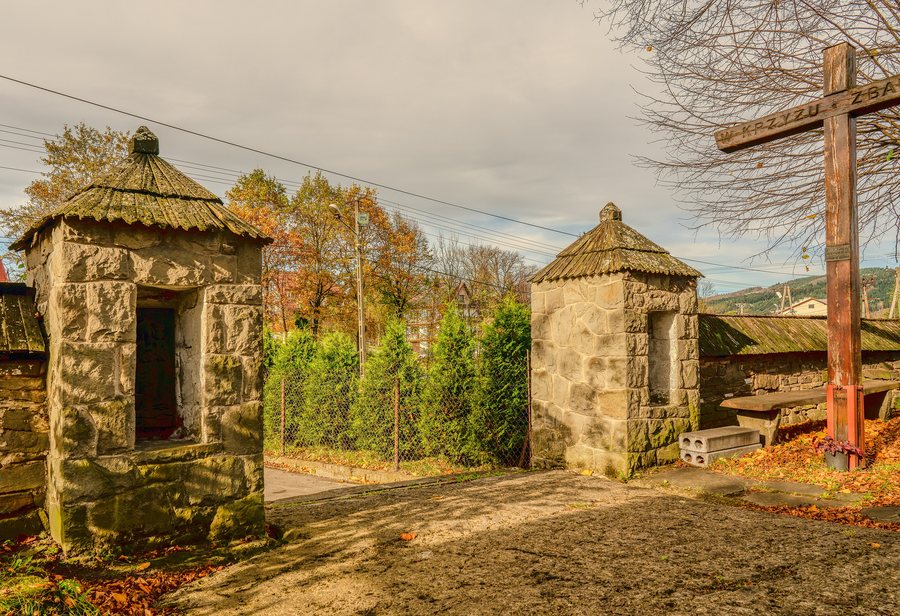 File:Kasina Wielka gm. Mszana Dolna kościół św. Marii Magdaleny A 839 (5).jpg
Photo: Januszk57 via Wikimedia Commons, CC BY-SA 4.0
File:Kasina Wielka gm. Mszana Dolna kościół św. Marii Magdaleny A 839 (5).jpg
Photo: Januszk57 via Wikimedia Commons, CC BY-SA 4.0
Kasina Wielka at a glance
- The historic wooden church was completed and consecrated in 1624; it lies on the Wooden Architecture Route.
- The “Hołd Karpatom” sculpture gallery by Stanisław Dobrowolski is located in the Wydarte part of town.
- The gallery’s sculptures stand alongside wall frescoes; paintings are displayed in an adjoining room. Visits are by prior arrangement.
- A First World War cemetery for Austrian soldiers lies next to the 19th-century railway station. The station is described as Poland’s highest-altitude railway station and is located at 570 m above sea level.
What does the wooden church tell us about the town?
Two details about the historic wooden church share the same year: it was both completed and consecrated in 1624. It lies on the Wooden Architecture Route. This gives Kasina Wielka a specific point of interest if you are interested in historic wooden buildings.
The year helps place the church in time, while its inclusion on the Wooden Architecture Route connects it to the subject of timber construction. These are two distinct aspects of the same attraction: the date refers to its completion and consecration, while the route indicates its place within wooden architecture.
What can you see at the “Hołd Karpatom” gallery?
The gallery is located in the Wydarte part of town and is named after Stanisław Dobrowolski. In the rooms described, sculptures stand alongside wall frescoes; paintings are displayed in an adjoining room. A visit to the gallery therefore encompasses different art forms rather than focusing on a single type of work. If you plan to visit, note the requirement: visits are by prior arrangement.
This arrangement is especially important for planning because access depends on making arrangements in advance. The contents can nonetheless be understood in advance: the sculptures and frescoes make up a shared exhibition area, while the paintings are in the adjoining room.
What history links the cemetery and the railway station?
The First World War cemetery for Austrian soldiers lies next to the 19th-century railway station. This places two distinct historical subjects side by side: the cemetery commemorates soldiers from the First World War, while the station recalls the railway history of the 19th century. The station is described as the highest-altitude one in Poland; its stated elevation is 570 m above sea level.
The elevation and the description go together: 570 m above sea level is the stated elevation, while “Poland’s highest-altitude railway station” is the classification given. For orientation, the location is also clear: the cemetery is next to the station. The two can therefore be viewed as neighboring historical points of interest.
What role does the historic railway line play in getting there?
The historic railway line by the station is used sporadically and exclusively for tourism, and is considered a tourist attraction. Its use should therefore be distinguished from ordinary travel planning: it is not described as a regular service. If you are interested in the railway, plan to experience it as a tourist attraction, not as a reliable part of your journey.
How should you focus your accommodation search?
The documented attractions in Kasina Wielka clearly focus on culture and transport history: wooden architecture, the gallery, cemetery, and railway station offer different ways to explore the town.
Discover more destinations: Kamionka Mała, Lubomierz, Jodłownik, Mszana Dolna, Kasinka Mala, Laskowa, Pogorzany and Mecina.
FAQ
When was the historic wooden church completed and consecrated?
Both took place in 1624. The church lies on the Wooden Architecture Route.
What can you see at the “Hołd Karpatom” gallery?
Sculptures stand alongside wall frescoes; paintings are displayed in an adjoining room. Visits are by prior arrangement.
How is the historic railway line used?
It is used sporadically and exclusively for tourism, and is considered a tourist attraction.
To the main travel overview: Limanowa.

.jpg)