
Grywałd: Gothic Wooden Church of St. Martin
Accommodation in Grywałd
Grywałd’s cultural identity is shaped by its Gothic parish church of St. Martin, built entirely of wood. It stands in the village center and features several details that can be dated. Nearby, the observation tower on the summit of Lubań offers a different focal point: views of the Tatras, Pieniny, and Gorce. Culture in the village and the surrounding landscape thus offer two distinct themes for planning a trip.
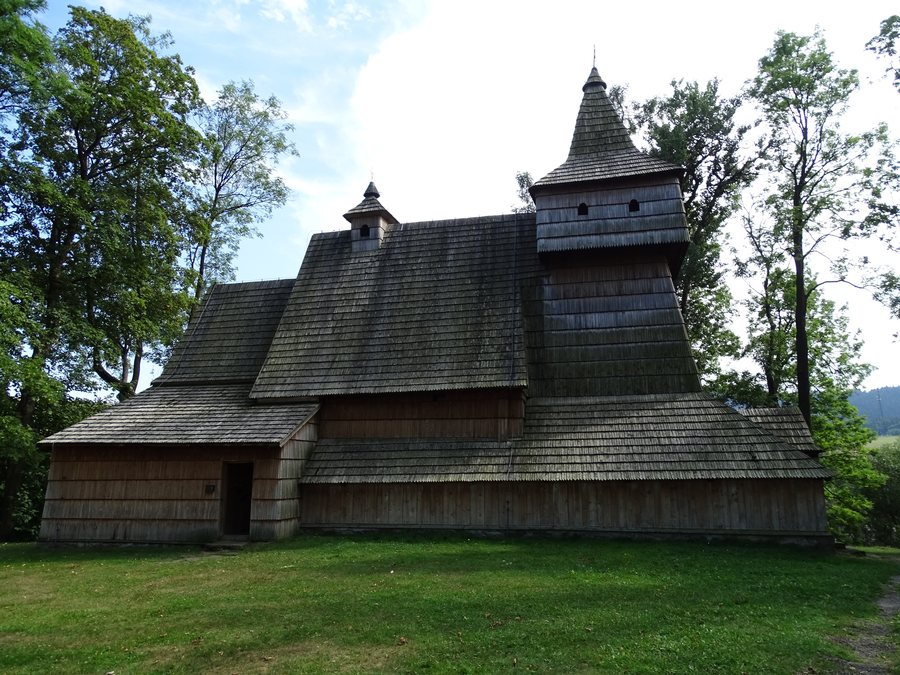 File:Kościół św. Marcina w Grywałdzie - DSC07650.jpg
Photo: Adams3683 via Wikimedia Commons, CC BY-SA 4.0
Grywałd at a glance
- The Gothic parish church of St. Martin is built entirely of wood and stands in the village center.
- The church tower was added in the 17th century.
- Polychrome decoration dating from 1618 survives in the chancel and nave.
- The church houses a Late Gothic triptych from the early 16th century.
- A wooden observation tower on the summit of Lubań, nearby, offers views of the Tatras, Pieniny, and Gorce.
What defines the Church of St. Martin?
The Church of St. Martin combines a Gothic style with the consistent use of wood: it is built entirely of wood and stands in the center of Grywałd. The tower, added in the 17th century, is a later element of the building. The wooden construction and the tower are distinct features of the same church: one describes its construction method, the other a part added later.
The interior also contains specific details. Polychromy means multicolored painted decoration; decoration dating from 1618 survives in the chancel and nave. The chancel is the area near the altar, while the nave is the central longitudinal space of the church. These terms help distinguish the two areas where the painted decoration survives.
How can the historical details be understood?
Another work of art is the Late Gothic triptych from the early 16th century. A triptych is a three-panel artwork. Chronologically, this work predates the polychromy of 1618; the tower was added in the 17th century. This allows the church’s different features to be distinguished: the artwork, the painted decoration in two areas of the interior, and a later architectural addition. Visitors interested in cultural history can explore St. Martin through its artwork, interior design, and architectural form.
What is there to see in the surrounding landscape?
To explore the landscape, head from the village center into the nearby surroundings. A wooden observation tower stands on the summit of Lubań; from there, views extend across the Tatras, Pieniny, and Gorce. The viewpoint is therefore outside the center of Grywałd and serves as a destination in its own right. This distinction helps when choosing what to focus on: St. Martin represents wooden architecture and historical furnishings, while Lubań offers views of three named mountain ranges. If culture is your priority when planning a trip, the church is the specific attraction in the village; if you are drawn to landscapes, the tower offers a different experience.
Discover more destinations: Maniowy, Maruszyna, Czorsztyn, Ratułów, Zaskale, Zubrzyca Górna, Jablonka and Rokiciny Podhalańskie.
FAQ
Where is the Church of St. Martin?
The Gothic parish church, built entirely of wood, stands in the center of Grywałd.
Which artworks have dated features?
The Late Gothic triptych dates from the early 16th century. The polychrome decoration that survives in the chancel and nave is dated to 1618.
Where is the observation tower?
The wooden tower stands on the summit of Lubań, near Grywałd. From there, you can see the Tatras, Pieniny, and Gorce.
Go to the main travel overview: Nowotarski.

