
Discover Stryszów
Accommodation in Stryszów
You can get to know Stryszów from two different perspectives: the manor house with its museum exhibition and the history of the Church of St John Cantius. There is also a circular route between Stryszów and Łękawica, as well as the village’s location on the Kraków–Zakopane railway line. This lets you consider culture and route planning separately when planning your stay.
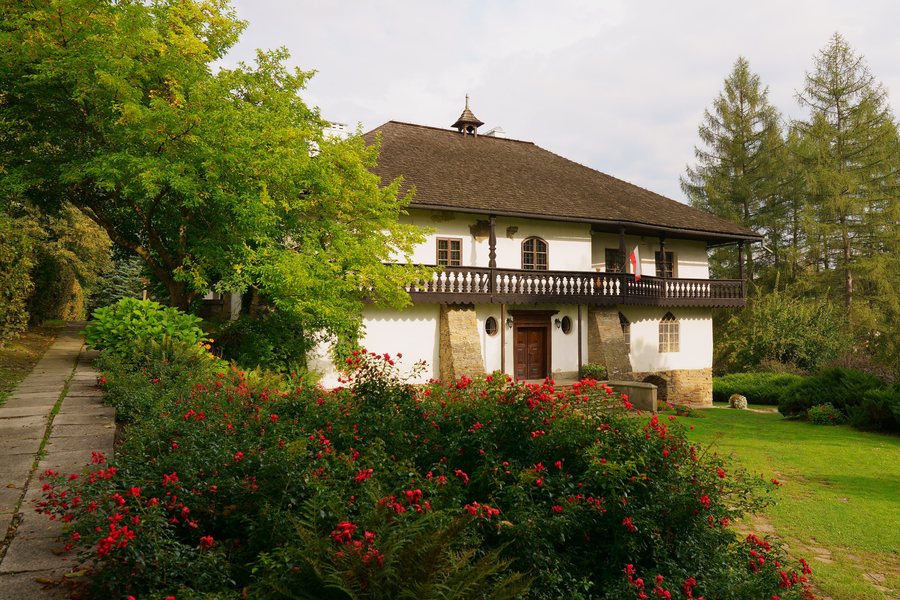 File:Stryszów 508 gmina Stryszów. Zespół dworski dwór park A 1039 M.jpg
Photo: Janusz Krzyżek via Source, CC BY-SA 4.0
File:Stryszów 508 gmina Stryszów. Zespół dworski dwór park A 1039 M.jpg
Photo: Janusz Krzyżek via Source, CC BY-SA 4.0
Stryszów at a glance
- The manor house is a branch of the Muzeum Zamku Królewskiego na Wawelu.
- The upper floor of the manor house features colourful polychrome decoration from the first half of the 18th century.
- The Church of St John Cantius was completed in 1742.
- The Pętla wokół Stryszowa circular route between Stryszów and Łękawica is 7.0 km long.
What can you discover at the manor house?
The manor house is a branch of the Wawel Royal Castle museum. It houses the permanent exhibition “Wnętrza dworu polskiego w wieku XIX”. The manor house itself and the exhibition are therefore the main attractions if you are interested in historic domestic culture. The title refers to the Polish manor house of the 19th century; the exhibition is explicitly described as permanent.
Another specific feature is on the upper floor: there you can see colourful polychrome decoration from the first half of the 18th century. You can consider this historic interior decoration alongside the exhibition without associating them with the same period: the polychrome decoration dates from the first half of the 18th century, while the exhibition focuses on the Polish manor house in the 19th century. For your visit, please check the museum’s current visitor information.
What story does the Church of St John Cantius tell?
The brick church was built on the site of a wooden church that burned down in 1739; construction of the new place of worship was completed in 1742. The principal benefactor was Kazimierz Wilkoński of the Odrowąż coat of arms, owner of Stryszów. These details provide a clear historical context for the church, linking the site of its predecessor, the new brick building and its named benefactor.
The furnishings also offer several details that can be dated. The high altar and the two side altars are late Baroque and date from around the middle of the 18th century. The high altar is crowned by a painting of St John Cantius from the early 17th century. The painting is therefore older than the church building, which was completed in 1742. The church also has architectural, historical and landscape value. Taken together, these features help you consider the building’s history and its furnishings as distinct aspects of the site.
What should you know about the route and getting there?
The Pętla wokół Stryszowa is a 7.0 km circular route between Stryszów and Łękawica. Check the current route conditions before setting out.
Stryszów is on the Kraków–Zakopane railway line. If you are planning to travel by train, check your specific journey times against the current timetable.
To compare other destinations, you can also discover Klecza Dolna, Radocza, Leńcze, Bachowice, Kalwaria Zebrzydowska, Lanckorona, Mucharz and Sułkowice.
FAQ
What exhibition is shown at the manor house?
The manor house features the permanent exhibition “Wnętrza dworu polskiego w wieku XIX”. The manor house is a branch of the Muzeum Zamku Królewskiego na Wawelu.
What historical details are documented about the church?
The brick church was completed in 1742, after its wooden predecessor burned down in 1739. Its late-Baroque altars date from around the middle of the 18th century; the painting of St John Cantius on the high altar is older, dating from the early 17th century.
How long is the Pętla wokół Stryszowa?
The circular route between Stryszów and Łękawica is 7.0 km long. Check the current route conditions before setting out.
For the broader travel overview: Wadowice.

