
Kalwaria Zebrzydowska: World Heritage, Pilgrim Routes and Furniture Tradition
Accommodation in Kalwaria Zebrzydowska
Kalwaria Zebrzydowska brings together a UNESCO-listed architectural and landscape park complex, pilgrim routes and a long furniture-making tradition. When planning your trip, it is therefore worth considering both the religious sites and routes and how to get there by train.
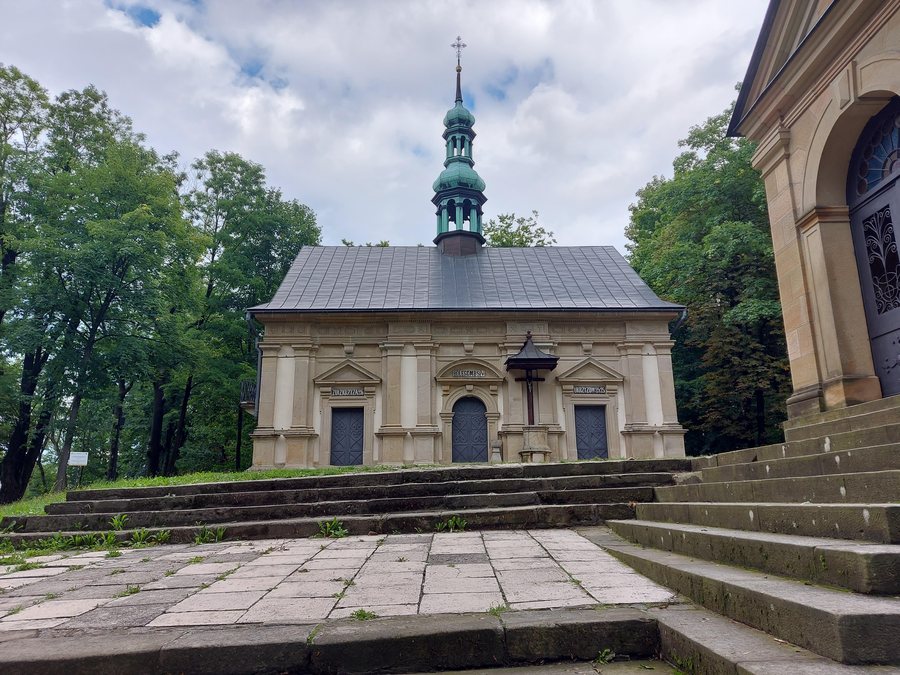 Chapel of the Crucifixion in Kalwaria Zebrzydowska (1)
Photo: Sylwia Botev via Wikimedia Commons, CC BY 3.0 PL
Chapel of the Crucifixion in Kalwaria Zebrzydowska (1)
Photo: Sylwia Botev via Wikimedia Commons, CC BY 3.0 PL
Key facts about Kalwaria Zebrzydowska
The Mannerist architectural and landscape park complex was added to the UNESCO World Heritage List in 1999. The Marian Passion Sanctuary includes a church, a monastery, chapels and a landscape park. The Calvary paths comprise 42 Baroque and Mannerist churches and chapels and extend for about seven kilometres. Kalwaria Zebrzydowska is accessible by train; the town has two railway stations: Kalwaria–Lanckorona and Kalwaria Zebrzydowska.
What defines the World Heritage Site and pilgrimage park?
The pilgrimage park is closely associated with the Passion of Christ and the life of the Virgin Mary. These themes connect its religious sites. The complex also comprises a variety of elements: the church, monastery and chapels are accompanied by the landscape park. Visitors interested in culture, religious history or the design of landscape parks will find several aspects here that come together as they explore.
The UNESCO inscription took place in 1999 and applies to the Mannerist architectural and landscape park complex of Kalwaria Zebrzydowska. It is a useful point of reference for visitors choosing the destination for its cultural heritage. The paths and chapels also give the park its own spatial structure: rather than focusing on just one building, the ensemble extends across several stops and locations.
Which routes and stops can you discover?
The Calvary paths extend for about seven kilometres and comprise a total of 42 Baroque and Mannerist churches and chapels. The approximate distance refers to these paths.
At the sanctuary, devotions are held along the Paths of Jesus, with 28 stations, and the Paths of the Virgin Mary, with 24 stations. The Paths for the Departed are also included; they follow the route of the Paths of the Virgin Mary. The different route names thus represent distinct religious themes, while the Paths for the Departed are linked to the Marian route.
The A loop of the Wojciech Weiss Calvary Route is also intended for walkers and invites them to follow the Calvary paths in the footsteps of Wojciech Weiss. It runs from the Market Square past the Bernardine Monastery, Pilate’s Town Hall and the bridge over the Kidron to Golgotha Hill, then back to the Bernardine Monastery. This sequence gives you specific guidance on the named stops along the route.
What religious celebrations and group options are available?
The pilgrimage park provides the setting for the representation of the mysteries of the Stations of the Cross and the celebration of the Feast of the Assumption of the Blessed Virgin Mary. Both events have been held there regularly since the early 17th century—that is, for more than 400 years—and are attended by thousands of pilgrims and tourists. These religious celebrations have therefore been among the destination’s longstanding reasons to visit.
Organized groups of 15 or more visiting the Kalwaria Sanctuary can request a guide. The guide can introduce the history of the sanctuary or lead a prayer along the Calvary paths. Groups may wish to take this option into account when planning; a request does not guarantee a particular tour or date.
What role does the furniture-making tradition play?
Kalwaria Zebrzydowska is shaped by more than its sanctuary. Furniture-making dates back to the 18th century. At that time, the town already had more than 40 carpentry workshops, which made furniture primarily for wealthy citizens of Krakow. This history reveals another side of the town: alongside its religious heritage, craftsmanship is also part of its longstanding identity.
Furniture fairs have been held in Kalwaria Zebrzydowska since 1914 and continue to this day. Together with the history of the carpentry workshops, they form a distinct cultural theme. If you do not want to focus your trip solely on religious buildings and pilgrim routes, the furniture-making tradition offers another reason to explore the town’s history.
How do you get to Kalwaria Zebrzydowska?
The town is accessible by train and has the railway stations Kalwaria–Lanckorona and Kalwaria Zebrzydowska. Both names are relevant when searching for a suitable train connection. When choosing your accommodation, you can first decide whether your trip will focus on the routes, the sanctuary, the furniture-making tradition or a combination of these themes.
Browse more places in the directory: Dolany Dolany, Ponikiew Ponikiew, Stryszów Stryszów, Tomice Tomice, Wadowice Wadowice, Witanowice Witanowice, Lanckorona Lanckorona and Klecza Górna Klecza Górna.
FAQ
How many churches and chapels do the Calvary paths comprise?
The Calvary paths comprise 42 Baroque and Mannerist churches and chapels and extend for about seven kilometres.
Which railway stations are there in Kalwaria Zebrzydowska?
The town has the railway stations Kalwaria–Lanckorona and Kalwaria Zebrzydowska.
Can organized groups request a guided tour?
Groups of 15 or more visiting the Kalwaria Sanctuary can request a guide. The guide can introduce the history of the sanctuary or lead a prayer along the Calvary paths.
What themes shape the celebrations in the pilgrimage park?
The pilgrimage park provides the setting for the representation of the mysteries of the Stations of the Cross and the celebration of the Feast of the Assumption of the Blessed Virgin Mary. Both events have been held there regularly since the early 17th century.
Since when have furniture fairs been held in Kalwaria Zebrzydowska?
Furniture fairs have been held since 1914 and continue to this day.
For the broader travel overview: Wadowice.

.jpg)