
Aleksandrów Łódzki
Accommodation in Aleksandrów Łódzki
Aleksandrów Łódzki combines historic buildings with opportunities to get active. From neoclassical architecture to a combined walking and cycling path, there are plenty of ways to shape your stay. If you are looking for a hotel, you can first consider whether you are more interested in architecture and urban history or in getting active.
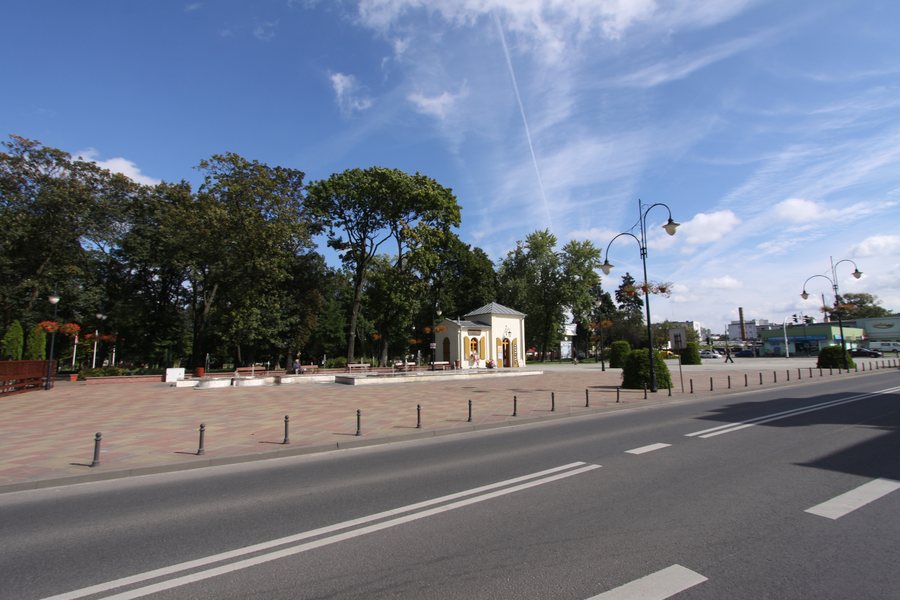 File:Aleksandrów Łódzki, zespół przestrzenno-architektoniczny Rynku, pocz. XIX 01.JPG
Photo: Lukasz pob via Source, CC BY-SA 3.0 pl
File:Aleksandrów Łódzki, zespół przestrzenno-architektoniczny Rynku, pocz. XIX 01.JPG
Photo: Lukasz pob via Source, CC BY-SA 3.0 pl
Key facts about Aleksandrów Łódzki
- Plac Kościuszki was laid out as a central public square in 1815.
- The Church of St. Stanislaus Kostka is neoclassical and has a rectangular floor plan.
- The Jewish cemetery is on the northwestern outskirts of the city, at the intersection of present-day Górna and Wąska streets.
- A combined walking and cycling path starts in the city centre and leads to the Municipal Sports and Leisure Centre.
- The Łódzki Szlak Konny horse trail passes through Aleksandrów Łódzki.
- The municipal swimming pool “OLIMPIJCZYK” is at Bankowa 5.
What architectural history can you discover?
The Church of St. Stanislaus Kostka was built in 1827–1828 by the local Evangelical congregation. Its neoclassical design and rectangular floor plan give the building a clearly defined form. Its location on the western side of Plac Kościuszki, at the corner of Łęczycka Street, is easy to pinpoint. The Evangelical Church complex comprises the church and the parsonage.
The development of public spaces is also reflected in several historical details. When the settlement was founded, Plac Kościuszki was laid out as a central public square in 1815. The town hall was built in 1824 on the south side of the market square. The municipal weighing house was added in the 1820s in the neoclassical style. Together, these buildings offer different points of reference for exploring the city's history; the dates given indicate when each place or building was established.
Which historic places offer a different perspective?
The Jewish cemetery was established in 1822 on the northwestern outskirts of the city. Its location at the intersection of present-day Górna and Wąska streets provides a specific point of reference within Aleksandrów Łódzki. As a historic site in its own right, it adds another theme to the architectural history of the church, town hall, and weighing house.
Jatki Miejskie refers to the municipal butcher and baker stalls. The present-day building is a reconstruction from the last decade of the 20th century. This date helps distinguish it from the 19th-century buildings. Anyone interested in the town's architectural development can consider different periods and building types, rather than assuming that all the historic sites are the same age.
What opportunities are there to get active?
A combined walking and cycling path is described as starting in the city centre and leading to the Municipal Sports and Leisure Centre. Another point of interest for travellers who enjoy physical activity is the Łódzki Szlak Konny, which passes through the city. These two routes offer different ways to get around: the combined walking and cycling path on the one hand, and the horse-riding trail on the other.
The city park is at Plac Tadeusza Kościuszki. The “OLIMPIJCZYK” swimming pool is at Bankowa 5. These add specific destinations to consider when planning your trip, alongside the historic sites. The information given specifies the park's location and the swimming pool's address.
How can you choose a hotel to suit your stay?
If you are interested in architecture and urban history, the church, public square, town hall, municipal weighing house, and Jatki Miejskie offer a range of historical points of interest. If getting active matters more, the combined walking and cycling path and the Łódzki Szlak Konny, which passes through Aleksandrów Łódzki, provide other themes to explore. This lets you link your choice of hotel to what interests you most during your stay, without reducing all the destinations to a single focus.
The same directory also includes Głowno, Stryków, Skórka, Smardzew, Sokolniki-Parcela, Rąbień, Zgierz and Grunwald.
FAQ
Where is the Church of St. Stanislaus Kostka?
It stands on the western side of Plac Kościuszki, at the corner of Łęczycka Street.
When was the church built?
The local Evangelical congregation built it in 1827–1828.
Where does the combined walking and cycling path lead?
It starts in the city centre and leads to the Municipal Sports and Leisure Centre.
Where is the Jewish cemetery?
It is on the northwestern outskirts of the city, at the intersection of present-day Górna and Wąska streets.
For the main travel overview: Zgierz.

